







Phamaly flips the script with a ‘Pericles’ for the neurodivergent
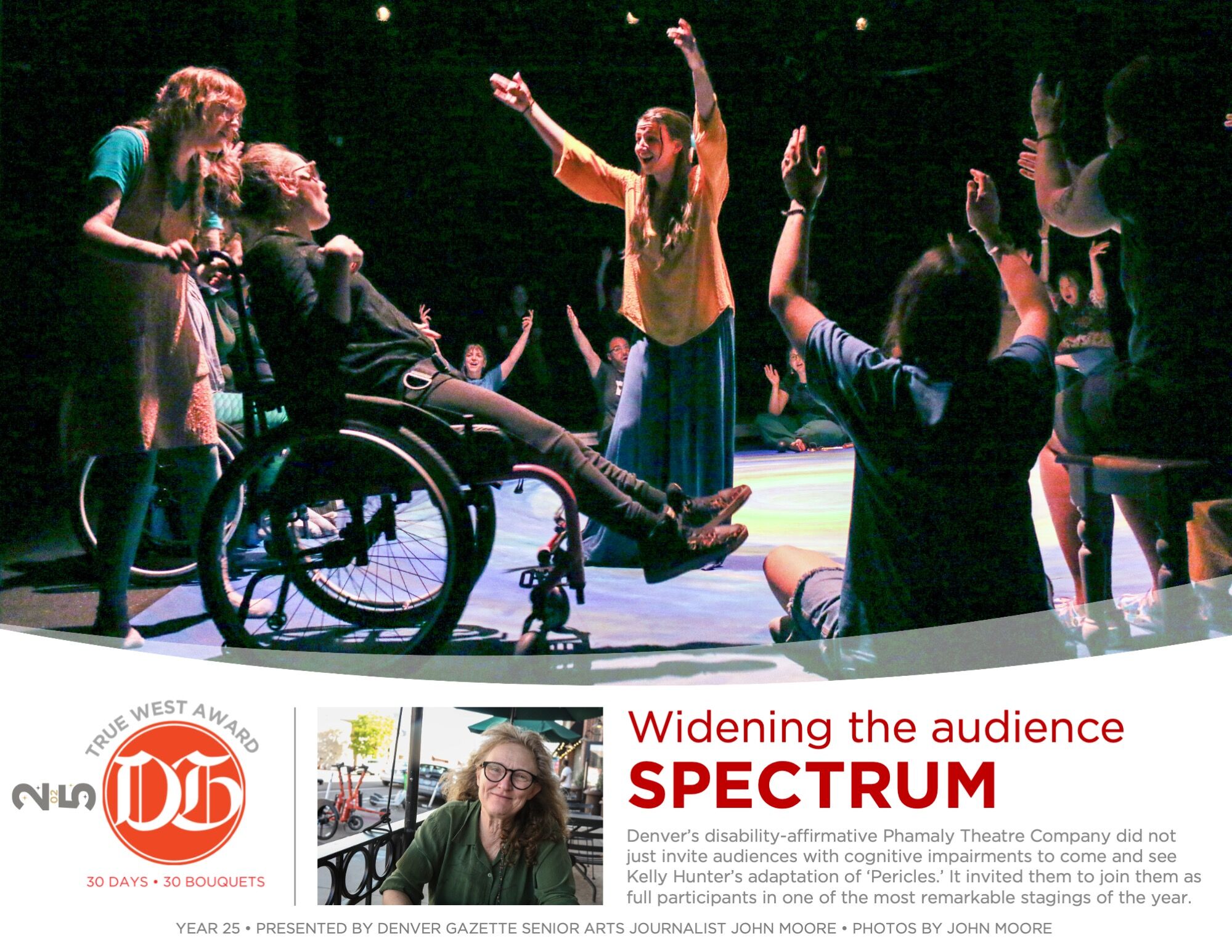
2025 DENVER GAZETTE TRUE WEST AWARDS: DAY 18
Remarkable traveling production not only welcomed audience members on the spectrum, it put them in the show
Over the past 25 years, I have seen about 4,000 live theater productions in my capacity as a Colorado arts journalist. And OK, I admit it: I am so, so spoiled. These companies don’t ask press to pay. They greet you at the door. They often tape off primo seats to make sure we see all the action from the very best possible angle.
A couple of decades ago, during the heyday of the Denver newspaper war (and theater criticism), the Denver Center would take painstaking care to make sure that for any visiting Broadway tour, Lisa Bornstein of the Rocky Mountain News and I would both be seated in the same orchestra-level row in the Buell Theater. And we would be placed in exact opposite aisle seats to avoid any possible perception of favoritism. Sometimes it seems as if the actors might be performing just for us.
On May 10, I attended perhaps the most beguiling live theater performance of my life. And for once, I received no special accommodation. I was welcome to sit in, sure, “but please just take a seat somewhere in the back.”

This play clearly wasn’t for me. And yet it gave me so much, just to witness what it gave to others. People who are usually afterthoughts in public spaces like these.
People on the autism spectrum. People who have had brain injuries or strokes. People with any kind of mental illness. People at any stage of dementia. People who are non-verbal. People who usually have a standing invitation from the outside world to stay the hell home. This play not only welcomed them all, it made them the center of attention as fully participating members of this acting company – reciting lines. Playing characters. Fully engaged.
I had never seen anything like it.
“I think the takeaway is that beautiful art can be created in every facet,” said Phamaly artistic director Ben Raanan. “And when you don’t put limitations on what art is, your mind can expand.”
The Hunter Heartbeat
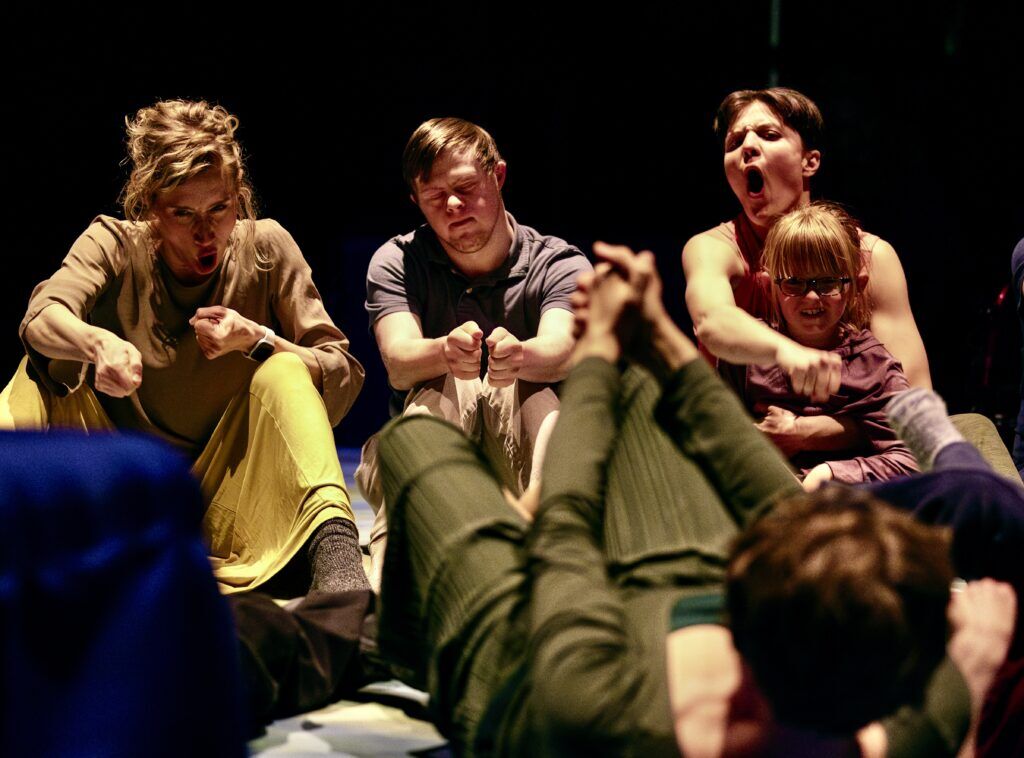
The play was a short, groundbreaking adaptation of “Pericles,” and it was performed by Denver’s disability-affirmative Phamaly Theatre Company based on interactive principles developed over 25 years by Kelly Hunter, visiting artistic director of London’s Flute Theatre and author of a book called “Shakespeare’s Heartbeat: Drama Games for Children with Autism.”
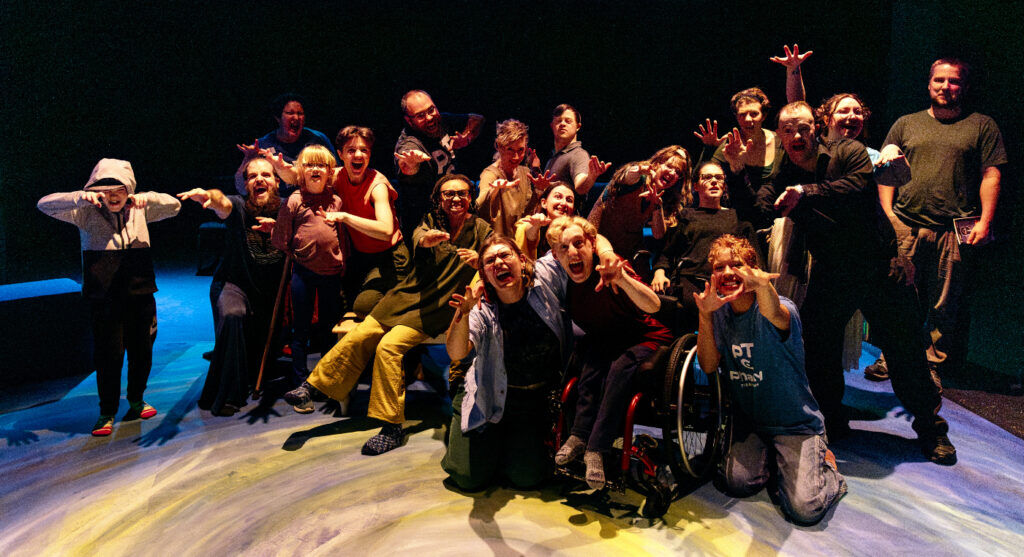
This utterly unique experience, made possible by a grant from the National Endowment for the Arts, started with Hunter and 10 carefully selected actors from Phamaly, each with disabilities themselves, performance experience and a demonstrated knack for spontaneous improvisation and human empathy.
After putting them all through essentially a boot camp on “The Hunter Heartbeat” method, the ensemble staged three weeks of performances in Boulder, Colorado Springs and Aurora.
The wild card: At each performance, up to 12 random persons with cognitive disabilities would be invited to apply in advance to fully participate in each performance. No experience (or rehearsal) required. That open invitation included persons with profound disabilities.
Those who were chosen were each partnered with two professional Phamaly company actors who acted as their caretakers by safely guiding them through every step of this strange, skeletal telling of a lesser-known Shakespeare story, and their important parts in it.
“Those 12 people are likely to have a life-changing experience because for once in their lives, they are the center of the performance,” said Hunter, who has been working with marginalized communities her whole adult life.
Dozens more, on the spectrum and not, came with their families just to watch and experience storytelling in a unique language that is designed to cut through all the noise in their heads. Many in this audience will come back night after night, no matter what city the performance is taking place in, because where else are these families going to find an experience so tailored to their child’s unique circumstances?
On this night, the performance was being held in the tiny studio theater on the top floor of the University of Colorado’s main theater building on the Boulder campus. Perhaps you remember this stage from my triumphant (I say) appearance as a horse who gets his eyes spiked out in a student production of “Equus” sometime in the previous century?
No? Anyone in the back? Neigh?
It starts on the way in
The audience has been told to gather in the basement of the university’s massive theater building, down where the box office and bathrooms are.
“For our visitors, I believe the experience should start the minute you walk in the door,” said Hunter. When you do, you are greeted by Phamaly actors singing the word “Hello,” followed by the actual individual names of the 12 who have signed up to join them on stage that night. That, Hunter said, is meant to ease their anxiety as they transition into this most unfamiliar setting.
She considers this to be a calming ritual that her actors numbingly repeat for 20 minutes. Then, we take turns riding the elevator to the top floor.
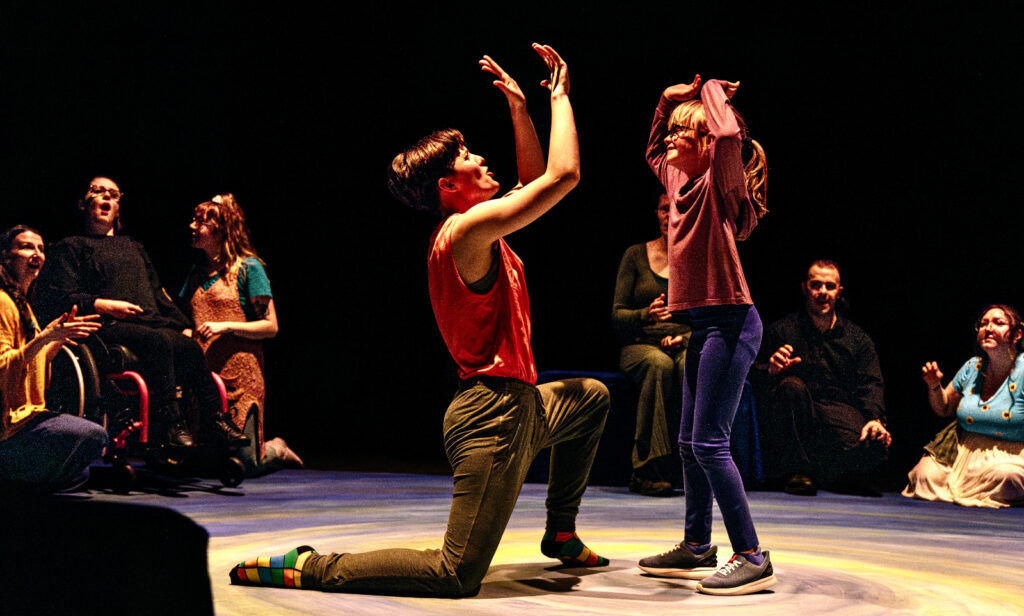
Once inside the actual theater, you must imagine a circle in a square. The Phamaly company members guide their participating visitors to form a circle that essentially constitutes the stage. The rest of us – a cross-section of parents, friends and fascinated general theatergoers, take our seats behind them in a single row of chairs on each side, forming a square around them.
So how does all of this turn into an effective telling of “Pericles,” Shakespeare’s problematic swashbuckler? You’ll get the bones of the story, Hunter says – or at least the bones that Hunter thinks are most skeletally important to understand.
“You see everything that matters,” said Hunter, herself once an actor with the prestigious Royal Shakespeare Company. “We follow the story of a man who has to flee for his life until he meets a down-to-earth fisherman who tells him there’s a beautiful girl down the road who’s about to get married. But she doesn’t love him, so – go get her.” That’s it.
There are very few line exchanges in Hunter’s production. But each triad, consisting of a citizen volunteer actor and their two professional caregivers, will take turns delivering every line of dialogue three times or more – and you can see the citizen actors’ confidence and understanding growing each time. I likened it to the theatrical equivalent of listening to a Catholic Rosary.
Perhaps you’ve been told that people on the spectrum do not welcome being touched or being startled. Not here. In this calm sea of safety, these sensory-sensitive people quickly lose all inhibitions. They hug, they make silly noises, they ham it up right alongside their professional counterparts.
It works, Hunter said, “because we start all that with just a little fingertip touch. That’s so those participants who might be nervous of physical touch have the opportunity to begin in that very small way.”
It does not stay small for long.
The play ends as it began, with the professional Phamaly actors gently preparing their guests to transition out of this welcoming world they have created and back to their not-always-welcoming outside lives. Now they are not singing “hello” but rather “goodbye.”
But by now, their real-life loved ones have joined them on stage. A massive dance party breaks out. The joy is palpable, for all of them. They arrived scared. They will leave forever changed. That means everyone.
“As the years have gone on, I’ve realized that what I have created is doubly worth the effort for the families and the caregivers than it is even for the autistic person themselves,” Hunter said. “Because, think about what life is like for them. From the age of 2 or thereabouts, your loved child who you would die for has been deemed ‘a problem.’ ‘Something is wrong.’ And they are laughed at and spat at and pointed at. And even if you know intellectually that it’s not your fault, you’re going to think it’s your fault, because human beings do that to themselves. So the guilt, the shame, the anxiety, the wishing life was different – even for the best people with the best attitude – that is always there.
“And this experience reverses that. So we have flipped what was a problem into a source of absolute pleasure.”
Life in the margins
Hunter has been developing the nuances of her delicate approach to “Pericles” for 25 years. She’s brought it to life in cities across the world with an ever-changing group of professional actors assisting her. But this is the first time ever that her actors are themselves members of a marginalized community. Three are previous True West Award-winning performers – Casey Myers, who is paralyzed below the knees; Maggie Whittum, who overcame a debilitating stroke; and Katelyn Kendrick, who is living with a variety of communication disorders. They know their stuff.
“They can’t just be any actors,” Hunter said. “They have to be the most talented actors I can find. And by talented, I mean not vain actors. I mean open-hearted and brilliant actors who can really stay present in the moment.”
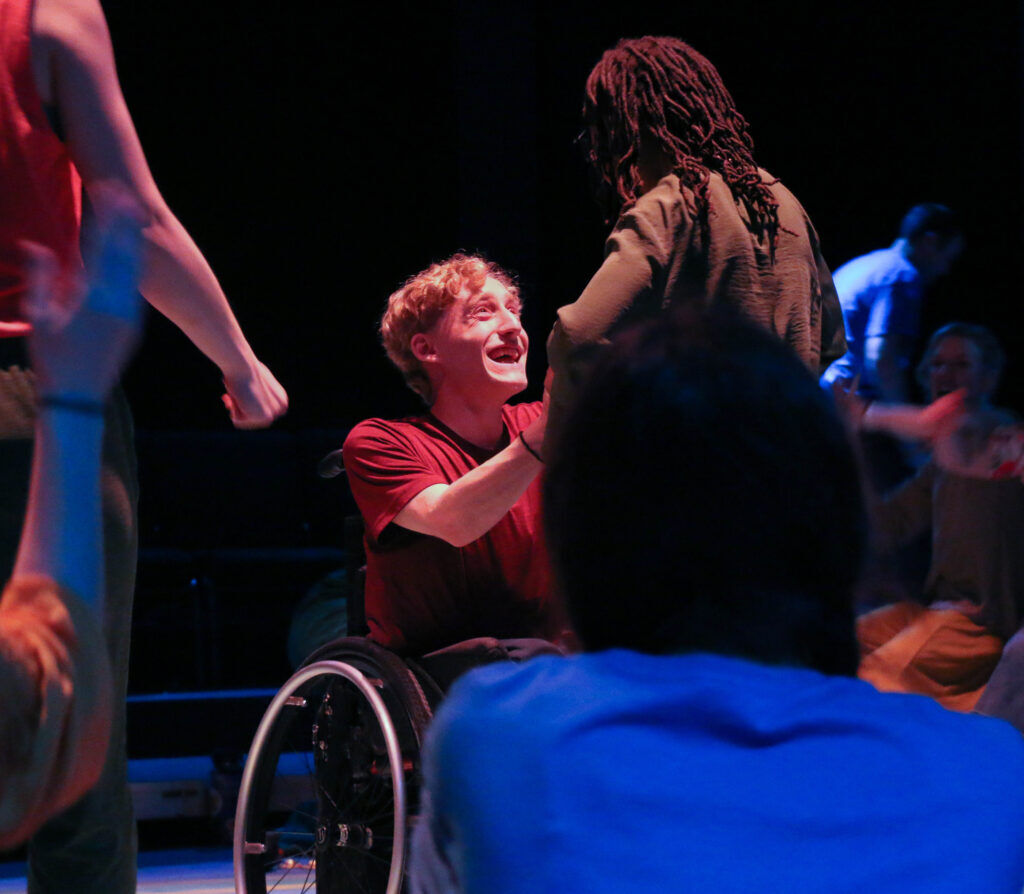
On this night, Kendrick was partnered with a wheelchair-using participant named Brenna, whose coping mechanism was to loudly echo every word spoken in the play with her mellifluous singing voice. Repeating every word spoken, I later learned, was her way of processing the story.
Here, though, she wasn’t shushed for it, as she might have been at pretty much any other public gathering. Here, her unique method of participation informed the soundtrack of that particular performance. Brenna”? I feel like that kind of speaks for itself,” Kendrick said. “Art is beyond ability. It’s human.”
These Phamaly actors clearly connect with the guest performers in a way few ever could.
“It’s more than simply meeting someone where they’re at,” said Phamaly actor Trenton Schindele. “It’s also meeting their soul.”
But just as this story did not end right where you think it might (with the paragraph above), the performance did not always end with “goodbye.”
“One night, someone had signed up to be on stage, but when he arrived at the theater, he got so scared that he just couldn’t do it,” Raanan said. “So instead, he sat in the audience and watched. Which was perfectly fine.
“But just as the play is about to be over – we had already sung our goodbyes – he decides, ‘OK, I’m ready to go,’ and he walks out onstage. And Kelly, without missing a beat, just changes the narration on the fly. She goes: ‘And now Pericles, as he begins to die, starts dreaming about all the things that have shaped his life.’ And we took that cue and literally just did the entire play over, just for this one guy (to have a chance to say the lines he had missed). All of the actors picked up on it and went with it. It was a beautiful moment.”
One unlike anything else you are likely to see on any other stage. Which made me more than happy to take my place as a stranger for a night in the place I call home – a theater audience.
“All any of us want is to be seen and known and accepted and loved,” Hunter said. “This play allows for any participant to have that, no matter what package your body is in. And there is such freedom in that. It’s vocal freedom. It’s physical freedom.
“It’s just freedom.”
Note: The Denver Gazette True West Awards, now in their 25th and final year, began as the Denver Post Ovation Awards in 2001. Denver Gazette Senior Arts Journalist John Moore celebrates the Colorado theater community throughout December by revisiting 30 good stories from the past year without categories or nominations.
‘Pericles’/Phamaly cast members:
- Annie Sand
- Casey Myers
- Corey Exline
- Jamie Bruce
- Katelyn Kendrick
- Kennedy Isaac
- Maggie Whittum
- Miranda Ireland
- Trenton Schindele
- Vin Ernst
Phamaly/Coming up
• “Little Women“: March 19-April 4, at Northglenn Arts’ Parsons Theatre
• “Violet,” June 5-28, at the Aurora Fox Arts Center
More True West Awards coverage
• Our original report on the Air Force’s ‘Legally Blonde’
• 2025 True West Awards, Day 1: Matt Zambrano
• Day 2: Rattlebrain is tying up ‘Santa’s Big Red Sack’
• Day 3: Mission Possible: Phamaly alumni make national impact
• Day 4: Jeff Campbell invites you to join him on the dark side
• Day 5: Cleo Parker Robinson is flying high at 77
• Day 6: Mirror images: Leslie O’Carroll and Olivia Wilson
• Day 7: Philip Sneed will exit Arvada Center on a high
• Day 8: Ed Reinhardt’s magic stage run ends after 27 years
• Day 9: Costume Designer Nikki Harrison
• Day 10: DU’s tech interns getting the job done
• Day 11: Husbands, wives keep home fire burning
• Day 12: Denver School of the Arts’ Drama Dash
• Day 13: Theater as a powerful response to violence
• Day 14: Elitch Theatre no longer a ghost town
• Day 15: A double play for playwright Luke Sorge
• Day 16: ‘Legally Blonde’ at the Air Force Academy? Elle, yes!