







The Kirkland at Denver Art Museum sets an artful holiday table
Festively set Thanksgiving dinner tables tend to bring out the best from cupboards and china cabinets. The finest dishes, cutlery and stemware set the table for memorable holiday meals.
“When you take the time to set a table, make each place setting and choose what dishes you want to show off, it makes the event feel special,” said Becca Goodrum, assistant curator at the The Kirkland at Denver Art Museum.
Tablescapes can be laden with memories and spread with meaning.
“Dinnerware and setting a table is an important way to carry on certain family traditions and connect with one another. It is also a conversation starter. Maybe you use your great grandmother’s set once a year and the family looks forward to seeing them and reminiscing about family that has passed,” Goodrum said. “Imagine if some of these dishes could speak! The conversations they have overhead at the dinner table, from the mundane to the extraordinary — we do some of our best talking at a dinner table.”
The Kirkland’s holdings include an enviable collection of dinnerware made of porcelain, earthenware, stoneware, silver, silver plate and glass. The Kirkland Collection, in large part amassed by the museum’s founders Hugh Grant and Merle Chambers, encompasses around 17,000 objects. More than 10,000 objects d’art range from mid-19th century to late 20th century with a focus on the Arts and Crafts era to Postmodernism — 150 years of decorative design. The museum’s six main galleries present chronologically ordered vignettes from design movements.
“We like the museum to feel very comfortable, like you stepped into someone’s home,” Goodrum said.
Dinnerware chronicles aspects of American history
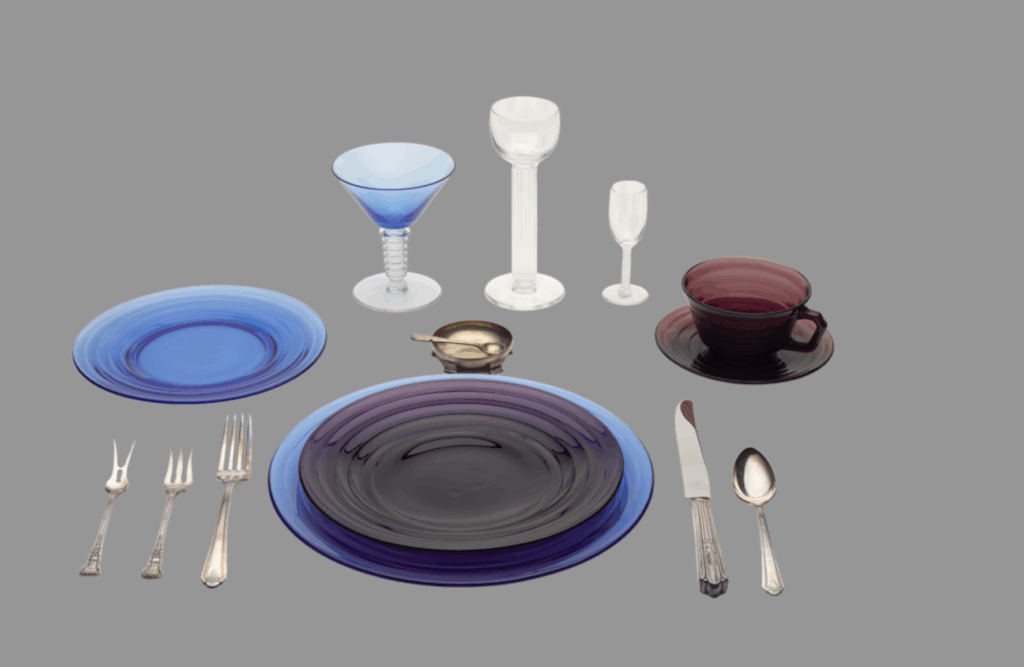
“Table settings can tell us a lot about the time period in which they were designed. For example, during the Art Deco era there were a lot more specialized pieces on a table. We had specific glasses for specific drinks and individual salt cellars with little spoons for each guest. During this era, we do see more salt and pepper shakers coming out so the cellar was becoming less common and would become obsolete in later years,” said Goodrum.
Stemware branched out during Prohibition
The Kirkland collection has a multitude of drinking glasses.
“Many of those are from the Art Deco period when, at least in America, we were dealing with prohibition and moved our cocktail parties to our homes. You needed all sorts of different-shaped glasses for whatever sort of drink you were serving,” said Goodrum. “They had one for white wine, one for red, one for cocktails, one for mixed drinks, one for whiskey, one for our digestifs. They also came in all sorts of colors and shapes, with etches or without. There was glassware for all types of tastes and budget.”
Modernity turned the tables
“In the early 20th century formal dinners were absolutely an expression of wealth or status. The tablescape had to be beautiful, the dinnerware had to be perfect for the occasion, the right glass had to be used for the right drink at the right time, and the staff would know what dishes were needed when,” Goodrum said.
Post-World War II, most Americans no longer employed domestic help in their homes. Consequently, more casual dinners focused on the nuclear family, Goodrum said.
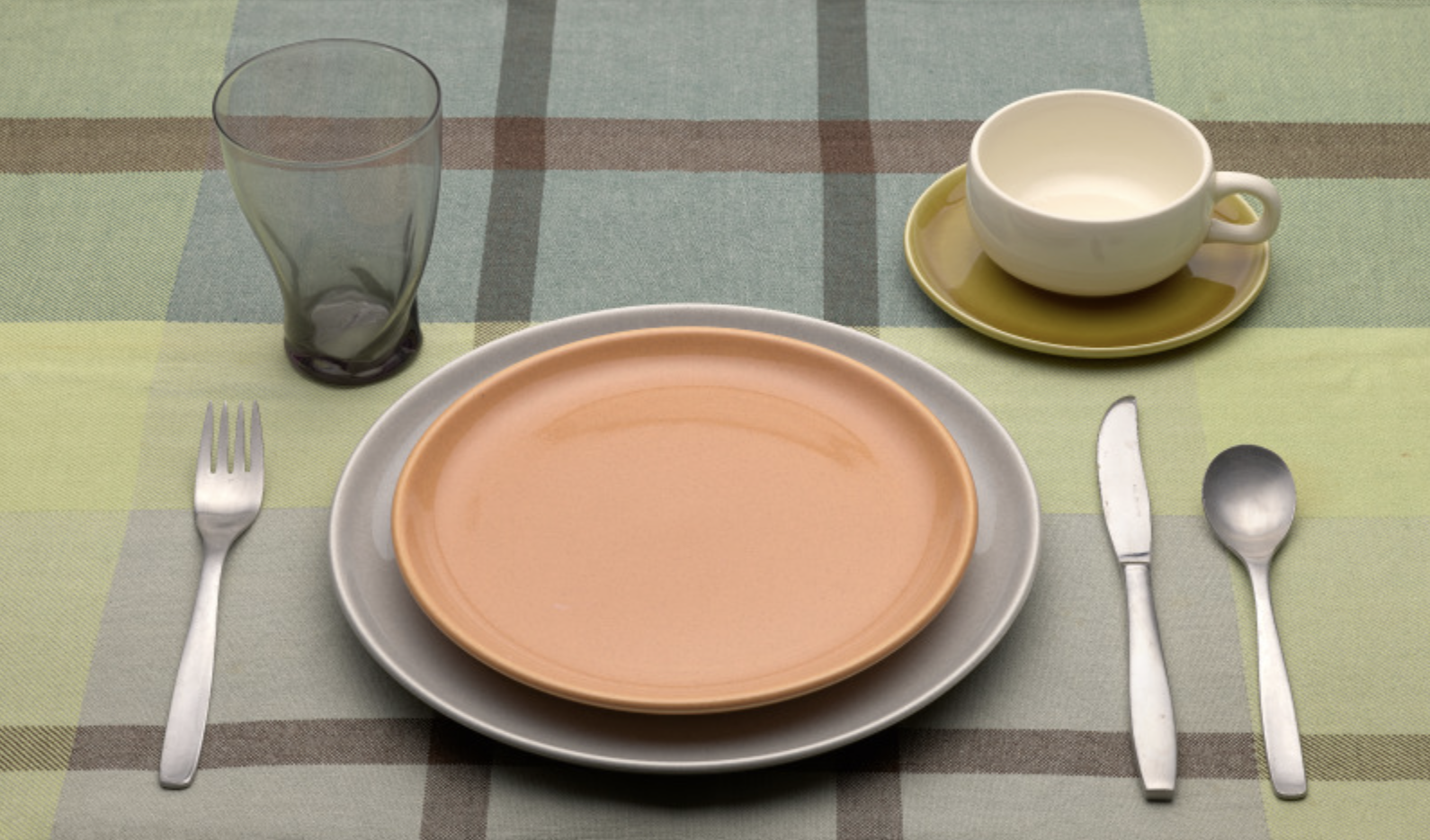
“That is where Russel and Mary Wright come in with their extremely popular dinnerware service: American Modern. They also released their book A Guide to Easier Living in 1950, a handbook on more informal living and dining, which quite literally changed the way Americans lived,” said Goodrum.
“Mary and Russel Wright popularized buffet-style dinners and sold their American Modern dinnerware in what they called starter sets, which included just the necessary items to set a table for the nuclear family. You could buy accessories separately, or not, because maybe they didn’t always need the gravy boat. They ushered in a new era and embraced a more casual lifestyle open to all classes.”
Less formality for nuclear-family dinners
Increasingly, American dinnerware leaned away from formality and toward the nuclear family.
“Dinnerware sets start becoming available in just four-to-six settings. In the past you may have needed a set of 12 for your extended family,” Goodrum said.
“Aesthetically things became simpler, less decoration on the pieces themselves, less objects on the table — a paring down and a move to a more casual dining,” she said. “Dinnerware becomes fun and playful, an expression of the host or hostesses’ aesthetic sensibility. You may not need a nice set for the holidays that you put away, you can just use your everyday set for all the parties.”
Plastics appear on the table
The era introduced plastics, too, as affordable, lightweight, kid-friendly options.
“Many lines were made of melamine, which is a heat-resistant plastic, making it a good choice for dinnerware,” Goodrum said.
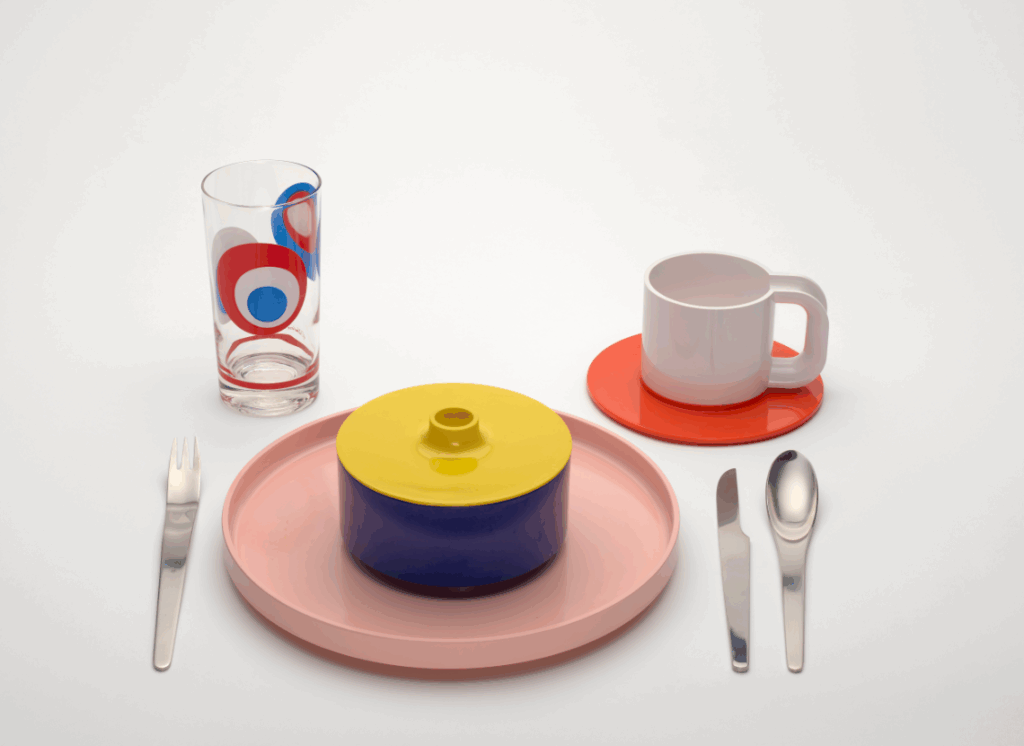
“Hellerware was designed by Italian husband and wife Massimo and Lella Vignelli in Italy in 1964, but not made in the U.S. until 1971. The dishes were stackable and made to be easily stored and available in bright colors,” she added, noting that MoMA sells the brand.
Hellerware is a favorite of the Kirkland’s curator, Christopher Herron.
“I’ve always liked the bright, bold colors and shapes of the Heller pieces,” he said. “A relative owned some of these pieces and I remember them growing up. They definitely recall a time. They’re fun.”
Everyday design: accessible art
According to Herron, “Design can be something overlooked in our daily lives, but a lot of thought went into that fork or spoon you’re holding. We’re calling attention to that by treating them like art objects, talking about their design and aesthetic appeal and about the people that made them.”
Anyone who has pulled out the good silver to find pieces tarnished knows well the upkeep certain dinnerware can require.
“Thankfully we have a fabulous conservation team,” Goodrum said. “Keeping these objects safe and protected for future generations is the whole point.”
At the Kirkland, visitors of a certain age can expect to see familiar items — a grandmother’s teapot, for example, a grandfather’s ash tray.
“I love seeing visitors point out something they recognize from their families’ collections, it never gets old!” Goodrum said. “We have all sorts of things people may recognize. Dinnerware patterns that your grandparents served you Thanksgiving dinner on, some decorated tumblers that your aunt collected in all sorts of fun patterns and colors, maybe even a cocktail glass that you admired as a kid.”
Decorative arts evoke nostalgia
Visitors to the Kirkland tend to connect emotionally with decorative arts objects that feel familiar and domestic.
“It’s one of the best parts about working with a decorative art collection. Decorative art has the ability to immediately put people at ease, like ‘Oh, OK I recognize these objects,” she said. “There is also this sense of nostalgia that I love to witness. When someone recognizes a piece that someone they loved had used or collected, it’s heartwarming. It’s unique because many people will never live with a painting by Van Gogh, for example, but many objects in our collection are accessible to any level of collector. They are lived with and used by ordinary people! It is such an accessible art form and that’s why I fell in love with it.”
Setting the artful table
“For table settings, we have plates for all sorts of food, glassware for all sorts of drinks, salt and pepper shakers, pitchers, bowls, condiment jars, and the very popular centerpiece. We sort of do away with elaborate center pieces after the war, but decorating a table for your party used to be serious business,” Goodrum said
The Kirkland’s flatware often was designed by architects and desitners. Goodrum cited the AJ flatware by Arne Jacobsen as a favorite.
The museum, she said, does not include a large collection of table linens.
“But when a designer like Russel Wright designs tablecloths, we must have them,” she said.
Gio Ponti, the architect of the neighboring DAM building, designed plates in the Kirkland collection.
Goodrum said: “I am definitely biased, but I find all dinnerware interesting. We have pieces by more recognizable names like Gio Ponti, Frank Lloyd Wright, Victor Schreckengost, Clarice Cliff, Eva Zeisel, Alexander Girard, and more allusive names like Ben Seibel or Charles Murphy.”
Vance Kirkland’s tableware
The museum includes pieces owned by Vance Kirkland, himself, one of Denver’s most notable artists.
“We have a display case in his studio that includes pieces he owned and used,” Kirkland curator Herron said. “We have some very traditional china and glasses, as well as much more forward-looking designs like Moderntone by Hazel-Atlas and Russel Wright’s American Modern. Along with the Italian majolica wares, the case demonstrates his varied interests.”
Goodman added: “Legend has it Vance loved a cocktail called the Zombie, so he had some Russel Wright Eclipse glasses specifically to enjoy that cocktail.
“Moderntone glassware dishes are from the 1930s and came in cobalt blue, pink, green, and a dark amethyst. Later the line would come in more opaque glass colors with pastel hue. Vance Kirkland collected this glassware, and we have some on display in his studio. It was an affordable dinnerware line that came with all sorts of accessories as well, cheese plates, salt and pepper shakers, mustard jars, butter dishes, tumblers, sherbet dishes, soup bowls and various sizes of plates.”
Hospitality matters most
This Thanksgiving and winter holiday season, people hosting dinners are all over the board in terms of setting the table. While some opt for the ease of plastic plates and paper napkins, many still endeavor to set an elegant table.
“I think we do still like to set a table for those two-to-three events a year when the larger family gets together! It gives the event a sense of formality that most family dinners don’t have anymore,” said Goodrum.
“That being said, not a lot of us have a set of 12 dishes that we can pull out for a large gathering so we might opt for a disposable option or a mix and match option, which is my favorite,” she said. “Now we are trying to have moments of connection around a dinner table, but we all have so much to do, so we may opt for less dishes to clean after a big event.”
The holiday season, Goodrum said, offers opportunities to appreciate one’s possessions related to the art of the dinner table.
“I think ‘eventizing’ a holiday dinner is never a bad idea. It makes the moment more memorable,” said Goodrum. “That being said, it doesn’t matter how fancy your table or your dinnerware is. Making your guests feel special by inviting them to gather with you is really the whole point. The table setting can just be a nice bonus.”