







As lawmakers return, federal pressure and fiscal stress poised to shape Colorado’s 2026 session
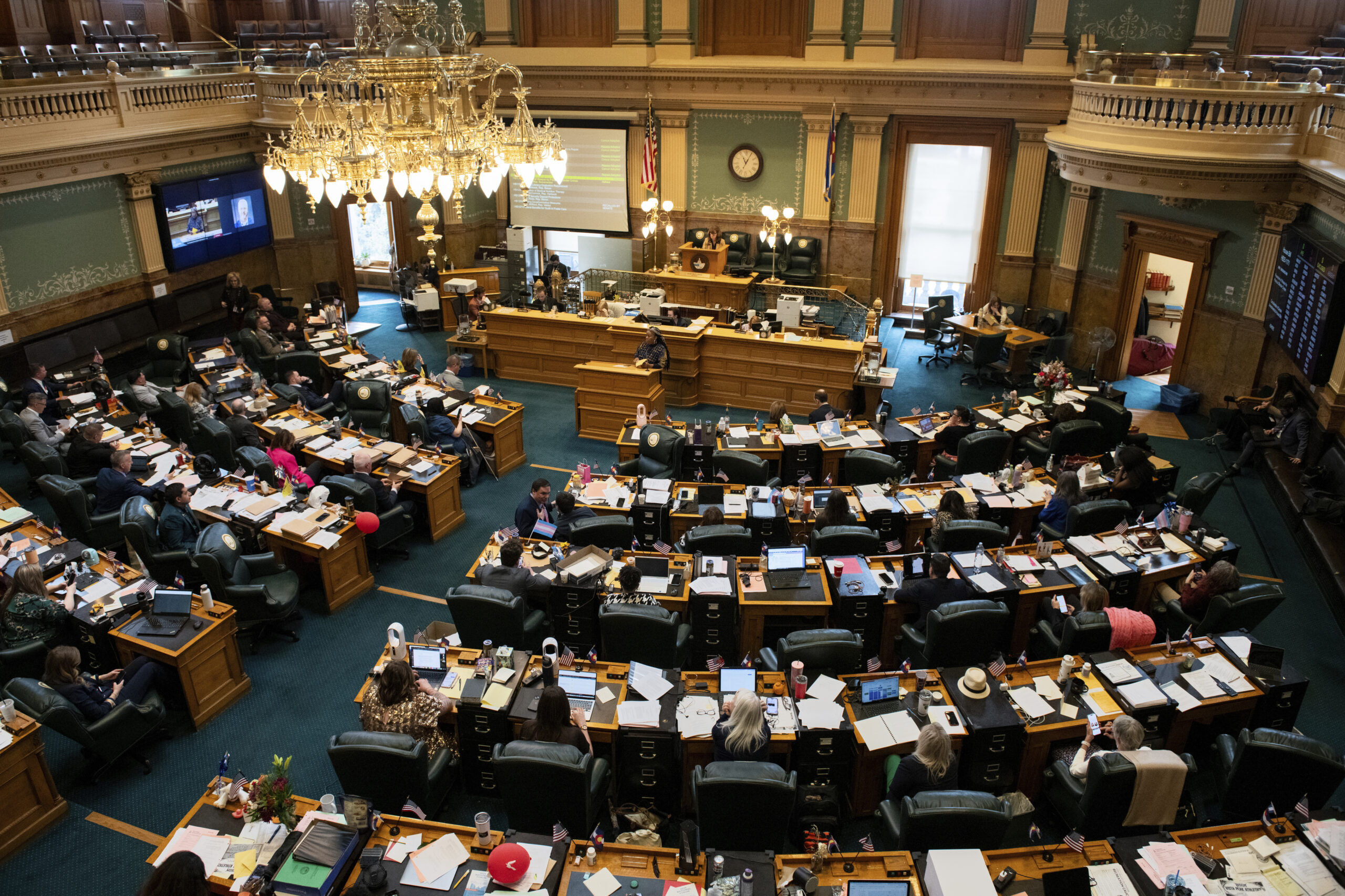
The eight months since lawmakers wrapped up the 2025 legislative session have been anything but quiet. Federal funding cuts, a flurry of presidential executive orders, an election year fast approaching — not to mention a projected $1.2 billion budget shortfall — are all converging as policymakers prepare to return to the Capitol for the 2026 session.
In addition to the political fights, federal and Colorado policies have clashed.
Last month, for example, President Donald Trump signed an executive order establishing a task force to challenge state-level laws regulating artificial intelligence, part of his efforts to institute a nationwide framework for this emerging technology.
The president said this aligns with his policy to “sustain and enhance” America’s “global AI dominance through a minimally burdensome national policy framework.” Under the order, noncompliant states could see their federal share of broadband money withheld.
And Colorado is one of a few states that passed laws to regulate AI.
Having adopted legislation on topics ranging from “deepfake” imagery and biometric technology to facial recognition software, some view Colorado as a leader in AI regulatory policy, while others argue that its actions have been misinformed and misguided. The state’s most sweeping AI regulation to date is a 2024 bill that prohibits the use of “algorithmic discrimination” in business and other areas.
Kjersten Forseth, a lobbyist who represents a group called Peoples’ Association for Responsible Technology, called Trump’s threat “a letter to Santa,” arguing he’s simply telling states what he wants them to do — but that he has no authority to actually compel them.
“The idea that the president can unilaterally decide that states can’t enforce their own laws is kind of ridiculous,” she said, adding that states have no choice but to take AI policy into their own hands, as they can’t trust the federal government to do so in a timely manner.
“Congress does have a job to do here, but they’re incapable of passing anything,” she said. “So, the idea that we have to defer to Congress is ridiculous, and I think states just need to do what they have to do in order to protect the people that they govern.”
A task force by itself would not necessarily prevent states from passing new laws or from implementing legislation they have already adopted. However, if Congress regulates AI policy, any local law conflicting with it would be preempted under well-established rules.
And some in Colorado, including Gov. Jared Polis, prefer a federal framework, rather than a patchwork of state laws that — he said when he signed the AI law — could “tamper innovation and deter competition in an open market.”
“I am concerned about the impact this law may have on an industry that is fueling critical technological advancements across our state for consumers and enterprises alike,” the governor said in his signing letter.
What the federal government wields is a carrot and a stick. Notably, it can threaten to cut federal funding or make it difficult for states to obtain those funds if they contravened the White House’s agenda — tension that’s already playing out between Colorado and the Trump administration.
Federal cuts shape Colorado policy
Federal cuts, such as those outlined in H.R. 1, the budget bill, have already shaped legislative policy in Colorado.
After Congress passed a budget in July, Gov. Jared Polis called a special session to address its impact on the state’s spending plan.
The ramifications of H.R. 1’s cuts will remain top of mind throughout the 2026 legislative session and most likely even beyond that, said Chris deGruy Kennedy, a former state lawmaker and president of the Bell Policy Center.
Kennedy also pointed to the latest financial blow from the federal government: Earlier this week, the Trump administration announced it would freeze federal funding for several states’ childcare programs, including Colorado’s.
“Those kinds of things create huge problems for states like Colorado that do not have the ability to just put dollars into a program like that with the hope that, at some point in time, the federal government restores that investment, and that’s largely because of TABOR,” Kennedy said. “It limits our ability to adjust for these things as they happen.”
“There are no hidden solutions waiting to be found out there,” Kennedy said. “I think the reality is that the legislature’s authority here is extremely limited, so absent the voters approving a ballot measure that either changes TABOR or approves a new revenue stream of some sort, there are no solutions that are hanging out there.”
He added: “We’re pretty low on options, so I think that if the federal government makes a cut, it’s going to be a cut in Colorado.”
While Democrats have routinely blamed the federal government for the cuts, Republicans have argued that Polis and his Democratic majority at the state Capitol have presided over an exponential growth in government programs and spending, notably hiring thousands of state workers over the past several years.
The Taxpayer’s Bill of Rights, or TABOR, limits the power of the state and its
political subdivisions to raise revenue. Under TABOR, any new tax must get the voters’ approval. Supporters have touted it as an antidote to unchecked government spending, arguing it has kept, to some extent, taxes low. Critics countered that it has hampered the government’s ability to pay for its priorities.
Election-year politics play a smaller role at the state Capitol
Meanwhile, 2026 is a big election year for Colorado, with seats in Congress, the state legislature, and statewide positions — governor, attorney general, and secretary of state — all up for grabs.
Michael Fields, whose organization Advance Colorado is behind several successful and pending ballot measures, said there was a time when election years meant a slower legislative session, as lawmakers were careful not to do anything controversial that could impact their campaigns.
However, since the Democrats took control of both chambers, that has become less of the case, he said.
“We’ve had single-party control in Colorado for several cycles now, and I don’t think we’ve really seen as big a difference between election-year sessions and non-election-year sessions,” he said. “I don’t think it impacts things as much as it used to.”
Kennedy, who served in the House from 2017 to 2024, agreed: “I think there’s much ado made about being in an election year and how that changes the politics inside the Capitol, and I guess I just think that’s overblown.”
“There have been times in the past where one party or another decided that anyone running for a higher office wasn’t going to get any of their bills passed, but I think that’s kind of outdated, and I think most of the legislators that I know have moved on from that way of thinking,” he said.
One of the most significant changes to come after the upcoming legislative session is the person in charge of the executive office.
Colorado has been under Gov. Jared Polis’ leadership since 2019, with him at the helm for six legislative sessions, a global pandemic, and three presidential administrations. When the 2027 session begins, he won’t be the governor.
“This is the big thing that is unknown going into the next session after the election: Polis isn’t going to be governor anymore, so what is the new makeup going to be?” asked Fields. “What happens in some of these primaries, and what does that mean in terms of the shift that I think has been dramatic already and could be even more dramatic?”
Will ballot measures impact the session?
To many, the people’s ability to pass laws through the initiative process has served as a check to the legislature’s powers — notably important, they have stressed, when the state Capitol is under one party.
Others have decried the initiative process, saying they’re only accessible to well-financed groups.
What’s undeniable is that a ballot measure or even just the threat of one could could impact legislative policy.
In the summer of 2024, Advance Colorado and Colorado Concern announced plans to introduce a pair of measures: property tax cuts and revenue growth caps, arguing that the legislature has failed to protect businesses and residents alike amid skyrocketing property taxes. The organizations pledged not to proceed with the initiatives after reaching an agreement with lawmakers and the governor to secure property tax reductions through the legislature.
After the deal was secured, Polis called a special session, during which legislators passed legislation to cut both residential and business property taxes. The two groups fulfilled their promise to rescind the measures.
Some have accused Fields and other organizations of running ballot measures to sway the legislature. Fields rejected the claim.
“We don’t run ballot measures to try to anticipate or pressure the legislature, he said. “We’re looking at what’s good policy, what can pass with voters, and obviously, if (the legislature) goes and fixes something that we think needs to get fixed, that would take the ballot measure off the table.”
This year, Advance Colorado plans to place a ballot measure on competency evaluations in criminal court proceedings, an issue that has been in the spotlight due to several high-profile cases, in which people accused of violent crimes have been released into the streets because they were found to be incompetent to stand trial. Some went on to reoffend after their release.
The group also hopes to put a measure on the ballot that would require voter approval before the state can impose fees above a certain amount.
“The legislature has not been dealing with public safety or affordability, so now we’re at a point where our state is second from the bottom on public safety and it’s the second-highest cost of living in the country,” Fields said. “These trends are heading in the wrong direction, and I would hope legislators would look at the policies they’ve been passing over the last few years with single-party control and saying, ‘Hey, we’re going the wrong way in a lot of these rankings, and now people are starting to not move here or to move away from Colorado because of it. How can we reverse that?’”
For his part, Kennedy isn’t sure that ballot measures will shape policy as much this session as they have in the past.
“It may not be the case this year, and I think that’s in part because the budget situation is so serious that there aren’t a lot of games to be played here,” he said. “This is gonna be a legislative session about budget cuts, and that’s gonna be the defining theme of the session.”

U.S. House probes reports of fraud, waste in Colorado’s Medicaid program
Marianne Goodland
marianne.goodland@coloradopolitics.com
Updated 7 hours ago
A congressional committee is probing reports of waste, fraud and abuse in Colorado’s Medicaid program, citing recent stories outlining over-billing in transportation spending and alleged improper payments in autism services. The U.S. House Committee on Energy and Commerce has sent...

Marianne Goodland
Reporter
Colorado lawmakers’ speeches on immigration, Iran draw worries about decorum, grandstanding
Marianne Goodland
marianne.goodland@coloradopolitics.com
Updated 15 hours ago
Several speeches from Colorado legislators this week have raised new worries about decorum and grandstanding in the state House after two members talked about immigration and Iran using what’s called a “point of personal privilege.” Under the rules of the...
Marianne Goodland
Reporter

Colorado legislators eye changes to credit card ‘swipe fees’
Marianne Goodland
marianne.goodland@coloradopolitics.com
Updated 16 hours ago
Colorado legislators are proposing to eliminate “swipe fees” on sales taxes, a move that proponents say would save businesses tens of thousands of dollars a year but which will likely revive counter-arguments that those fees help create a stable and...
Marianne Goodland
Reporter

As parents claim some AI chatbots encourage teen suicide, Colorado legislators eye regulation
Marissa Ventrelli
marissa.ventrelli@coloradopolitics.com
Updated 16 hours ago
Last September, the parents of two teen boys appeared before the U.S. Senate Judiciary Subcommittee on Crime and Terrorism to tell their stories. Megan Garcia, the mother of 14-year-old Sewell Setzer, said her son took his own life in 2024....

Marissa Ventrelli
Reporter
Colorado Gov. Jared Polis ignites fierce debate after raising clemency questions in Tina Peters case
Marianne Goodland
marianne-goodland@denvergazette.com
Updated 13 hours ago
Gov. Jared Polis ignited a political firestorm Tuesday night after weighing in on the prison sentences of two former Colorado officials — a Democrat and a Republican — convicted of attempting to influence a public servant. The comments quickly fueled...

Marianne Goodland
Reporter

Gov. Jared Polis, Upper Basin states criticize federal draft plan for managing the Colorado River
Marianne Goodland
marianne.goodland@coloradopolitics.com
Updated 2 days ago
With no agreement among the seven Colorado River states, which missed multiple federal deadlines, the Upper Colorado River Commission on Monday sharply criticized the U.S. Department of the Interior’s draft plan for managing the river after the current guidelines expire...
Marianne Goodland
Reporter
Bills on ballot access, dual office ban move swiftly through Colorado legislature
Marianne Goodland
marianne.goodland@coloradopolitics.com
Updated 1 day ago
With an eye on the 2026 election cycle and mounting tensions with the Trump administration, Colorado lawmakers are fast-tracking a pair of election bills they say will protect the state’s mail ballot system and tighten rules for elected officials. The...
Marianne Goodland
Reporter

Colorado GOP chair Brita Horn loses ‘no-confidence’ vote, vows to refocus on ‘mending that divide’
Ernest Luning
ernest.luning@coloradopolitics.com
Updated 2 days ago
The Colorado Republican Party’s state central committee approved a resolution expressing “no confidence” in state chair Brita Horn in a landslide late Monday night near the end of an online meeting marked by rancor and confusion. Almost 80% of the...

Ernest Luning
Reporter
Colorado lawmakers tackle legislation on sexual assault
Jenny Deam
jenny.deam@gazette.com
Updated 2 days ago
A panel of Colorado lawmakers on Monday unanimously approved a bill that supporters say will offer protections and support to victims of domestic violence, stalking, sex trafficking and sexual assault, including mandatory training for law enforcement on trauma. The measure,...

Jenny Deam
Reporter

Colorado legislators want employers to grant them leave of absence from regular work
Marissa Ventrelli
marissa.ventrelli@coloradopolitics.com
Updated 2 days ago
When she was elected to the legislature in 2022, Sen. Janice Marchman said was hopeful she could bring real-world experience to the state’s education policy. Marchman, a Loveland Democrat, was the only active working teacher in the Colorado General Assembly...
Marissa Ventrelli
Reporter
PREV
PREVIOUS

Denver weather: Snow could impact Thursday evening commute
Denver weather forecasters are calling for waves of snow across the metro area on Thursday which they say could lead to a sloppy evening commute. Meteorologists with the National Weather Service in Boulder said to expect snow to fall “mainly between 7 a.m. and 2 p.m.” on Thursday, but daytime accumulation is expected to be […]

Police looking for driver who allegedly struck officer in Commerce City
A driver allegedly injured two Colorado State Patrol troopers Thursday morning near Commerce City before fleeing the scene. CSP was conducting a “team operation” on Interstate 76 near the Sable neighborhood around 9 a.m., according to a news release from the agency. During the operation, one of the troopers attempted to pull over a white […]