








NASA taps Colorado companies to lead development on telescope searching for life on other planet
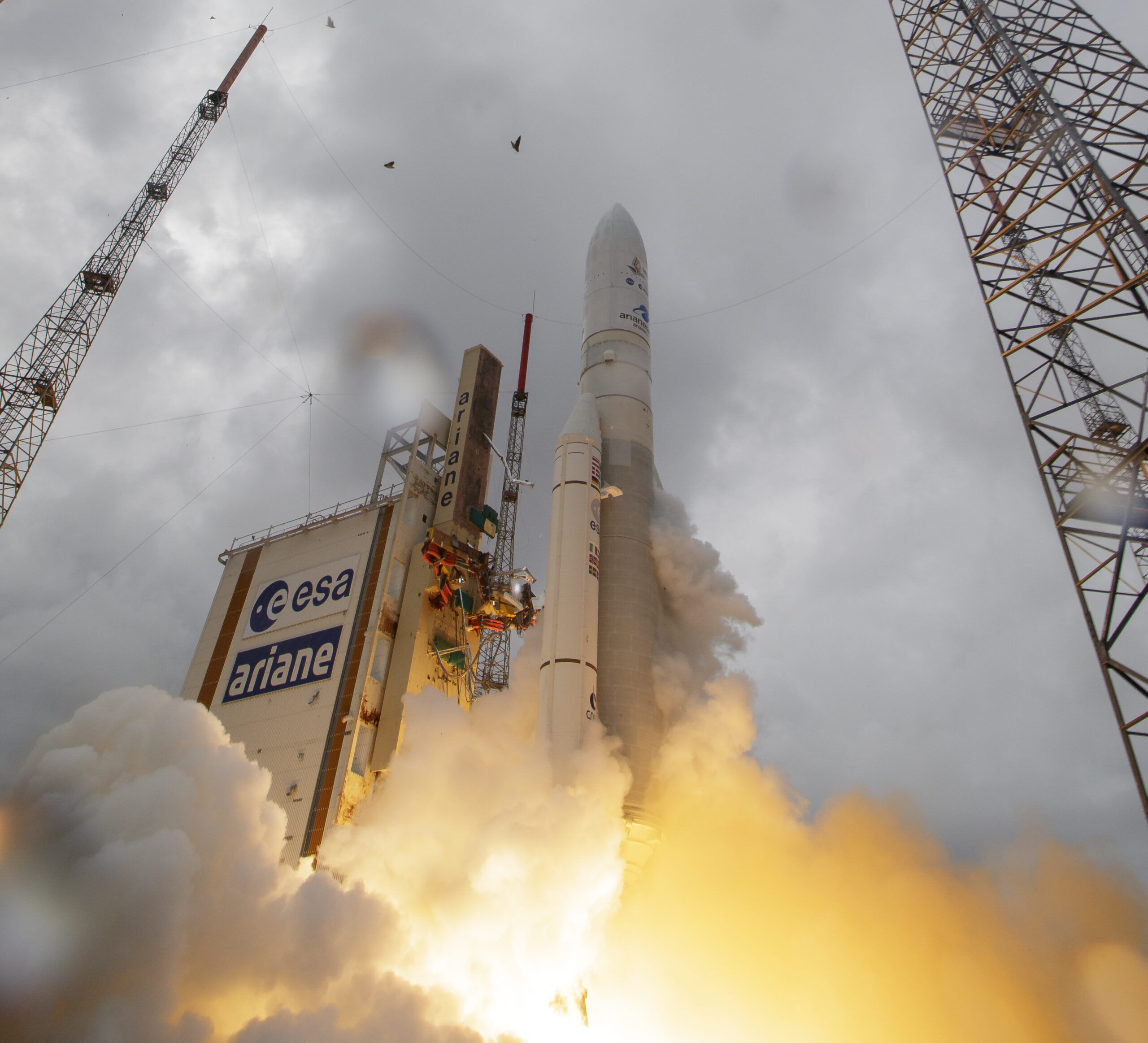
NASA has selected two Colorado companies to help develop a future NASA space telescope that will look for signs of life on other planets.
The flagship project, called the Habitable Worlds Observatory, will be the first space telescope purpose built to observe planets orbiting distant stars.
It will seek to answer one of humanities ongoing questions: Are we alone?
The telescope is still a concept; it is expected to be developed fully sometime after the Nancy Grace Roman telescope is launched next year.
The $105 million set aside for the study will be spread among seven total companies including Denver-based Astroscale U.S. and Westminster-based BAE Systems Space and Missions Systems, formerly Ball Aerospace. Other companies, like Lockheed Martin and Northop Grumman, have a significant presence in Colorado.
The companies have been directed to research new technologies for a future NASA flagship program. Astroscale U.S. is focusing on how to make the new space telescope repairable while orbiting the Earth.
It is well suited to the task and aware of the significant challenges associated with the observatory, said to Tayler Overschmidt, a spokesperson with the company.

“We will be studying the exciting technology innovations that allow highly autonomous and precise robotic on-orbit servicing, and the interfaces and technology needed to empower it,” said Overschmidt.
The Hubble Space Telescope orbits at about 310 miles above Earth, close enough for astronauts to visit and repair it. The Habitable Worlds Observatory will be stationed about 900,000 miles above the Earth, beyond the orbit of the moon.
The distance will also create a 5-second, one-way communications delay, meaning robots tasked with making repairs can’t be controlled in real time like a drone, added Overschmidt.
Another major engineering hurdle is the need for a super stable and precise optical system. While it is collecting data, the satellite must not move “more than the width of an atom,” according to NASA.
Companies like BAE Systems and Space Mission Systems, which acquired Ball Aerospace in 2024, is well versed in this level of precision. It designed and built the mirrors used on the James Webb Space Telescope as well as the actuators that adjusted them.
“Aligning the primary mirror segments as though they are a single large mirror means each mirror is aligned to 1/10,000th the thickness of a human hair,” said Lee Feinberg, Webb Optical Telescope Element Manager at NASA Goddard.

The proof of Ball’s precision was evident in the images beamed back to Earth in 2022. Erin Wolf was the program manager of Webb in 2022, and said she was surprised how awe inspiring the images were.
“In that room there was a lot of us that have spent decades on this program, and there was an audible gasp when the images came up,” she told the Gazette in 2022.
For NASA Administrator Jared Isaacman, that is exactly the kind of work he wants to see continued at NASA. At an agency-wide townhall, hosted shortly after he was confirmed by the Senate, Isaacman said America will lead in the peaceful exploration of space.
“The Habitable Worlds Observatory is exactly the kind of bold, forward-leaning science that only NASA can undertake,” said Isaacman in a Monday news release. “Humanity is waiting for the breakthroughs this mission is capable of achieving and the questions it could help us answer about life in the universe.”

Other companies tapped to develop parts of the Habitable Worlds Observatory include Northrop Grumman, L3Harris Technologies and Lockheed Martin, which combined employ over 15,000 people in Colorado.
Statewide, the space industry employs 55,000 people directly, according to the University of Colorado Boulder. The 2,000 companies calling the state home also indirectly support 184,000. Contracts from NASA generated $5 billion in economic activity, supported more than 21,000 jobs and contributed over $190 million in state tax revenue, according to the university.


Q&A: Colorado Chamber of Commerce CEO sees warning signs for state economy, despite strengths | FISCAL ROCKIES
Thelma Grimes
thelma.grimes@coloradopolitics.com
Updated 1 month ago
Editor’s Note: Once among the nation’s fastest-growing economies, Colorado today confronts mounting challenges that threaten its momentum. This series reveals how a state once defined by prosperity is navigating economic cliffs and ridges. We explore the impact that increased regulations, tariffs,...

Thelma Grimes
Reporter

Once a step ahead, Colorado’s economy cools, burdened by rising costs and regulations | FISCAL ROCKIES
Thelma Grimes
thelma.grimes@coloradopolitics.com
Updated 1 month ago
Editor’s Note: Once among the nation’s fastest-growing economies, Colorado today confronts mounting challenges that threaten its momentum. This series reveals how a state once defined by prosperity is navigating economic cliffs and ridges. We explore the impact that increased regulations, tariffs,...
Thelma Grimes
Reporter

Hundreds of flights delayed out of Denver airport on busiest travel day
Noah Festenstein
noah-festenstein@denvergazette.com
Updated 1 month ago
Hundreds of flights on Sunday were delayed at Denver International Airport amid freezing temperatures on what officials said was projected to be the busiest travel day of the Thanksgiving holiday season. As of 3 p.m., 482 flights were delayed and...

Noah Festenstein
Reporter
Colorado regulators target oil and gas emissions anew
Scott Weiser
scott-weiser@denvergazette.com
Updated 1 month ago
A Colorado commission is mandating an additional 50% cuts in nitrogen-oxide emissions from oil and gas operations by 2030. The Denver basin has a serious problem with summer ozone, though more than half of that comes from wildfires, pine trees...

Scott Weiser
Reporter

Private satellite mission control center is headed for Denver area
Mark Samuelson
mark-samuelson@denvergazette.com
Updated 1 month ago
Denver is poised to get a state-of-the-art, automated mission control center that can track and operate entire constellations of spaceborne satellites, according to the startup company Quindar, which reports having lined up $18 million in funding for the project. “The...

Mark Samuelson
Reporter

York Space Systems prepares to become Denver’s next public company
Bernadette Berdychowski
bernadette.berdychowski@denvergazette.com
Updated 2 months ago
York Space Systems, the Denver-based aerospace company, took its first steps to go public. The company filed documents to set up an initial public offering with the Securities and Exchange Commission on Monday, the first formal step toward offering shares...

Bernadette Berdychowski
Reporter
Air Force Academy may cut back distinguished visiting professor program
Mary Shinn
mary-shinn@denvergazette.com
Updated 2 months ago
The Air Force Academy may pare back the number of distinguished visiting professors it hires next school year as a cost-saving measure — a step that worries professors with knowledge of the proposed cuts. Those who are concerned say the...

Mary Shinn
Reporter
Air Force Academy may cut back distinguished visiting professor program
Mary Shinn
mary-shinn@denvergazette.com
Updated 2 months ago
The Air Force Academy may pare back the number of distinguished visiting professors it hires next school year as a cost-saving measure — a step that worries professors who say the number of highly qualified instructors has already faced serious...
Mary Shinn
Reporter
Flight reductions continue at DIA
The Denver Gazette
the-denver-gazette@denvergazette.com
Updated 2 months ago
As of Saturday afternoon, 64 flights scheduled for Saturday had been cancelled at Denver International Airport, according to the flight tracking website Flightaware. Also, 66 flights scheduled for Sunday and 38 flights scheduled for Monday have already been cancelled. The...

The Denver Gazette
Reporter

More than 70 flights cancelled at Denver airport amid air traffic reductions
Bernadette Berdychowski
bernadette.berdychowski@denvergazette.com
Updated 2 months ago
On the first day of reductions across the nation’s airspace, Denver International Airport is experiencing a wave of flight cancellations. There are 74 cancelled flights at DIA as of Friday morning, according to air travel disruption tracker FlightAware. The top...
Bernadette Berdychowski
Reporter
PREV
PREVIOUS

Colorado snow totals for Jan. 8-9, 2026 storm
The following Colorado snow totals have been reported across the state by the National Weather Service for the Jan. 8-9, 2026 storm as of 11 a.m. Alamosa — 6 inchesArvada — 5.3 inchesAurora — 1.5 inchesBailey — 6 inchesBerthoud — 0.8 inchesBlack Forest — 9.6 inchesBoulder — 6.4 inchesBreckenridge — 6.5 inchesBroomfield — 3.7 inchesCalhan […]

Red Carpet Reception proves new home’s a winner for Coors Western Art Exhibit & Sale | NONPROFIT REGISTER
NATIONAL WESTERN STOCK SHOW News: It wasn’t just the art that people were talking about at Thursday night’s Red Carpet Reception for the 34th Coors Western Art Exhibit & Sale. A good number of the 1,000-plus guests were on their first visit to the show’s spacious new location on the second floor of The Legacy, the recently completed, four-story, $100 million world headquarters for the National Western Stock Show. And […]