







Colorado School of Mines wants to prove a masters isn’t needed to work in quantum

A new program at the Colorado School of Mines aims to fix a major misconception in the budding quantum industry: that a master’s or doctorate degree is required to secure a job in the field.
It doesn’t help when nearly all quantum degrees and training programs in the U.S. are primarily for graduate students.
So starting next fall, the university based in Golden will launch a new bachelor’s degree in quantum systems engineering — a first of its kind in the nation.
The new quantum systems engineering degree is designed to take quantum ideas and help scale them for mass productions as the industry aims to scale its reach, said Fred Sarazin, director of quantum at the Colorado School of Mines. The university said more than half of the industry’s jobs require a bachelor’s degree or less, yet few programs exist in the U.S. to meet the need.
Masters and doctorate degrees will still be most needed to develop the “secret sauce” for quantum companies, Sarazin said. But engineers will be needed to translate the quantum technology into reality.
“We’re not going to make them quantum theorists,” Sarazin said. “We’re going to make them quantum engineers.”
Quantum computing is a rising technology of supercomputers designed to solve problems most classical computers would take years to compute. Experts hope the technology can span from artificial intelligence to helping cure diseases or better understanding the climate.
But the technology’s implementation in the marketplace is still minimal due to the high costs of setting up quantum computers. The Mountain West region is a federally-designated quantum hub with more than 3,000 workers working in Colorado, according to the Colorado Office of Economic Development and International Trade. State leaders project the industry to grow to 30,000 jobs over the next 10 years.
Quantum companies may have a product or concept they’d like to push to the market, but often they’ll have to go through several prototypes to get the right design, Sarazin explained. And if it’s going to sell to more people, the technology also needs to be designed to be operated by someone with little to no quantum understanding. That’s where engineers come in.
“You start from the quantum side, but very, very quickly it becomes an engineering problem,” he said.
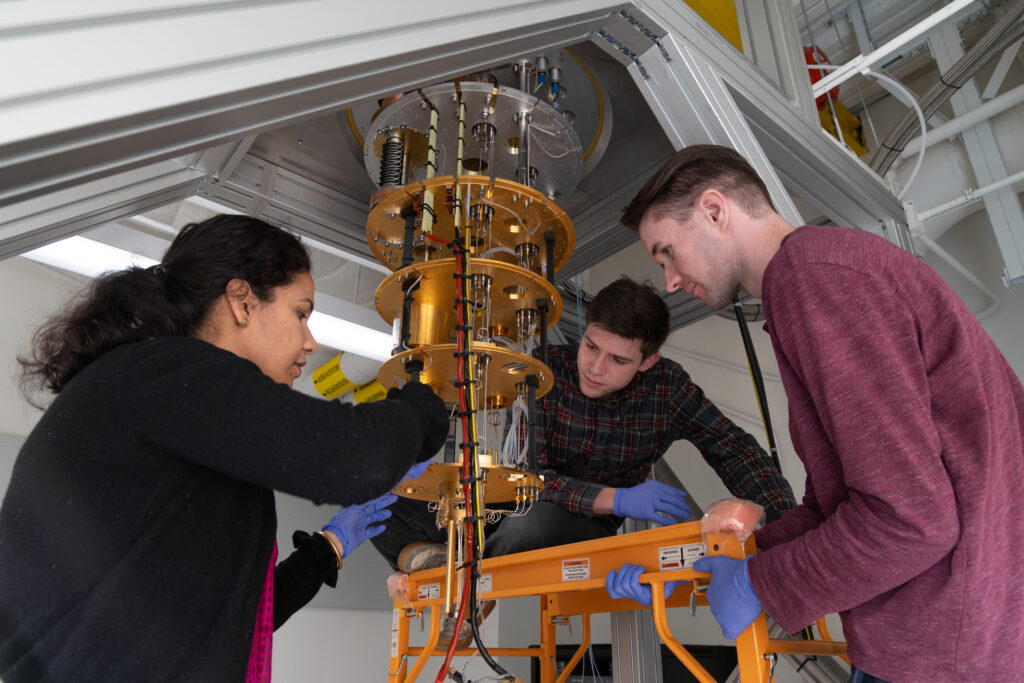
The interdisciplinary degree will combine skills gained from traditional degrees such as physics, computer science, design and electrical and mechanical engineering. Students will have access to the new Quantum Commons business campus in Arvada, and complete a yearlong “industry-sponsored” capstone project.
“The degree is to train versatile engineers who are able to look at the product life cycle from its conception as an intrinsic quantum device all the way to its deployment as a cost-effective, ready-to-be-used product,” Sarazin said.
The new degree has gotten praise from both state and industry leaders.
Gov. Jared Polis said this new degree will help fill a critical gap in the workforce.
“This program strengthens Colorado’s talent pipeline, supports good-paying jobs, and reinforces our state’s position as a global leader in the quantum economy,” the governor said in a news release.
Elevate Quantum’s CEO, the nonprofit organization that helped the region secure its tech hub designation and federal grants, stated the industry’s lack of qualified workers is one of its largest bottlenecks preventing it from growing faster.
The degree was “built to meet that moment,” said Zach Yerushalmi of Elevate Quantum, and will “produce graduates ready to have immediate, real-world impact across national security and nearly every major scientific and industrial domain.”
The program’s first students are expected to graduate in Spring 2029, the Colorado School of Mines said.