







Deadlocked: Colorado basin states negotiations collapse

With the Feb. 14 deadline looming, the seven states in the Colorado River Basin failed to reach an agreement on how to manage the river after the 2026 operating guidelines expire later this year.
John Entsminger, Nevada’s chief negotiator, said there is no deal in place.
“The seven Colorado River Basin states have failed to reach an agreement to collectively protect our respective communities and economies in the face of almost certain reductions to our use of the river,” Entsminger said. “As I talk with people throughout Southern Nevada, I hear their frustrations that years of negotiations have yielded almost no headway in finding a path through these turbulent waters.”
Entsminger added, “As someone who has spent countless nights and weekends away from my family trying to craft a reasonable, mutually acceptable solution only to be confronted by the same tired rhetoric and entrenched positions, I share that frustration.”
The statement was initially reported by the Water Desk at the Center for Environmental Journalism at the University of Colorado Boulder.
Entsminger’s statement referred to the failure of the Upper Basin states of Colorado, Wyoming, Utah and New Mexico and the Lower Basin states of California, Arizona and Nevada to come up with a framework to manage the dwindling water supplies of the Colorado River and whether the states can agree on cuts to their allocations.
Tom Buschatzke, Arizona’s Colorado River negotiator, also lamented the failure of the negotiations.
“Arizona and its Lower Basin partners have offered numerous good-faith compromises to the representatives of the Upper Basin states. In that time, virtually all of them have been rejected,” he said in a statement on Friday.
He noted the options the Lower Basin states have offered, such as substantial cuts to their Colorado River allocations: 27% for Arizona, 17% for Nevada and 10% for California.
“Not enough” for the Upper Basin states, he said.
Last summer, the Lower Basin states “proposed a revolutionary and innovative method of dividing the river’s bounty holistically based on a three-year rolling average of the ‘natural flows’ in the river.” The Upper Basin states rejected that, too, he said.
The message from the Upper Basin states has been consistent, he said — no firm commitment to reduce their allocations, “no matter how dire the conditions of the river may be.”
“We have offered to do more,” Buschatzke said, “But we simply cannot take on the task of saving this precious river system on our own.”
On Friday afternoon, the Upper Colorado River Commissions responded, saying it didn’t create the problem.
“We’re being asked to solve a problem we didn’t create with water we don’t have,” said Colorado’s commissioner, Becky Mitchell. “The Upper Division’s approach is aligned with hydrologic reality and we’re ready to move forward.”
“The Upper Division has stepped up and offered a compromise framework that could serve as a basis for a long-term agreement,” added Brandon Gebhart, who represents Wyoming on the commission. “We are choosing workable solutions over litigation and political messaging. Conflict won’t change the hydrology.”
In a last-ditch effort to get through to the states, the White House had invited the governors of the seven states to discuss the path forward.
As it turned out, there isn’t one.
The ball is now back in the court of the U.S. Department of the Interior and the Bureau of Reclamation, which has been without a permanent commissioner since President Donald Trump took office.
The first nomination was withdrawn last August due to objections from Upper-Basin state senators, notably from Sen. Mike Lee, R-Utah, who chairs the Senate Energy and Natural Resources Committee, which has the authority to recommend the reclamation nominee.
Trump has yet to name another nominee.
In the meantime, Interior Secretary Doug Burgum named Scott Cameron as acting commissioner, formerly the Interior Department’s principal deputy assistant secretary for policy, management and budget, and also previously the acting assistant secretary for water and science.
The Trump administration has twice set deadlines for the seven states to reach agreements, yet they have remained deeply divided over one major issue — how much water the Upper and Lower basins should receive and by how much that allocation should be reduced.
The Colorado River is no longer capable of providing the amount of water outlined in several long-standing agreements, starting with the 1922 Colorado River Compact.
Under those agreements, the Lower Basin was allocated 75 million acre-feet of water over 10 years, with the Upper Basin receiving the same amount. The Upper Basin states have maintained they’ve never taken the full amount.
The Lower Basin states actually took about a million acre-feet more annually, in part because they did not account for factors that would reduce that allocation, such as evaporation and transit losses. The Lower Basin states have since agreed to account for those losses.
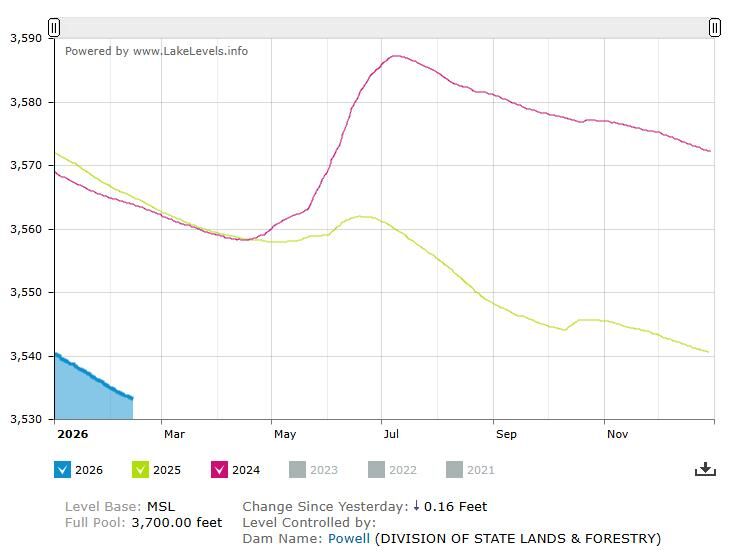
Amid the flailing negotiations, the winter of 2025-26 has been among the worst in history for poor precipitation, largely the snowpack that feeds the Colorado River, beginning at its headwaters in Rocky Mountain National Park.
Downstream, the low water levels at Lake Powell — the water bank for the Upper Basin states — and Lake Mead, which servers the same purpose for the Lower Basin states, could mean both reservoirs, the largest in the nation, will struggle to deliver water to 40 million residents of the seven states, supply water to millions of acres of agriculture and provide hydropower through the reservoirs’ two dams, Glen Canyon and Hoover, respectively.
The federal government last month released a draft environmental impact statement (EIS) that could form the basis for the agreement, but it’s one the seven states aren’t happy with.
When the draft EIS was released, Andrea Travnicek, the assistant secretary at Interior for water and science, said the department “is moving forward to ensure environmental compliance is in place so operations can continue without interruption when the current guidelines expire.”
She added that the river and the 40 million people who rely on it cannot wait.
“In the face of an ongoing severe drought, inaction is not an option,” she said.
A coalition of environment and river groups also issued a warning on Friday.
“The Draft Environmental Impact Statement for post-2026 operations makes clear that the system is operating with little margin for delay,” said the coalition, which includes American Rivers, the Environmental Defense Fund, The Nature Conservancy, Theodore Roosevelt Conservation Partnership, Trout Unlimited and Western Resource Advocates.
“Failure to reach consensus could lead to litigation that would likely take decades to resolve and delay progress towards the solutions needed at this crucial moment for the Basin and its communities. There remains a narrow opportunity for the Basin to shape its own future through negotiated, forward-looking solutions, including many of the meaningful tools identified in the Draft EIS,” the coalition said.
The Department of the Interior has said it wants to see an agreement in place by Oct. 1, the start of the next water year.

Denver breaks heat record for Feb. 15
Piper Russell
piper.russell@outtherecolorado.com
Updated 2 hours ago
Denver has broken another heat record this winter, with the National Weather Service announcing that the Mile High City saw the hottest Feb. 15 in recorded history. The NWS Boulder said that temperatures at Denver International Airport hit 68 degrees...

Piper Russell
Reporter
NWS issues winter storm warning with 10-18 inches of snow possible
Piper Russell
piper.russell@outtherecolorado.com
Updated 5 hours ago
The National Weather Service (NWS), has issued a winter storm warning including parts of Colorado’s high country. According to the NWS, the warning is in effect from 11 p.m. Monday to 5 a.m. Thursday. The warning includes the northwest San...
Piper Russell
Reporter
A dream for Spring? Colorado gardeners still wait to see if winter comes first
Bernadette Berdychowski
bernadette.berdychowski@denvergazette.com
Updated 7 minutes ago
Last year, Front Range Gardens began selling cacti and succulents sourced from the Phoenix area and they were a hit. The desert-climate plants sold out, said Scott Jeffries, the owner of the garden center located in Broomfield. And this year,...

Bernadette Berdychowski
Reporter
With the deadline missed, Bureau of Reclamation plans to move forward on Colorado River operations
Marianne Goodland
marianne-goodland@denvergazette.com
Updated 11 hours ago
Feb. 14 was no Valentine for the seven states of the Colorado River, which failed to come up with an agreement by that deadline on how to manage the river beginning Oct. 1. The Department of the Interior and the...
Marianne Goodland
Reporter

From decrepit to opulent: How 20 years of the Ellie Caulkins Opera House has elevated Denver
John Moore
john.moore@denvergazette.com
Updated 12 hours ago
Celebrating two decades since downtown finally got a worthy home for opera, ballet, concerts and more People forget what life was like before the Ellie Caulkins Opera House. When opera fans had to head down to the basement to find...

John Moore
Reporter
Loveland celebrates sweethearts in annual Valentine’s Day festival
Michael Braithwaite
michael.braithwaite@gazette.com
Updated 8 hours ago
Love was in both the air and the land north of Denver on Saturday. As Americans celebrated Valentine’s Day, Loveland earned its name, hosting its annual Sweetheart Festival. Hundreds of people from all over the Front Range, many wearing pink-colored...

Michael Braithwaite
Reporter

DougCo deputy fired after DUI, careless driving arrest
Michael Braithwaite
michael.braithwaite@gazette.com
Updated 1 day ago
A Douglas County Sheriff’s deputy was fired Friday after he was arrested by Parker Police the previous weekend. Andrew Sanders faces charges of driving under the influence, careless driving, assault on a police officer and obstruction in relation to a...
Michael Braithwaite
Reporter
I-70 closed Friday evening after snowy, two-dozen vehicle pileup
Michael Braithwaite
michael.braithwaite@gazette.com
Updated 1 day ago
Interstate 70 was closed for nearly three hours in the eastbound direction Friday evening after two dozen vehicles crashed in snowy conditions. Authorities first responded to reports of a multiple vehicles involved in multiple crashes on the interstate just east...
Michael Braithwaite
Reporter

1 dead, another hospitalized after southwest Denver shooting
Michael Braithwaite
michael.braithwaite@gazette.com
Updated 1 day ago
One person died and another was hospitalized after shooting in southwest Denver Saturday, Denver Police said. Police first posted on social media at 5:42 a.m. Saturday saying that a man was taken to the hospital with leg injuries after a...
Michael Braithwaite
Reporter

Greeley-based Alquist emerges as leading 3D construction printing company
Hap Fry, Special to The Gazette
hap-fry@gazette.com
Updated 4 hours ago
GREELEY • One might say that Zachary Mannheimer is a bit of a riverboat gambler — a calculated one, though. As founder and chairman of Greeley-based Alquist 3D, Mannheimer didn’t follow the most conventional path into the world of 3D...

Hap Fry, Special to The Gazette
Reporter
PREV
PREVIOUS

Push to regulate high concession prices in Colorado could hurt vendors, critics warn
High food and drink prices have long been a staple of going to a sports game, concert, festival or the airport. But as inflation has increasingly pinched people’s wallets, pushback against higher concession prices is growing. The issue has reached Colorado’s Capitol this year. A group of Democrat policymakers seeks to curb expensive game day […]
Colorado legislators, friends and family pay tribute to late Sen. Faith Winter
Colorado legislators on Friday, joined by current and former lawmakers, memorialized the late Sen. Faith Winter, noting her contributions to public policy in transportation, family and medical leave, and climate legislation. Winter died in an auto accident on Nov. 26 at the age of 45. Winter’s legacy in the General Assembly, where she served from […]