







Susan Blanco is the next Colorado Supreme Court justice

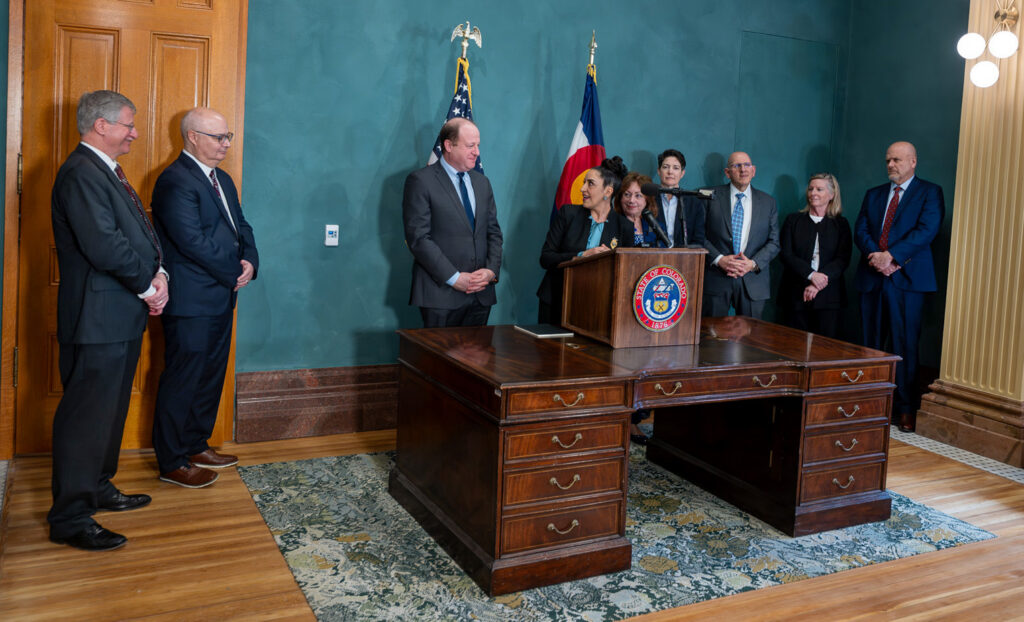
Chief Judge Susan Blanco of Larimer and Jackson counties is the newest member of the Colorado Supreme Court, Gov. Jared Polis announced on Tuesday.
“A few words come to mind: Innovation. Excellence. Creativity. Hard work. These are values we need across society,” said Polis during a press conference announcing Blanco’s appointment.
Blanco, 48, became a district judge in January 2017. She will join four other former trial judges, including two other former chief judges, on the seven-member Supreme Court.
“I’ve conducted home visits, jail visits, and appeared in dozens of Colorado courtrooms witnessing firsthand the extraordinary diversity of our communities and the very vast barriers that many face in accessing justice,” Blanco said. From the bench, “I saw clearly the differences in resources in urban and rural communities, and how profoundly access to justice can depend on geography.”
Blanco is Polis’ second appointment to the court during his two terms in office, following his selection of Justice Maria E. Berkenkotter in 2020. Blanco will fill the unexpected vacancy caused by the departure of Justice Melissa Hart early in January.

She will serve until November 2028, when voters will decide whether to retain her for a 10-year term.
“I’ve always felt like she was passionate about people having access to the legal system, and making sure the widest swath of people feel welcomed and feel like they have access,” said Jennifer L. Rice, a family law attorney in Fort Collins. “She’s always been good at trying to get people to collaborate. Even though she’s the one running the meeting or has the most authority, she uses it in a sort of unassuming way.”
Polis, speaking to the different considerations between his 2020 Supreme Court appointment and Blanco’s, said he evaluated the needs of the court and the characteristics of the three finalists, who also included District Court Judge Christopher Zenisek and Deputy Solicitor General Andrea S. Wang.
“I was looking for somebody who’d be a strong operator. Somebody who showed a strong interest — yes, of course, in the judicial work of writing decisions and making decisions, but went above and beyond that in being interested in being hands-on in some aspect of the successful administration of the courts,” he said. “To me, that was a critical factor in distinguishing Justice Blanco with her operational achievements in Northern Colorado.”
Blanco graduated from Colorado State University in 2000 and later earned a law degree from the University of Colorado. The daughter of Iranian immigrants, she worked as a prosecutor, a criminal defense attorney, and a legal representative for children in neglect cases.
At the press conference announcing her appointment, she called herself “a living promise of the American Dream,” who continues to think about those in Iran and the Middle East who “do not enjoy the protections of the rule of law that we hold sacred in the United States.”
Currently, she leads the Judicial Department’s access-to-justice and information technology committees. She is co-chair of the branch’s chief judges’ council.
Chief judges “kind of have a unique perspective because — I keep equating it to my parents’ restaurant. When you’re going into the courts, you can hopefully just enjoy everything working smoothly for you,” she told Colorado Politics earlier this month after becoming a finalist for the vacancy. “When you’re dining in a restaurant, you’re not worried about what’s going on in the back of the kitchen if everything’s going right. The chiefs are in that position of keeping everything running smoothly for you.”
Blanco helped launch her jurisdiction’s competency court and veterans treatment court, which assist and support certain criminal defendants in resolving their cases. Larimer County Sheriff John Feyen said the competency court has resulted in better outcomes because people are receiving improved services, complying with their medications, and living a better quality of life.
“We have different roles in the judicial system. However, regardless of whether I have agreed or disagreed with her, I have found her extremely approachable,” Feyen told Colorado Politics. And, “if anything else, eminently fair and a great student of the law.”
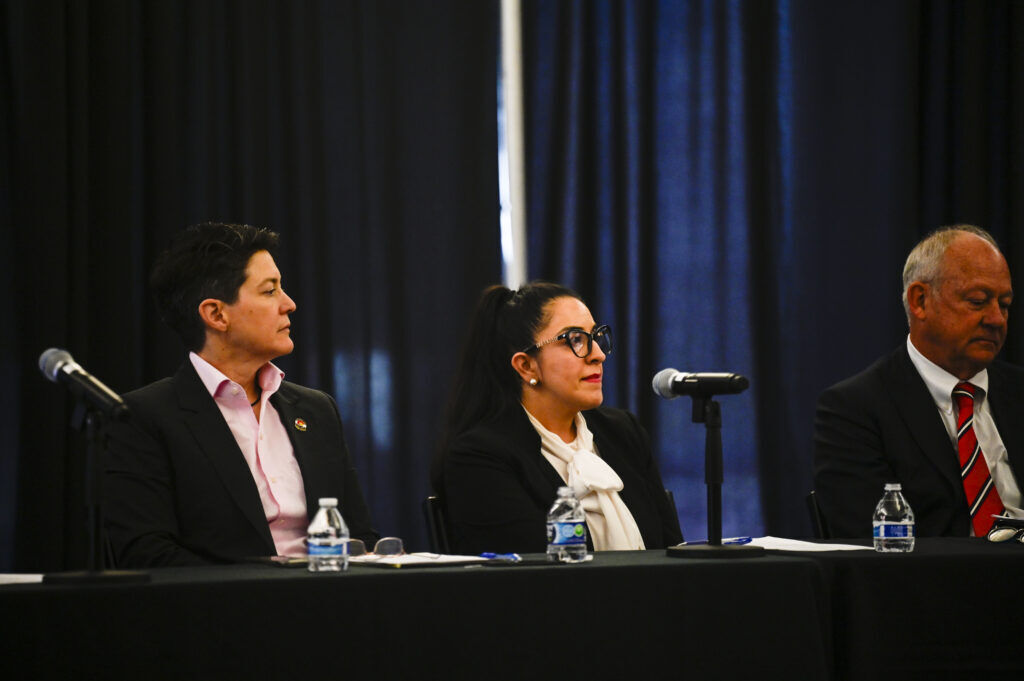
Derek Samuelson, a criminal defense attorney in Fort Collins who has known Blanco for around 20 years, said she takes the rights of criminal defendants and victims seriously. He recalled voicing his concerns during a trial about the recent revision to the definition of “reasonable doubt.” Blanco was a member of the judges-only committee that introduced a new template jury instruction for reasonable doubt, which defense lawyers found to be constitutionally problematic.
“I would think some judges would let their pride get in the way of criticism of something they had just poured their heart and soul into,” said Samuelson. “Believe me, at the end of a trial when everybody is exhausted — you’ve been in trial for a week or more and you get the jury instructions — no one’s excited about trying to make a better mousetrap, perhaps. But she was not about to let her pride get in the way of her judicial decision-making and responsibilities.”
Instead, Samuelson said Blanco agreed to modify the new instruction to reflect his concerns. Coincidentally, Blanco will join the Supreme Court as it prepares to hear a challenge to that same instruction.
Although the Supreme Court is most visible when it holds oral arguments or issues opinions in cases, the job largely entails behind-the-scenes committee work and administration of the legal system. Blanco previously told Colorado Politics she enjoys working on the access-to-justice and IT committees, but that she would embrace whatever assignment she receives as a justice.
Blanco also told Colorado Politics she was interested in getting involved with the judiciary’s legislative agenda. Last month, the chief justice brought Blanco to the annual legislative oversight hearing, where she spoke about competency courts. She said she previously talked to lawmakers about livestreaming court proceedings.
“I really did enjoy being able to talk with them and learn the different perspectives,” she said.
After the press conference, Blanco said she was interested in continuing her work with technological developments.
“It’s gonna be on the forefront for us, trying to figure out how we’re gonna govern AI in our courts, to make sure we have fair access and fair trials for individuals,” she said. “I do think that will be very paramount for us and for other states.”


Colorado Supreme Court accepts cases about reliability of gun-to-bullet matching
Michael Karlik
michael-karlik@denvergazette.com
Updated 3 days ago
The Colorado Supreme Court announced on Monday that it will hear two cases questioning the reliability of expert testimony that purports to identify whether a specific bullet was fired from a specific gun. At least three of the court’s seven...
Michael Karlik
Reporter
Denver man gets 40 years in prison for plotting wife’s murder
Michael Braithwaite
michael.braithwaite@gazette.com
Updated 4 days ago
A Denver man was sentenced to 40 years in prison Friday for a murder-for-hire plot against his wife while he was in jail. Yaury Hill, 34, pleaded guilty Feb. 6 for trying to convince his roommate to kill his wife...

Michael Braithwaite
Reporter

Arvada man sentenced for tampering with woman’s dead body
Sage Kelley
sage.kelley@denvergazette.com
Updated 4 days ago
An Arvada man will spend a decade in prison after tampering with a 29-year-old woman’s dead body. Jefferson County District Court Judge Megan Miloud sentenced 41-year-old Daniel Ryan Clark to 10 years Wednesday after Clark pleaded guilty to a charge...

Sage Kelley
Reporter
Colorado justices skeptical of challenge to water enterprises’ eminent domain power
Michael Karlik
michael-karlik@denvergazette.com
Updated 3 days ago
Members of the Colorado Supreme Court appeared receptive on Wednesday to the notion that water-related enterprises have the legal authority to exercise the governmental power of eminent domain over private property. An enterprise is a government-owned business that provides fee-based...
Michael Karlik
Reporter

Man charged over alleged Adams County bomb threat
Michael Braithwaite
michael.braithwaite@gazette.com
Updated 2 days ago
District attorneys charged a man Wednesday for allegedly calling in a bomb threat to the Adams County Courthouse. Steven Sandoval, 47, faces charges of false report of explosives, weapons or harmful substances and false reporting an emergency, according to a...
Michael Braithwaite
Reporter
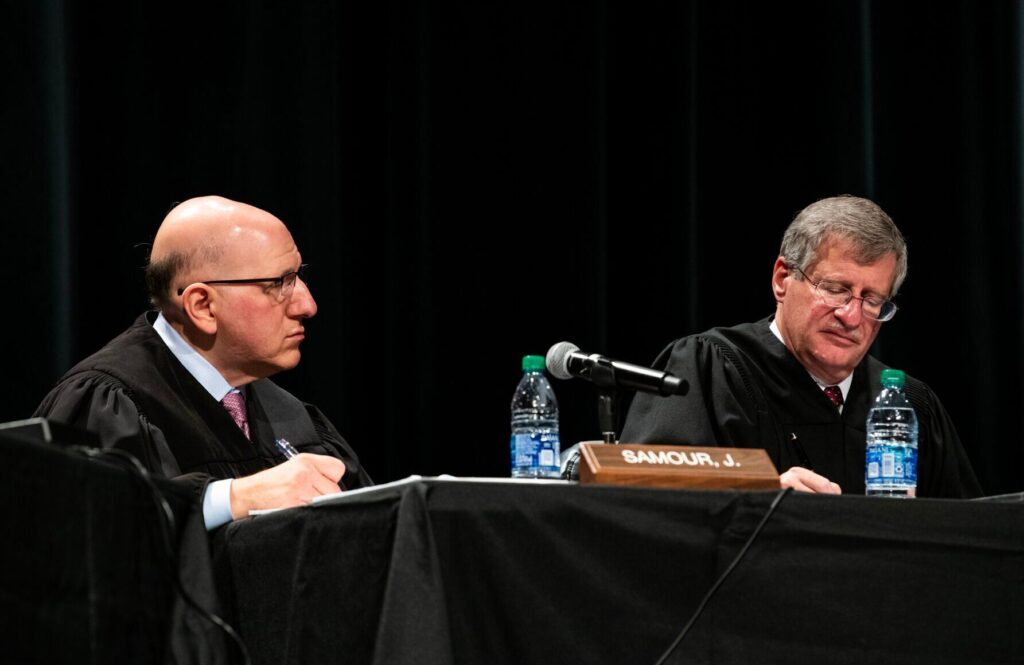
Colorado justices concerned about retrying defendant after jury signaled acquittal
Michael Karlik
michael-karlik@denvergazette.com
Updated 5 days ago
Some members of the Colorado Supreme Court appeared uncomfortable on Tuesday with allowing a criminal defendant to stand trial a second time after a Larimer County jury signaled it was deadlocked on some counts but had found him not guilty...
Michael Karlik
Reporter

Missy Woods pleads not guilty; trial set for fall
Jenny Deam
jenny-deam@denvergazette.com
Updated 6 days ago
The former Colorado Bureau of Investigation DNA expert charged with more than 100 felonies entered a plea of not guilty to all of them Wednesday in a packed Jefferson County courtroom. The plea was entered by her defense attorney Tom...

Jenny Deam
Reporter

10th Circuit orders lawyer to pay $1,000 for faulty AI citations
Michael Karlik
michael-karlik@denvergazette.com
Updated 1 week ago
The Denver-based federal appeals court ordered a lawyer on Monday to pay $1,000 to the opposing side for submitting a legal filing with fake case citations generated by artificial intelligence. A three-judge panel of the U.S. Court of Appeals for...
Michael Karlik
Reporter
Funeral home operator sentenced to 40 years
Stephanie Earls
stephanie-earls@denvergazette.com
Updated 2 weeks ago
Hundreds of families who entrusted their loved ones’ remains to the owners of Return to Nature funeral home have spent years hoping the courts would provide some version of closure after one of the most gruesome crimes in the history...

Stephanie Earls
Reporter

Arvada woman sentenced after death of disabled abuse victim
Sage Kelley
sage.kelley@denvergazette.com
Updated 1 week ago
An Arvada woman will spend more than a decade in prison after the death of an abused woman she was supposed to be taking care of. Jefferson County District Judge Jason Carrithers sentenced 55-year-old Laura Prats to 11 years in...
Sage Kelley
Reporter
PREV
PREVIOUS

Fire breaks out near Limon, jumps highway
A vegetation fire just southwest of Limon broke out Tuesday afternoon, reaching several miles in length and jumping Highway 181, according to fire tracking site WatchDuty. The fire, labeled by WatchDuty as a vegetation fire, jumped the highway south of County Road 74. Units arrived on scene around 12:30 p.m., WatchDuty updates show. Storm Chaser […]

Palantir moves its HQ from Denver to Miami
Palantir Technologies Inc., a large artificial intelligence and software company with many government contracts including federal immigration forces and U.S. military, is moving its headquarters out of Denver. “We have moved our headquarters to Miami, Florida,” the company posted on X on Tuesday. The location on the company’s profile is now shown as Miami. The […]