







‘Die-in’ recounts record year of Denver traffic deaths
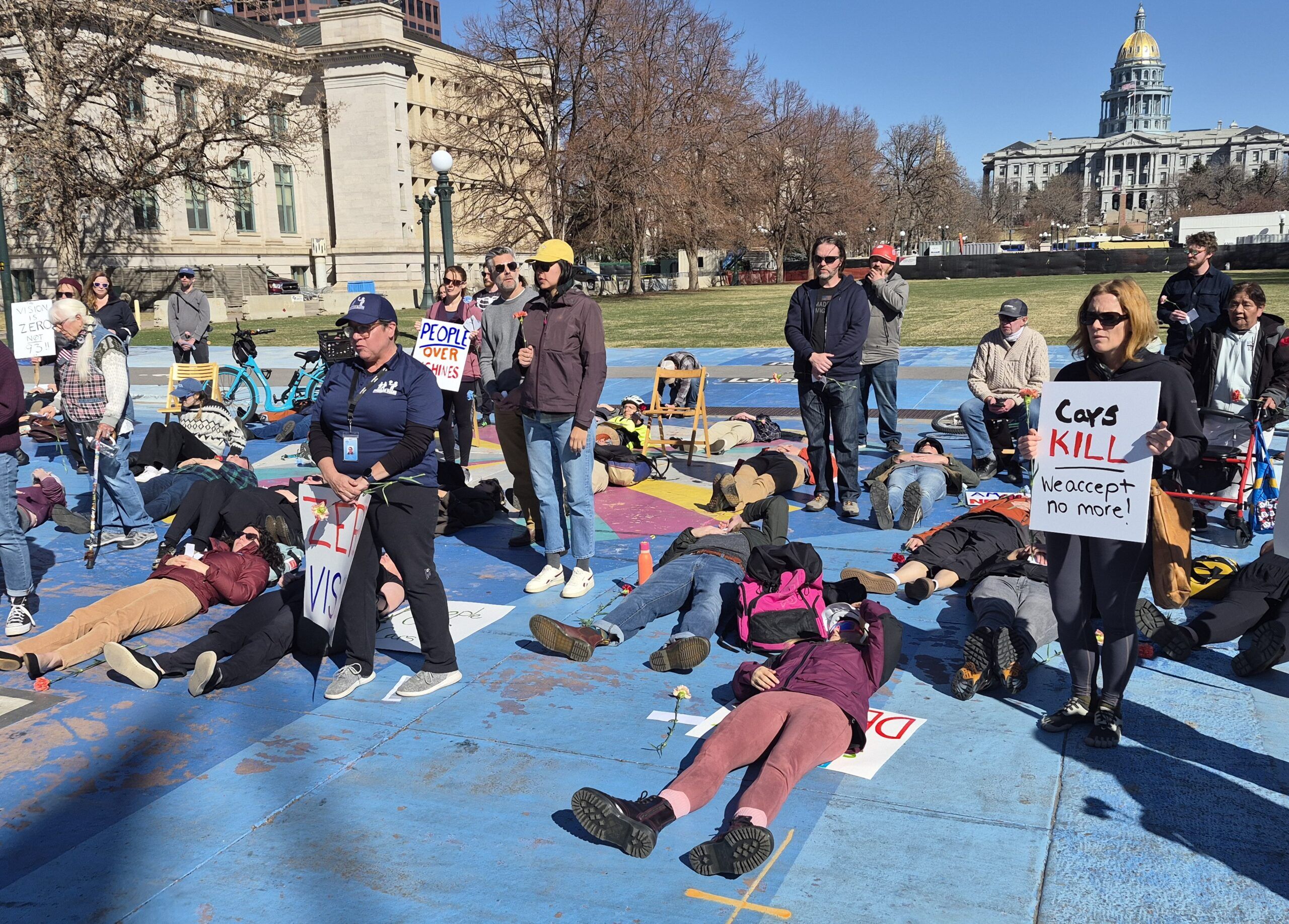
Denver’s record number of traffic deaths last year received a stark depiction at the City and County Building on Wednesday — a “die in” that marked each of the 93 victims killed in 2025 crashes.
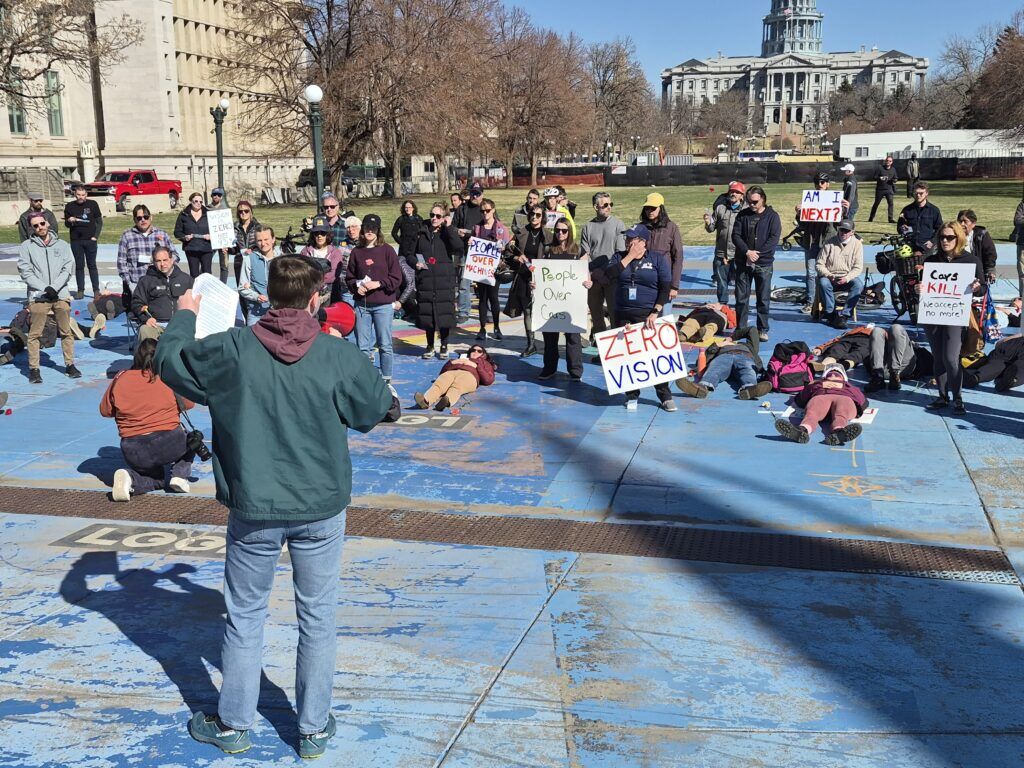
As a volunteer from the Denver Streets Partnership tolled off the names of each fatality, others laid down in succession in the plaza, each marking a single passing. Some of those involved had individual connections to victims.
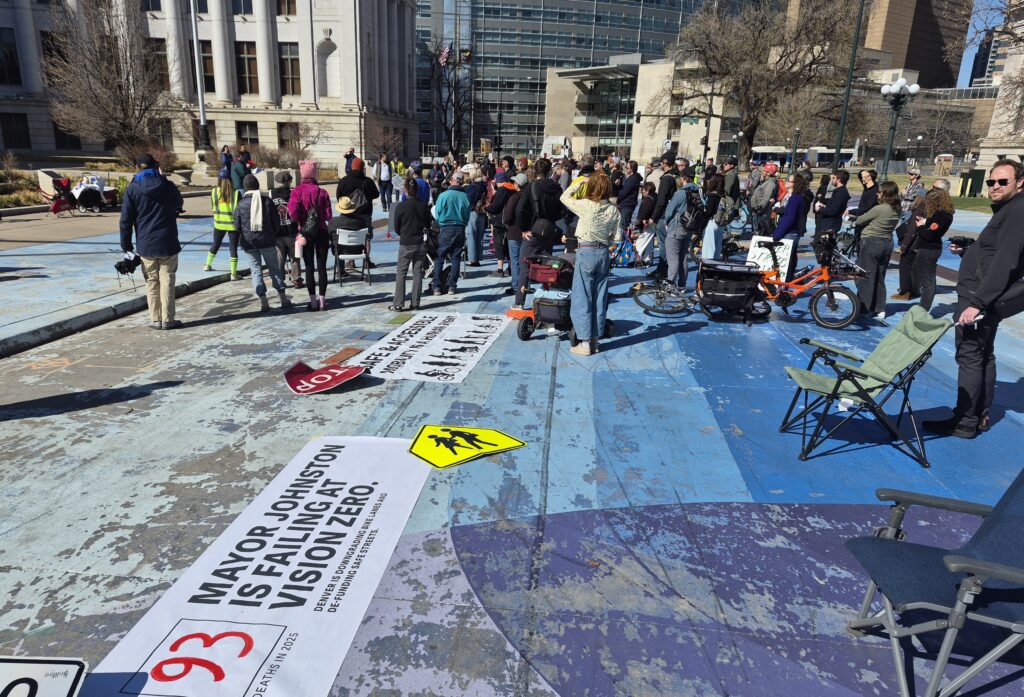
Part of the demonstration was targeted at Mayor Mike Johnston and his Department of Transportation and Infrastructure, responsible for Denver’s “Vision Zero program,” which is aimed at eliminating traffic deaths in the city.
Rather than falling, traffic fatalities rose last year from 80 to 93. The fatality rate has climbed some 82% since 2017, when Denver adopted the Swedish-inspired program.
“Our audience is the mayor and the director of (DOTI), who have the power to make decisions to make sure that we have safe access to our streets,” Alejandra Castañeda, representing the group Pedestrian Dignity, told The Denver Gazette.
Asked whether the event had a specific message for the mayor, Castañeda said: “Yes, to live up to his commitments that he made us a candidate to ensure that safety is first, people are prioritized and we realize mode shift in transportation.”
Vision Zero has been implemented in Denver with a growing infrastructure of bollard-lined bike lanes, traffic circles and other installations, some on residential streets, others on major arterials like east Alameda.
Efforts to narrow the flow of traffic on arterials to fewer lanes have been informally referred to as “road diets.”
Today, a debate rages over whether the measures have served to reduce the likelihood of accidents or to further them. Some want the city to double down on “road diets,” with the goal of reducing speed. Others counter that Vision Zero and similar initiatives have failed to understand driving psychology.
Former engineer critic
Dennis Royer, who had been chief traffic engineer for Denver when flows along many of the city’s arterials had been originally designed, said that road diets and other Vision Zero-inspired installations could themselves be responsible for increases in crashes and pedestrian deaths.
He questioned whether a program designed in Sweden and which had been successful in European cities is being correctly applied in U.S. metropolitan areas, given the latter’s very different traffic situations and experiences.
Other sponsors of Wednesday’s event included the Denver Streets Partnership and the Denver Bicycle Lobby. Earlier in the day, the consortium gathered at the intersection of south Federal Boulevard and west Alameda Avenue for a “Walk & Roll” event, proceeding to the City & County Building.
Castañeda said the route, including an RTD bus segment, was picked to highlight challenges that pedestrians face in crossing the city.
Automatic enforcement
Jill Locantore, executive director of the Denver Streets Partnership, said that the long-term goal is redesigning the city’s streets for safer operation. However, unsafe driving, including speeding, requires better enforcement, she added.
“Enforcement is an important tool,” Locantore told The Denver Gazette. “Our preference has always been for automated enforcement because that is the most effective way to reduce speeding in a long-term way.”
“What actually changes people’s behavior is if you know every time you drive down Federal Boulevard, you’re going to get a speeding ticket because there’s a speed camera there 24-7.”
Locantore said that automatic enforcement has been a challenging issue statewide, but cities in the metro area have begun applying automated systems, while Denver was lagging behind.
“Here we are in 2026 and for mysterious reasons, the city has yet to implement automated enforcement,” she added. “We’re hopeful that 2026 will be the year where we finally start rolling this out.”
“It seems like transportation safety is just not a priority for this mayor,” Locantore said. “A lot of surveys and polling have shown that the vast majority of people do support automated enforcement as a tool for addressing safety.”
In an earlier statement to The Denver Gazette, a representative for the Denver Police Department noted that traffic enforcement had decreased due to workload challenges during and following the COVID pandemic.
“DPD is working to restore some lost capacity in the Photo Enforcement Unit caused by attrition over the past couple of years,” the representative noted. Some positions lost were civilian positions related to photo enforcement, he said.
Some participants on Wednesday focused specifically on car traffic itself as the issue. One held a sign “Cars Kill.” A mission statement of the Denver Streets Partnership calls for “cultural and systemic changes necessary to reduce our city’s unsustainable dependence on cars.”
But Johnston has pushed back in recent weeks, after charges from activists and city councilmembers that city decisions were failing to reflect safety concerns.
“Our job as a city is to get (drivers) to and from work safely and to get to and from work in a way that makes it possible to live and work here,” Johnston told listeners on a podcast last month. He had singled out some tactics used by activists who had verbally attacked engineers and other staff responsible for achieving Vision Zero’s goals.
“That is not the way you have a civil discourse,” Johnston said.
He noted that he commutes that stretch himself and said his own trip downtown had gone from 10 or 12 minutes to 30 minutes as the Colfax project unfolds.
“Where do you think those ten or fifteen thousand (cars) went? Do you think that those drivers decided to put their two kids and their drywall business on a bike and ride to and from work?” the mayor asked.