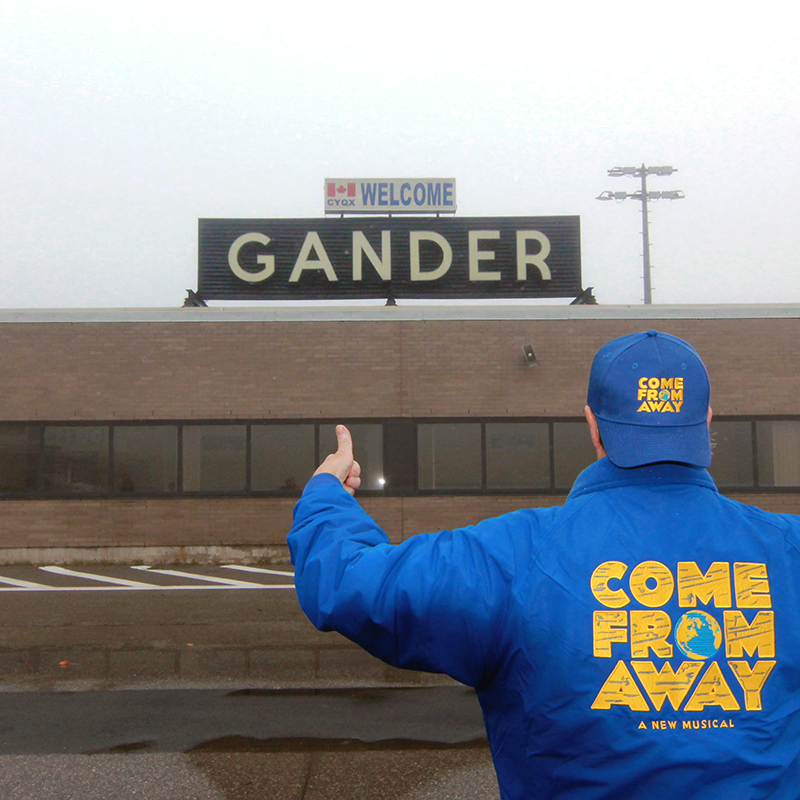
‘Come From Away’ pilots: After the unthinkable, the unforgettable
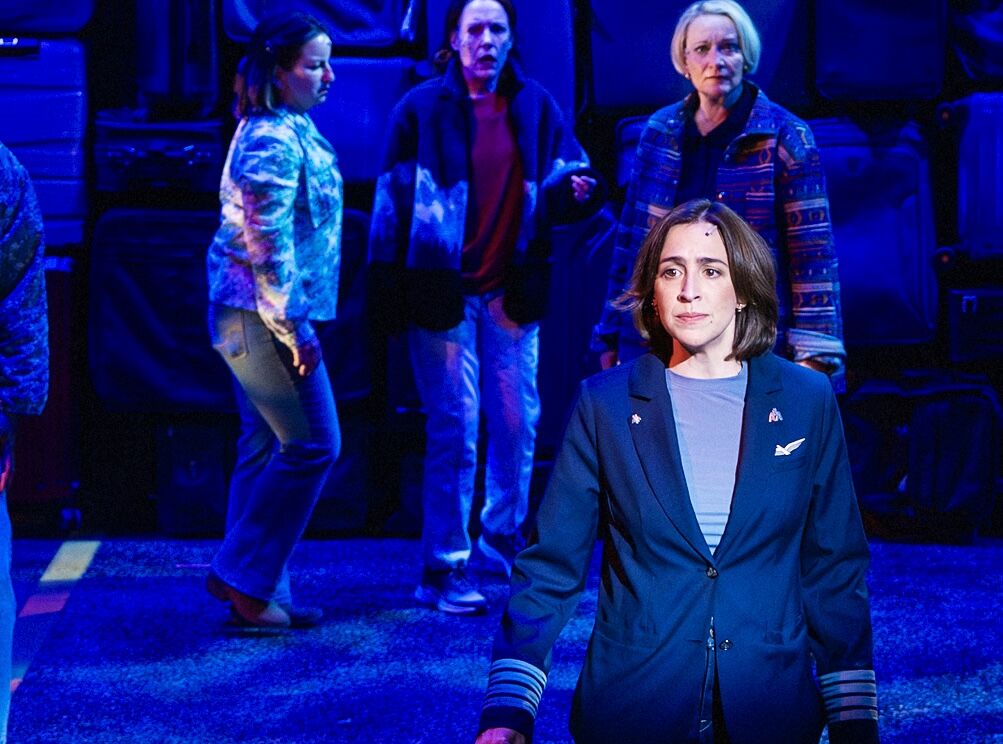
Beverley Bass and Kelsey Crismon: One navigated the plane on 9/11, the other now steers the story on the Arvada Center stage
When you hear about the celebrated Broadway musical “Come From Away,” you might naturally assume it is the story of 9/11.
Well, this is your captain speaking: “It is the story of 9/12,” says trailblazing American Airlines pilot Beverley Bass. “It is a celebration of the best in humankind.”
Bass should know. She was the pilot of a commercial flight that was diverted to the island of Newfoundland in the immediate aftermath of the attacks on America. The writers eventually chose to make Bass’ story a central part of their uncommonly joyful musical that opened Friday at the Arvada Center. It is the first homegrown staging by any Denver theater company, and the advance buzz has been supersonic.
“It is such a happy show,” Bass told me – which might seem incomprehensible to anyone who doesn’t know the magical story of the tiny town of Gander’s outsized role in the global tragedy.
But first, our story today. It’s about two pilots (of a kind): Bass, now 74 and retired, who made history as the first female captain at American Airlines back in October 1986, when she was 34. And Kelsey Crismon, the Denver actor and mom who is piloting the Arvada Center’s staging of the musical by playing Bass herself.
“I am so enamored and deeply inspired by her resiliency in the face of adversity,” Crismon said of Bass.
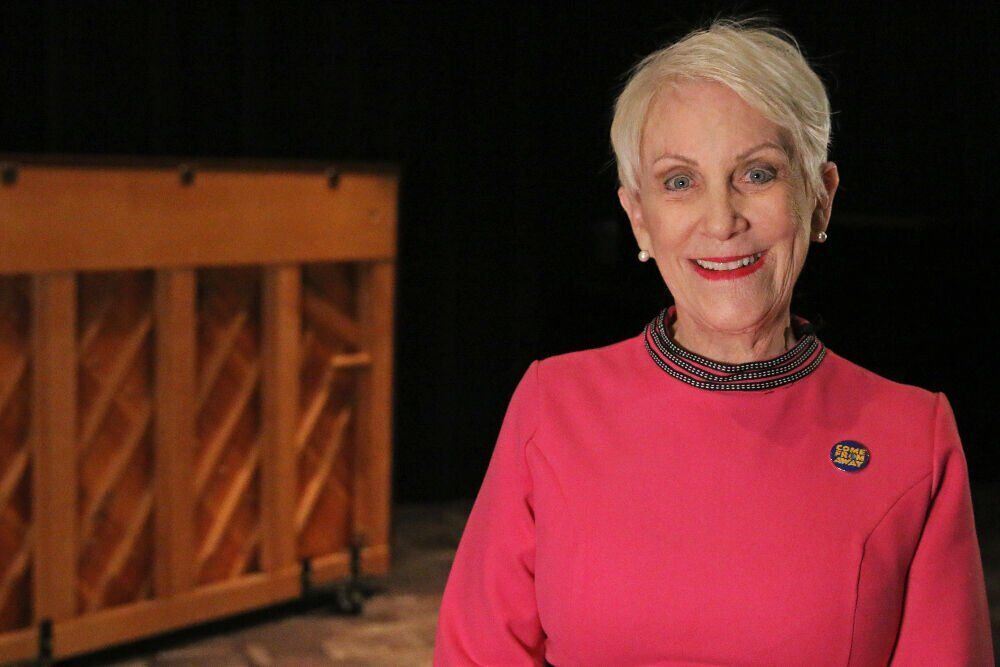
How it all began
On one of the most horrible days in human history, Bass landed her Boeing 777 in what she calls “the most peaceful place on Earth.” That was not at her intended destination of Dallas. It was in the tiny Canadian town of Gander, 3,000 miles to the east.
For Bass, Sept. 11, 2001, began “as an extraordinarily beautiful morning” in Paris. She was uneventfully carrying 158 passengers 35,000 feet above the Atlantic Ocean with her feet propped up on the dash when she got the call that an airplane had hit the World Trade Center in New York.
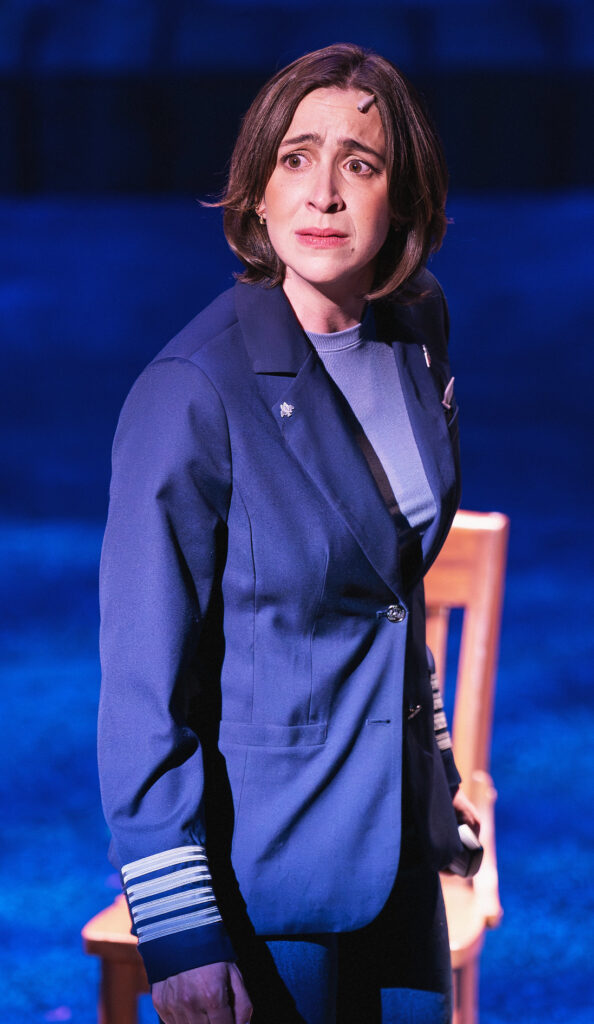
“We have an air-to-air frequency that all pilots are required to monitor over international waters, because we’re out of range of air-traffic control,” Bass said. “It’s a frequency where we just kind of chit-chat with each other over flight-related things.
“It was on that frequency that one of the other pilots said that an airplane had hit the World Trade Center. We thought it must have been a light airplane, but we also knew the weather was great in New York – so we couldn’t imagine why that would happen. You’d never dream it would be an airliner. That just wouldn’t even cross our minds.”
Concern turned to alarm 20 minutes later when the second tower was hit – and with that, the word “terrorism.”
“Things became very different at that time, obviously, in our cockpit,” Bass said.
“U.S. airspace was immediately closed, and that’s when we went into planning mode for a diversion.”
Bass assumed she would be sent to one of the major cities in Canada. There was enough fuel for the plane to get to Toronto, Montreal, Calgary or Edmonton.
Instead, 38 U.S.-bound commercial pilots were ordered to land in Gander to wait out the confusion – and to do it as quickly as possible.
Most pilots go their entire careers without ever landing in Gander, which is called “The “Crossroads of the World” for its strategic place on the globe. But all pilots know that an order to divert to Gander can mean only one thing, Bass said: An emergency is unfolding somewhere.
Within three hours, this remote aviation town of 9,000 was joined by nearly 7,000 involuntary visitors who would need to be clothed, housed and fed for the next five days. What happened next became the basis for “Come From Away.”
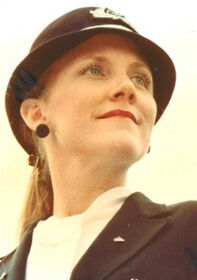
Bass was the 36th of 38 pilots to land at Gander. She lagged because, for her, landing so much earlier than planned came with a dicey dilemma.
“The reason I was so late is that I was a little bit overweight for landing,” she said. “I elected to jettison 7,000 pounds of fuel so that when we landed, we would be touching down at our appropriate landing weight. But I also didn’t know how much fuel would be available in Gander whenever we did leave. So I was wrestling with: ‘Do I land overweight – or do I jettison the fuel?”
She jettisoned the fuel.
Little did she know when she touched down at 10 a.m. after eight hours in the air that no one would be allowed off her plane for another 19 hours because there was simply no place for them to go. And because cell phones were not yet prevalent, no one knew the full extent of what was happening in New York. Some, Bass said, must have assumed World War III had broken out. The cockpit crew stayed awake all night listening to the news. The only feed they were able to get was the BBC.
“It was just a very, very hard night,” she said.
But when they finally got off the plane at 7:30 the next morning, Gander revealed itself to be a kind of Brigadoon.
“I can still remember walking into the terminal and just seeing it lined with tables and tables and food,” Bass said. “The people of Gander had stayed up literally all night cooking. It was incredible.”
This spontaneous relief effort was called Operation Yellow Ribbon. Because passengers were not allowed to access their luggage, Gander residents had brought diapers and baby formula to the airport. They filled 2,000 prescriptions. They brought inhalers and insulin needles and anything else they thought might be needed. Local merchants cleared their shelves without taking inventory. Gander is a town with only 500 motel rooms, so residents took strangers back to their homes to shower. One local veterinarian took charge of feeding the hundreds of animals that were locked away in airplane cargo holds.
Bass does not consider herself a specifically religious person, but she considers Gander to be a holy place. She and her husband, Tom Stawicki, have been back at least five times, and they seriously considered moving there permanently after they attended a massive 10-year reunion in 2011.

Squaring yourself with history
A month after earning her wings at American Airlines in 1986, Bass led the first all-female crew in the history of commercial jet aviation on a flight from Washington D.C. to Dallas. Still, she does not consider herself a pioneer. She considers herself a pilot.
She has ever since she was 4, when she saw a statue of Icarus in her hometown of Fort Myers, Fla. At 8, Bass’ aunt would take Beverley out to the airport at night just to watch the landing lights. At 16, she begged her father to let her take flying lessons, but he wanted her to focus on the family horse trade. So when she turned 18, she signed up for flying lessons herself. “When I came home from my first lesson, I walked into the house and told my parents I’ll fly for the rest of my life,” she said. And she has.
At the time, Bass didn’t even know what a glass ceiling was.
“I wasn’t part of the women’s movement,” she said. “I wasn’t part of the Gloria Steinem crowd. I wasn’t trying to break barriers. I was just following my passion. And my passion was to fly the biggest airplanes I could fly.”
But at the time, Bass had few role models. “Most of the time when women put applications in to the airlines, they were simply rejected,” she said. Until 1976, when Bass became the third female pilot ever hired by American Airlines.
“They had 10,000 applications for pilots that year, and they hired 87,” she said. “You had to be qualified, or you weren’t going to be part of the group.”
In the five days Bass was grounded in Gander, her Boeing 777 and others began to sink into runway asphalt that was never intended to bear so much weight. A hurricane was approaching. When it was all over, Bass was eager to return to the skies.
“I never once thought about not flying again,” she said. “I was not going to let that event ruin what I have loved so much for my whole life. And it never, ever affected me on any of my flights afterward.”
She said she did not have lingering anger issues that terrorists used the planes she loves as killing machines. “But what did happen to me is for 90 nights I woke up in the middle of every night, hoping it wasn’t true,” she said. “Thinking: ‘Please. This did not happen.’ And then, after three months … I was OK. I don’t know why.”
What has helped since, she says like the proud groupie she is, has been “Come From Away,” which Bass has seen in performance more than 180 times.
“It is such a happy show,” she said. “The story wouldn’t exist without the events of 9/11, but it was really written about the kindness and generosity that was bestowed upon us when we descended into the beautiful town of Gander.”
It was how Bass comported herself there, as much as anything, that has Crismon most enamored with her real-life counterpart.
“It’s not just knowing what she went through to not only become the first female captain with an all-female crew,” Crismon said. “But to also then be put in a terrifying position where she’s in charge of the safety of all those people on her plane? It’s hard to imagine.
“As an actor, what I can pull from all that is this certain drive and unwillingness to quit in the face of deep tragedy and fear of the unknown.”
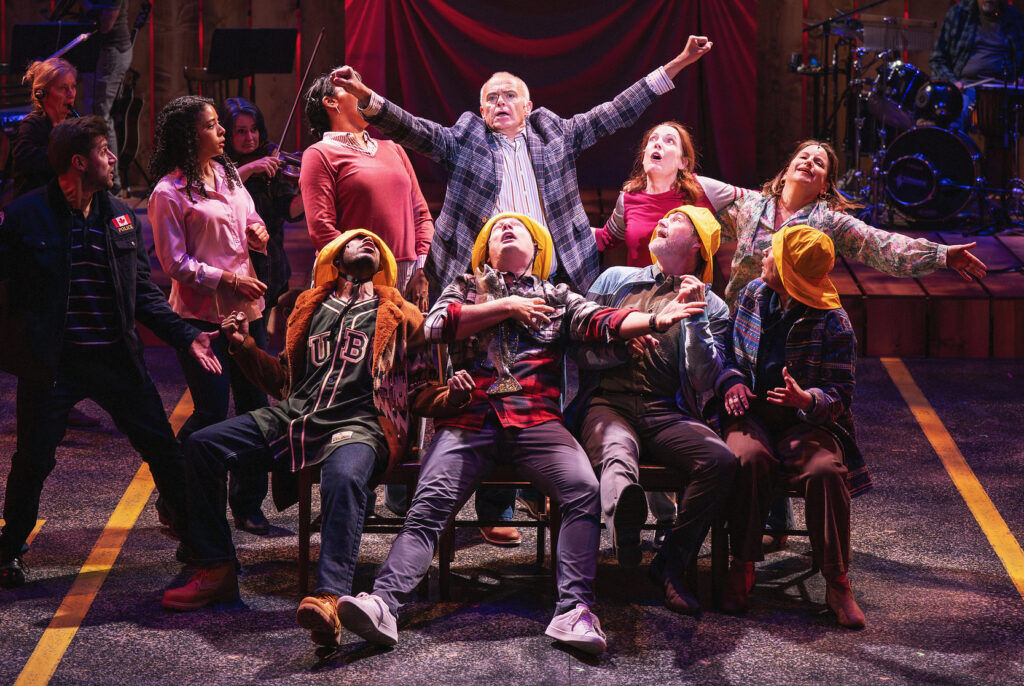
What’s in a name?
“Come From Away.”
It’s a common expression in parts of Atlantic Canada – a three-word noun that describes a visitor, a newcomer or anyone not born in that region. It refers to people who are from “away,” essentially identifying anyone who is not a local as a kind of welcome stranger.
But those same three words can be read as an imperative: A command that Bass says the entire world needs to hear right now: “Come from away!”
Put another way: “Come toward here!” Or, as the Beatles might say more simply: “Come Together.”
That’s what this musical aspires to. Think of it as disparate humans coming together and catching a connecting flight of the soul.
“This musical is so good,” Crismon said. “It lends itself to give you moments of breath, moments of laughter, moments of ease. And then it pairs it up with true moments of raw and authentic grief, because that is the actual human experience. And so, to me, if you’re someone who is feeling numb, if you are feeling alone, you need to come and see this show. You will be immediately reminded that there are people who are just waiting to be there for you.”
The world was a scary place on 9/11. It was scary in 2020. It’s scary now, which strangely continues to keep “Come From Away” relevant. Crismon recalls when celebrated Arvada Center director Kenny Moten gathered the cast to talk about it.
“One thing that everyone agreed on is that we are hoping audiences feel that same radical hospitality that was shown to all those who landed in Gander during a time when all of the world was listening and all of the world was hurting – which is something that’s happening right now.
“I personally hope that people walk out of this musical with more of a desire to extend themselves to others with grace, with humility – and to remember what humanity actually looks like. With a new desire to treat others as our neighbors, no matter their background, their heritage or their color.”
What the show has taught Bass is simple: It doesn’t take much to be kind to one another.
“One of my favorite lines from the show comes when one of the passengers — his name is Bob — has come home from Gander,” Bass said.
“His father asks, ‘How were you when you were stranded?’ And Bob says, ‘How do I tell him? Not only was I OK. … I was so much better.’”
Denver Gazette Senior Arts Journalist John Moore interviewed Beverley Bass in 2018 and first reported it for the Denver Center’s NewsCenter at the time of the first national touring production of “Come From Away.” He interviewed Kelsey Crismon on March 25. Email him at [email protected].
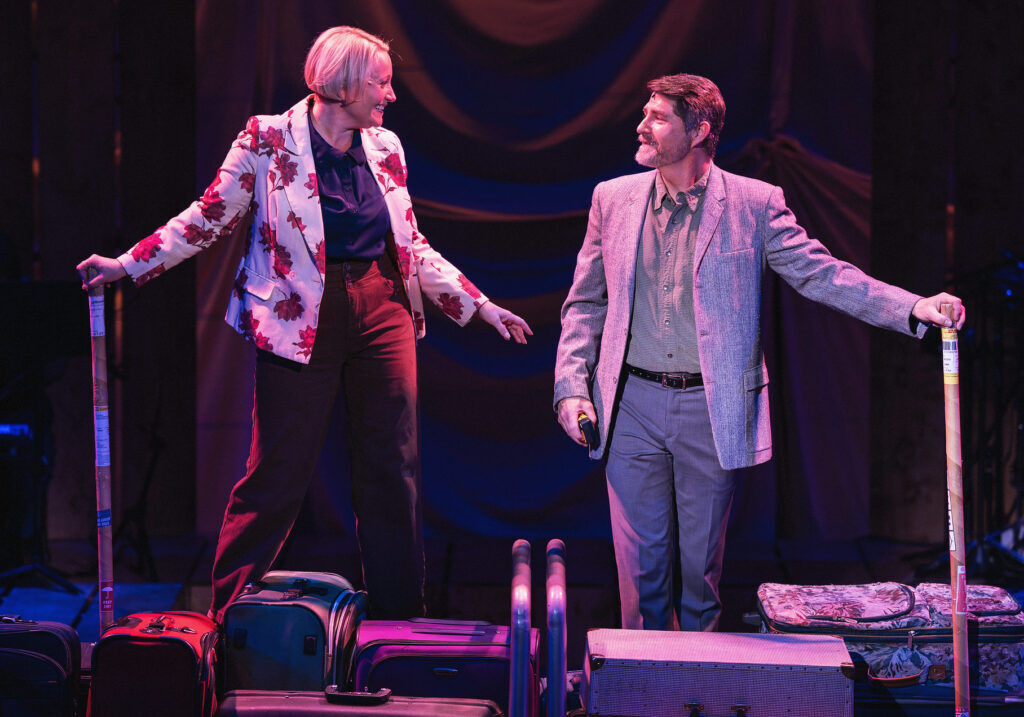
‘Come From Away’
- What: Broadway musical
- Presented by: The Arvada Center, 6901 Wadsworth Blvd.
- Directed by: Kenny Moten
- Featuring: Kelsey Crismon, Colin Alexander, Jake Bell, Randy Chalmers, Ralph Prentice Daniel, Nicole deBree, Elizabeth Harlen, Mary McGroary, Justin Milner, Jeremy Rill, Megan Van De Hey and Sharon Kay White
- When: Through May 10
- Run time: 1 hour, 45 minutes with no intermission
- Tickets: Start at $60
- Info: 720-898-7200 or arvadacenter.org