







Five years from the fall of Afghanistan: A refugee’s plight
Danger was never far away.
“The International Assistance Mission told us two days before the Taliban were coming to the city,” Fatima H. said. “The next day, after the Taliban took over Kabul, it was horrible just to leave the house for grocery shopping, especially the people who were working with USAID or the military.”
For a decade, Fatima, whose last name is being withheld because of her fear of repercussions, had worked with the Joint Development Association International (JDAI) based out of Grand Junction and then at the International Assistance Mission (IAM).
JDAI, which closed in 2019, was a non-profit that supported local solutions to community development, education, health, agriculture and economic growth. Fatima worked with internal refugees, with livestock development, and as an emissary for emotional resilience and hygiene education. She was well-known in Afghanistan for her work.
“As a woman who collaborated with the United States it was even more dangerous,” Fatima said. “We’d stepped over their Islamic rules.”
Fatima traveled to rural areas across Afghanistan, beyond the reaches of clinics, to teach women about pregnancy and how to care for the medical needs of their newborns and older children.
Once it became clear that the Taliban would control Afghanistan when the United States withdrew its forces, the JDAI chairman, Bob Hedlund, worked to get all of their Afghan partners out of the country, including the legal documents necessary for resettlement in the United States.
On Aug. 26, 2021, Fatima and her family were making their second attempt to reach Hamid Karzai International Airport in Kabul. Fatima received a text to turn back. The family only narrowly missed the suicide bombing at the Abbey Gate that killed 169 Afghan civilians and 13 members of the U.S. military. It wasn’t until that October that Fatima and her family were able to fly out of Mazar-i-Sharif to Abu Dhabi. For the next year and a half they remained in a U.S. refugee camp.
“After I fled, the Taliban threw my brother out of my house and searched it and the garden looking for documents. Before I left, I scanned and burned them all so I could keep my photo from the Taliban.”
Finally in December 2022 Fatima, her husband, and children arrived in Grand Junction. Prior to their arrival, Cody Kennedy of the Grand Valley Resettlement Program (GVRP) was frantically trying to find a home for the large family. No one would rent to them. So, Kennedy reached out to a fellow member of Monument Presbyterian Church, businesswoman Christina Shultz.
“There was something about the situation falling apart in Afghanistan,” said Christina Shultz. “This was one concrete thing I could do to help the situation. I had some money saved that I had thought about investing in a small business … I called my realtor on a Sunday and on the Thursday, I had an offer in.”
With her savings, and money borrowed from her parents, Schultz could offer the home at a rent Fatima’s family could afford. With the partnership of Vineyard Church, it was completely furnished by the time the family arrived.
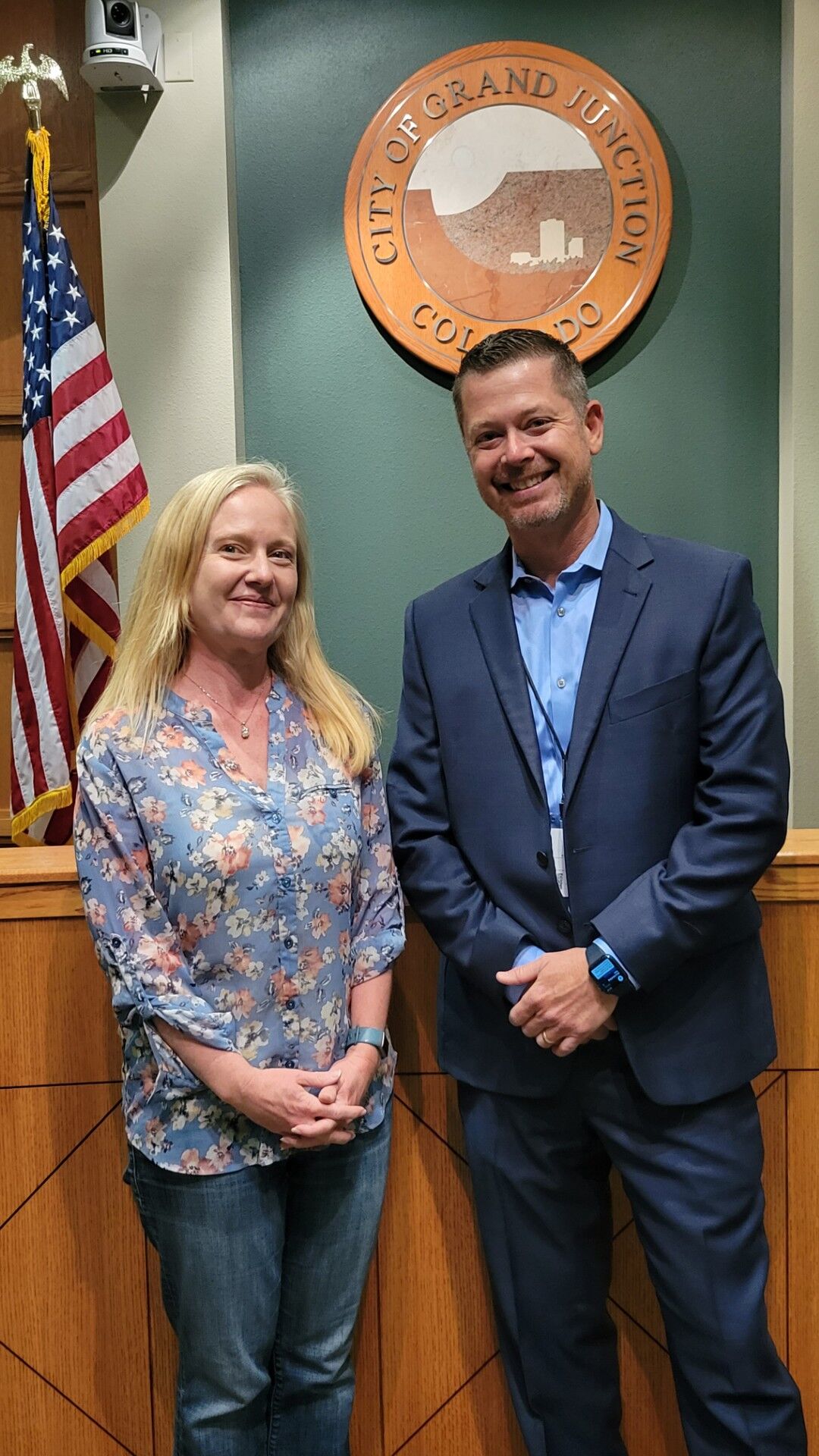
The GVRP helped not only the Fatima’s family, but in total 70 other Afghan refugees. Volunteers helped with everything — from obtaining driver’s licenses to finding grocery stores to navigating the U.S. bureaucracy. Cody Kennedy, now the mayor of Grand Junction, with his background in real estate, volunteered for the GVRP’s housing coordinator role.
The families were connected with a local church. The churches furnished the homes entirely and the pantries were stocked with culturally appropriate food.
“I wanted their first moment in Grand Junction to feel like a real welcome,” Kennedy said. “I actually had several families live in properties of mine when they were available, and it was a genuinely great experience. I was also able to help one of the fathers connect with a job at our local police department.”
One week after she arrived in Grand Junction, Fatima and Christina were able to meet.
“It was amazing and beautiful,” Fatima said. “By her generosity, we had a home where we could settle. I have so much appreciation for those helping us in the beginning. I knew who I should call and where I could go.”
As much support as Schultz, Kennedy, and the GVRP gave, Fatima said it was difficult in Grand Junction. The Muslim community was infinitesimally small. Fatima felt out of place in her headscarf and with her strong Afghani accent. It was hard for the family to find a community.
After two and a half years, Fatima had an opportunity to move to Denver, one she took, with its opportunity to settle into a larger Muslim community in Colorado’s capital.
With her work permit Fatima found a job as a custodian in a school. She worked hard, and she is currently a paraprofessional helping students with special needs.
She’d submitted her green card application in December 2023. Her immigration attorney, Linda Vuing of Lutheran Family Service, told Fatima it might take as long as 18 months.
But then on December 2, 2025, the U.S. Citizen and Immigration Services announced that citizens of 19 countries labeled high risk would have their applications for green cards put on hold. On January 21 this year, the Department of State paused all visa issuances to immigrant visa applicants for 75 countries.
“My work visa expired in September of last year,” Fatima said. “I don’t have any legal documentation now except for my green card application. If I can’t work how do I support my family? I am praying because the stress causes so much depression.”
A U.S. State Department press release dated Feb. 2 said the department was “undergoing a full review of all screening and vetting policies to ensure that immigrants from high-risk countries do not unlawfully utilize welfare in the United States or become a public charge.”
The immigration changes came in the wake of the shooting of two National Guard troops during Thanksgiving week last year. One National Guard soldier was killed, while the other was wounded in the shooting near the White House. After the shooting, the administration announced a flurry of decisions to scrutinize immigrants already in the country and those seeking to come to the U.S.
The suspect in the shooting, an Afghan national, had worked in a special Afghan Army unit known as a Zero Unit. The units were backed by the CIA. He entered the United States in 2021 through Operation Allies Welcome, a program that evacuated and resettled tens of thousands of Afghans after the American withdrawal. Many had worked alongside U.S. troops and diplomats.
The Afghan man had been unraveling for years, unable to hold a job and flipping between long, lightless stretches of isolation and taking sudden weekslong cross-country drives. His behavior deteriorated so sharply that a community advocate reached out to a refugee organization for help, fearing he was becoming suicidal, according to the Associated Press.
Grand Junction’s Schultz said Fatima has “always wanted to be independent — even when she got promoted with a $2 raise that meant she couldn’t have SNAP benefits anymore.”
Kennedy said that the families who came to Grand Junction did everything right, from their paperwork to the yearlong vetting process during which they waited in refugee camps.
“What I hope is that the people already here, people who followed the rules, who are working, raising their kids in our schools, contributing to this community, are treated with the same care and integrity that brought them here in the first place,” Kennedy said. “A security review and their stability are not mutually exclusive. We can do both.”
Fatima can only legally work until September 2026 and the stepped up ICE immigration enforcement has left her nervous again to be so visibly different. For Fatima, depression and anxiety are never far away. No matter the barriers to work or obtaining a green card, she cannot see any other road but staying in the U.S.
“It was my country, my language,” Fatima said as her voice dropped. “But I can’t imagine ever being able to go home. It’s impossible.”
The Associated Press contributed to this article.