Famed sci-fi writer Robert Heinlein designed his Colorado Springs bomb shelter house

Young Robert Anson Heinlein was a Navy man, graduating from Annapolis and becoming a naval officer. But that’s not what made him famous, as he went on to be called a “dean of science fiction writers” and a politically controversial one at that.
His military career was sidelined in 1933 when he was seriously ill aboard a Navy destroyer. Hit with pulmonary tuberculosis, he was retired in 1934 as totally disabled.
After a tiny, unsuccessful attempt at a political career in California, he wrote his first science fiction stories in 1939. In wartime 1941, a friend from the Navy helped him find a job as a civilian engineer in charge of the Materials Laboratory at the Naval Air Experimental Station at Mustin Field, near Philadelphia. Tedious work for sure, he admitted, but it was a time when he married the first of three wives.
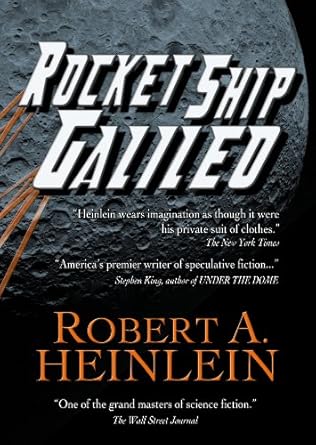
Published accounts of Heinlein’s career noted his early love of astronomy and space exploration, and he demanded scientific accuracy in his writing of fiction, fantasy fiction and nonfiction. There was acclaim for his “Future History” series and top works “Rocket Ship Galileo,” “The Puppet Masters,” “Double Star,” “Starship Troopers,” “Stranger in a Strange Land” and “The Moon is a Harsh Mistress.”
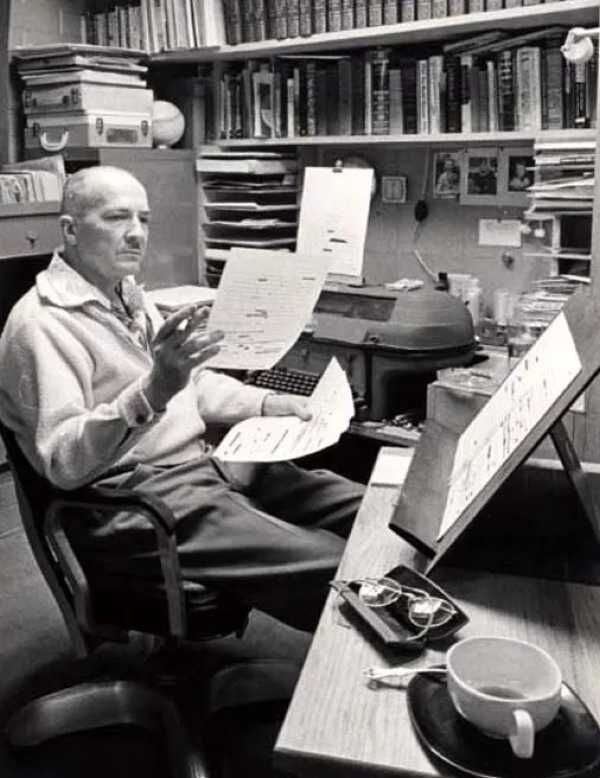
Heinlein, an advocate of social critique, social issues and individual liberty, was one of the “Big Three” of science fiction, along with Arthur C. Clarke and Isaac Asimov.

When it came to individual liberty, Heinlein’s biographer William H. Patterson Jr., wrote that “by 1930, Heinlein was a progressive liberal who had spent some time in the open sexuality climate of New York’s Jazz Age Greenwich Village.” He was a nudist. His political beliefs were pro-socialism, and he pointed out in many interviews that he was a Libertarian. As years went along, Patterson wrote, Heinlein believed that “a strong world government was the only way to avoid mutual nuclear annihilation.”
On the personal side, engineer Heinlein was divorcing wife number two as he spent 1948 making secret plans with future wife number three, Virginia Gerstenfeld. She was a chemical engineer and shared his understanding of science and love of science fiction themes. They had met when they worked at the Naval Shipyard in Pennsylvania. Both had continued separate higher education in California. Heinlein was busy writing and being published.
Enter the Heinlein Colorado Springs connection. He came to town in September 1948 because he was reported to believe he could escape the nuclear fears of those Russian Cold War years on America’s coasts and Colorado was safely in the middle. In “Fresh Starts,” he describes finding a furnished rental at 1313 Cheyenne Boulevard and purchasing a special love gift for Virginia, or “Ginny.” It was a piano, a Wurlitzer spinet, replacing one she had to sell before the move. He also got her a cat.
Heinlein, in “Fresh Starts,” said of the couple’s “masquerade” about their relationship: “I’ve acquired the habit of keeping silent about my private life …” Ginny flew to Denver, came to the rental, and they moved in together.
Even living quietly, they had neighbors and “the announcement (of their marriage) would appear in the local newspaper and everyone would know they had been ‘living in sin’ for the last weeks” until his divorce was final and the marriage publicly legitimate. They drove to Raton, N.M., for an immediate ceremony by a justice of the peace. The couple enjoyed traveling, and Ginny ice skated at The Broadmoor.
By 1950-51, the couple chose a luxurious area being developed near the Broadmoor Hotel for their original-design home filled with features so creative they were featured in a large story, “A Home to Make Life Easy,” in the 1952 Popular Mechanics magazine issue “House of the Future.” Some features found in today’s homes can be spotted in the Heinlein home: video doorbells, higher and handy power outlets, vents to warm floors and much more.
Stories about the incredible one-story Frank Lloyd Wright-style home and its Heinlein-selected 1776 street number have lived through the years, but what is almost always mentioned first is its huge bomb shelter underneath the house.
The fact is, because of the threat of nuclear war everywhere, there were and are fallout shelters throughout the Colorado Springs area and the state. Building permits for fallout shelters weren’t required at that time. Back then, schoolchildren practiced drills sheltering under their desks in case of a Cold War Russian attack, or even a hailstorm or tornado. And everyone could recognize the yellow and black shelter signs. Today, the shelters are often food pantries, wine cellars, extra rooms or even stocked for safety during weather alerts.
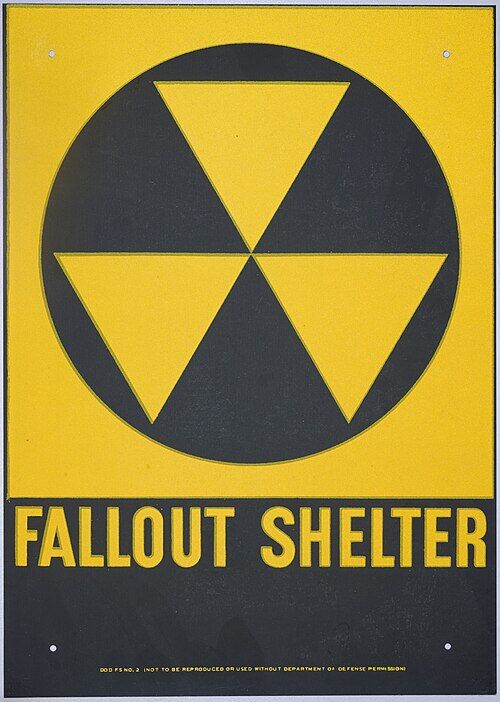
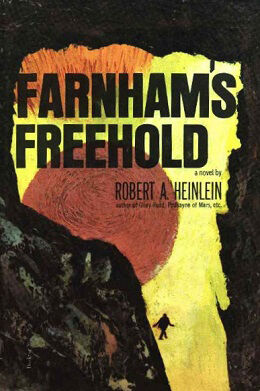
The Heinlein bomb shelter is a feature in one of his least popular books, “Farnham’s Freehold,” when a nuclear bomb hits and the shelter and the family inside are blasted into a horrible future. Critics weren’t kind about this book with its sexual slavery, cannibalism, child slaughter and other ugly subjects.
For those curious about driving by the original Heinlein house for a look-see, be aware it no longer exists, no matter what is online or on For Sale signs. It is a completely different residence, possibly sold twice. Some reports state that it was demolished, but others say there were expansions, remodeling and the addition of a second floor, leaving little of the Heinlein design. The fallout shelter apparently remains, but there are others in many homes built during the 1950s-60s.
In The Heinlein Society, author Patterson wrote that by 1965, the Heinleins needed to sell their house and move, particularly because of ongoing altitude-related health issues. They had also outgrown the house.
The original rationale for choosing Colorado – to be away from nuclear targets and out of fallout drift patterns – was long gone. In 1957, the North American Air Defense Command (NORAD) set up its headquarters to correlate data from the Arctic Distant Early Warning (DEW) line at nearby Ent Air Force Base. Then the Air Force opened the U.S. Air Academy nearby, and, to put a cap on it, NORAD was building into Cheyenne Mountain, virtually in Heinlein’s backyard, with construction scheduled to be completed in 1966.
Colorado Springs had become the No. 1 nuclear target in the U.S. – a fact Heinlein’s friends lost no opportunity to rib him about. Heinlein took his revenge by pounding Cheyenne Mountain flat in “The Moon Is a Harsh Mistress.'”
The couple headed for the West Coast and designed and built an ultra-modern circular home in the wooded Bonny Doon area near Santa Cruz, Calif., followed by a home in Carmel when Heinlein’s health was a problem. They continued their travels to much of the globe, including Antarctica.
His final novel, “To Sail Beyond the Sunset,” was published by Putnam on his 80th birthday, June 7, 1987.
Heinlein’s health worsened steadily, and he died during his morning nap on May 8, 1988. After cremation, his ashes were scattered in the ocean from the deck of a warship.
The nonprofit Heinlein Society is run by volunteers and “dedicated to Heinlein’s principle of Pay It Forward.”