







Nextdoor app users more likely to support aggressive policing, study finds

A recent study shows that people who use the social media app Nextdoor frequently are more likely to support aggressive policing.
The study, by the University of Colorado Boulder, also looked at how much has changed in how people interact with the world around them — now more ever through a cell phone or computer screen.
Toby Hopp and Patrick Ferrucci, professors at CU Boulder’s College of Communication, Media, Design, and Information, authored the report.
They approached the topic by questioning how Nextdoor informs the way people think about their communities and their neighbors.
A finding, according to the study, is that “people who use Nextdoor are more likely to be concerned about crime.”
The authors hypothesized that crime concern would be positively related to support for aggressive policing. Out of the three hypotheses they approached the study with, this was the only one confirmed by their experiment.
An important note is that the study is not “causally identified,” meaning it cannot determine the extent that Nextdoor causes people to be concerned with crime.
The study does conclude that there is at least a connection between Nextdoor users and a heightened concern for crime.
The data is drawn from 1,806 responses to an online survey conducted in 2023, in which the researchers asked how often the participants engaged with or created content on Nextdoor.
They also asked questions relating to social trust, crime concern, and support for aggressive policing on a rising scale of 1 to 7, according to the study. For instance, they asked “How supportive are you of the police stopping and frisking people who look out of place?” and “How concerned are you that you or someone close to you will be the victim of a violent crime?”
The questions surrounding the policing were not developed with any specific group or police department in mind, Hopp told The Denver Gazette. He said that the study is joining a debate as old as America itself.
The specific focus of the questions were “policing tactics that have constitutional implications,” Hopp said, as well as issues within recent public debate, citing concerns regarding the type of weapons local police departments use.
“We have seen concerns arising in the post-Iraq war period regarding the ‘recycled’ use of weapons designed for warzones,” Hopp said, “along with the ongoing debates around appropriate uses of police force and how police departments engage with minoritized populations.”
Most recently, the conversation surrounding aggressive policing centers on ICE’s policing strategy in large cities like Minneapolis.
While the authors maintain that there is evidence Nextdoor can create “productive relationships” and overall positive social interaction, “the omnipresence of crime information on Nextdoor” might contribute to social fear, the authors argue.
What makes Nextdoor unique is “geofencing,” which means that users only see posts from the people around their physical vicinity. Geofencing plays into how users perceive crime and community, and the authors mentioned that users can tend to use the app for surveillance purposes, according to the study.
The authors said their research is dedicated to understanding how social media produces the mental models we use to make decisions, whether it be about voting, or in this case, thoughts surrounding policing policies.
Nextdoor operates without journalistic norms, leading to posts about suspicious cars parked on the block or a person who looks out of place flooding the platform, according to Hopp.
“That’s not to say that some of those reports may not be true, but rather, they are not subjected to the same sort of scrutiny that we might do in a journalistic realm,” he said. “Now, that’s not to say that news is always perfect, but generally speaking, professional journalists have some norms that they build into their work processes, meaning that we verify to the best of our ability that something’s true.”
The study documents a cultural shift that has occurred over the past two decades as social media becomes more prevalent for the general function of society.
Before social media and the internet existed, people learned about the world in a much different way, Hopp told The Denver Gazette.
“For quite a long time, we relied on the mass media. Think about newspapers, radio shows, television shows. Those things still exist. But now that we’re in this digital world, we oftentimes use things like social media to make sense of the world around us,” Hopp said.
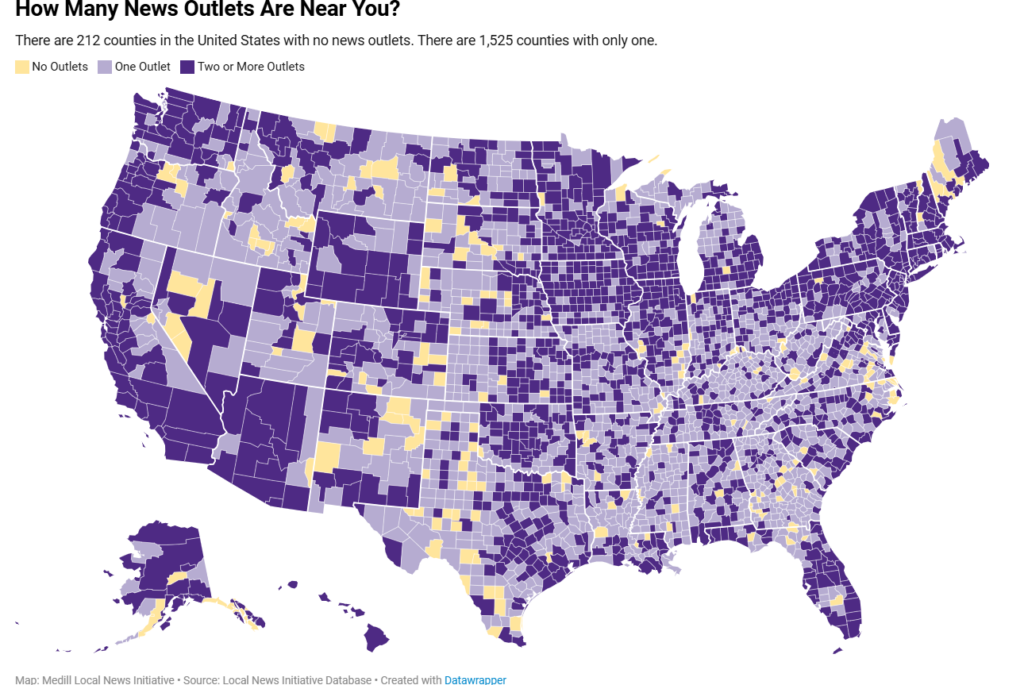
In the past two decades, almost 40% of local U.S. newspapers have disappeared and continue to at a steady rate, 148 closing or merging in 2025 alone, according to an annual report from Northwestern Local News Initiative.
The disappearance of local news sources has created “news deserts,” or “areas with extremely limited access to local news,” and 212 counties in America have no local news representation whatsoever, according the report.
One of Hopp and Ferrucci’s hypotheses — that a low level of social trust would result in a higher concern for crime and likelihood to support aggressive policing — was proven wrong. In fact, it is the people with high social trust that were more likely to scan Nextdoor for information about social disorder.
The study found that Nextdoor users who were worried about crime trusted the reports they saw on social media because of their higher levels of social trust, Hopp explained.
“I think when we think about our communities, of course we need to trust one another. Because when we trust one another, we can collaborate and communicate with each other in productive and respectful ways,” Hopp said. “But obviously, trust is complicated.”
The study focuses on how people develop mental models of the world, and this relates directly to perception of others and the world around us, specifically how that can change when the method of connection changes.
People might find certain policing strategies acceptable in another community, but not in their own because of the distance they have when thinking about another place, Hopp said.
“There might be someone who lives in a rural area who has a certain mental image of what life is like in more urban areas, and may endorse certain police strategies in those areas which they may perceive as sort of ‘crime-plagued’ that they wouldn’t endorse in their own community,” he said.