







The hidden story behind Lake Powell’s low water levels reveals a canyon coming back to life
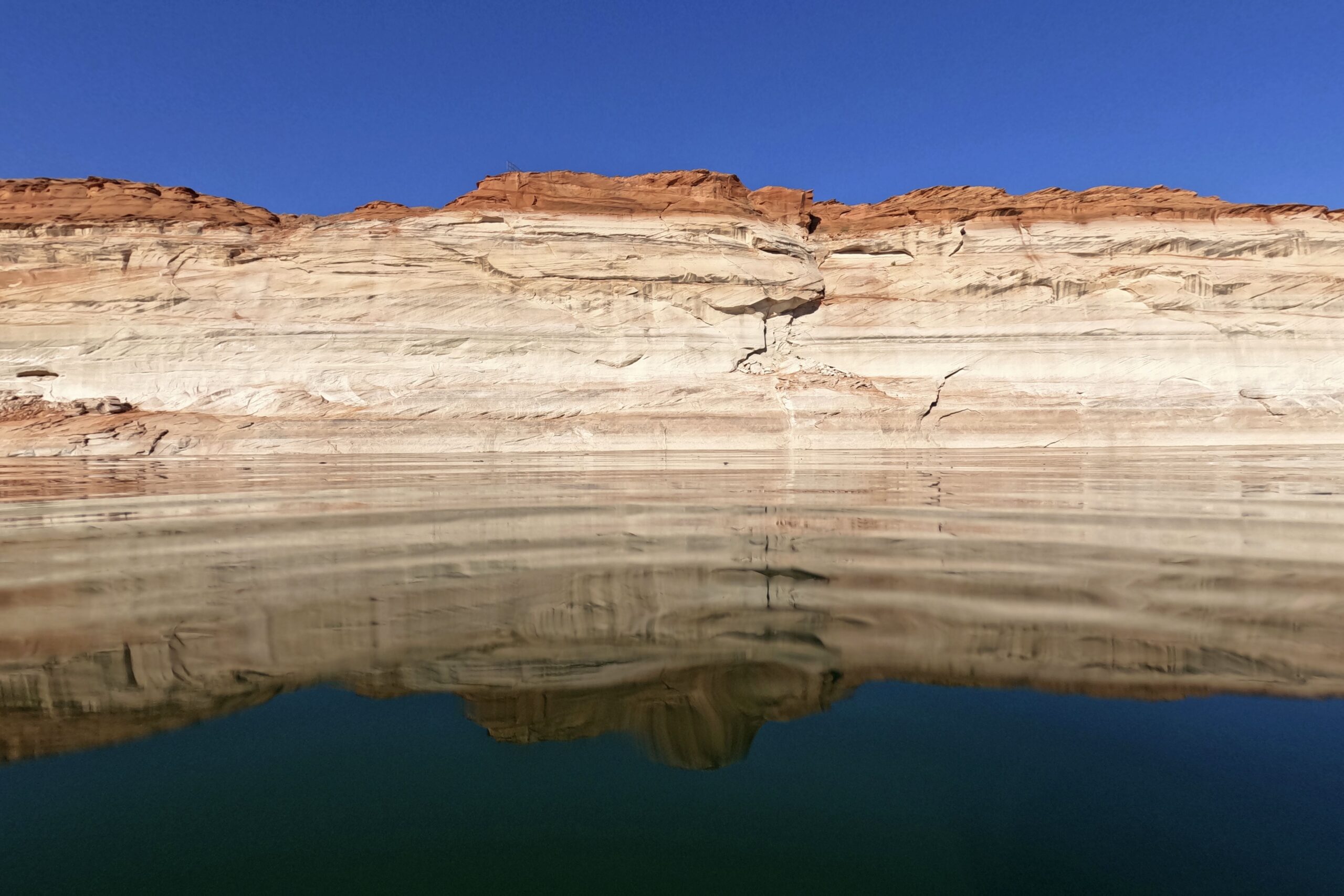
The Colorado River Basin is often described in terms of crisis — drought, climate change and failed water‑sharing talks. Yet beneath Lake Powell’s retreating shoreline, Glen Canyon is quietly experiencing one of the largest natural restorations in the river’s history.
The focus on the Colorado River has centered on the historic drought and the effects of climate change, which are reducing the river’s ability to supply water to seven states, Mexico, and the 40 million people and businesses that depend on it. Attention has also turned to the failed negotiations over how the river should be managed once the current operating guidelines expire later this year.
Lake Powell’s elevation this week is just under 3,528 feet above sea level — 31.7 feet lower than at this time last year. That leaves the reservoir about 158 feet above “dead pool,” the 3,370‑foot threshold at which Glen Canyon Dam can no longer generate hydropower.
Lake Powell was formed in the 1960s with the construction of Glen Canyon Dam.
But there’s another story unfolding along the river: what has happened to Glen Canyon — in the river itself, in the surrounding habitat, and across the newly exposed landscapes — as Lake Powell’s levels have steadily declined since 1999, the last year the reservoir was full.
Zak Podmore, formerly of the Salt Lake Tribune, explores this transformation in his book Life After Dead Pool: Lake Powell’s Last Days and the Rebirth of the Colorado River, published last year.
Podmore described his experiences over the past 15 years, including multiple float trips through Glen Canyon and beneath Glen Canyon Dam. He spoke on Thursday at the annual Colorado River conference hosted by the Getches‑Wilkinson Center at the University of Colorado Law School.
The story he says is being overlooked is one of natural rebirth — a recovery that required no intervention, no funding, and no coordinated effort from states, the federal government or any of the usual players. Nature, left alone, began the work itself.
Even if Lake Powell hits dead pool, Podmore said, the lake would still stretch about 100 miles upstream into Glen Canyon, with millions of acre-feet of water. At 3,500 feet, it would stretch more than 120 miles into Glen Canyon, he explained.
Glen Canyon is one of the most beautiful canyons along the Colorado River, and would have been designated a national park had the dam not been built, he said. That includes more than 100 tributary canyons that feed into Glen Canyon with thousands of cultural sites, arches, waterfalls and pools.
More than 70% of those tributary streams are perennial, supporting grottoes and glens of cottonwood trees, cited by John Wesley Powell when he named it Glen Canyon in 1869, Podmore said.
There are competing visions of what Glen Canyon represents to the general public: those who see Lake Powell as a recreational destination and those who knew Glen Canyon before the dam was built.
Podmore began taking river trips in 2011, starting at the headwaters of the Green River in Wyoming, one of the Colorado River’s major tributaries.
That trip began in October, and by November, he and his companions had reached Lake Powell. They eventually continued all the way to the Gulf of California in Mexico, where the Colorado River ends.
The following year, his group launched from the river’s headwaters in Rocky Mountain National Park.
He’s continued to travel down the river and into the canyons since then.
“If you talked about what low water on Lake Powell meant to a lot of people in the conservation, river-running communities at that time, they would paint a little bit of an Eeyore-type picture,” Podmore explained. “It’s all mud flats.”
People will say, “We need to fill it back up so it can be nice again and that’s what Podmore thought of Lake Powell, even years after having spent time slowly crossing the lake but not exploring it.
That changed in 2021, on a trip with 25 scientists who studied how record-low levels in Lake Powell were affecting the formerly flooded areas.
Low water on Lake Powell isn’t only about the retreating bays that expose areas that were nice places for motorboats, he said. It’s also not about the sediment or the waterfalls that have formed because of river displacement.
“It’s about the habitat in the river sections that are coming back,” he said. Giant cottonwood trees have grown up in less than 15 years since this area was flooded. There’s a growth of native plant species that are crowding out invasive species, river otters, beavers and peregrine falcons.
Podmore said that since Lake Powell was last full, 42 miles of the Colorado River have reemerged and begun to recover, along with 47 miles of the San Juan River, one of its major tributaries. In addition, 143 miles of perennial and intermittent streams have returned and roughly 100,000 acres of land once submerged beneath the reservoir are now exposed.
Podmore hiked into one of the side canyons, where he said you can see distinct stages of ecological succession as you climb — essentially walking forward through time and observing how each area changes the longer it has to recover.
That meant paddling through forests of “ghost” cottonwood trees that were drowned by the lake 50 and 60 years ago.
“They’re still standing. They still have their bark. It’s an interesting and eerie experience,” he said.
He has also walked along the shrinking edge of the lake and into the canyons, moving through areas that have only recently been exposed as reservoir levels continue to fall. Tumbleweeds have taken hold in some of these newly uncovered zones. “It’s much more dense. It’s lush. There are cattails growing up under the ghost forests,” he said.
And the animals are coming back: beavers that swam across the lake into other canyons are building dams again.
“These are all areas that have recovered entirely since 2000,” Podmore said. “Sometimes the beavers are so prevalent it can be hard to walk without getting your feet wet. These are just lush green areas with water seemingly pouring out of the rocks everywhere in these springs.”
Podmore noted that Seth Arens, an ecologist with Western Water Assessment at the University of Utah and the University of Colorado, who is doing a five-year plant survey in the area, found that in canyon after canyon, after 15 or 20 years, the ecological recovery has almost been made indistinguishable from areas that never flooded.
Just above Lake Powell’s high water mark, at 3,700 feet, there is sometimes a greater density and diversity of native plants than in areas above that high water mark, Podmore said, because of the rich sediment deposited by Lake Powell.
Then there are the cultural resources that Podmore said are reemerging: ancestral Pueblan steps, rock imagery and pottery.
He added, “Archaeologists have found full baskets and sandals from a thousand or more years ago that have remained intact despite being underwater for decades.”
Even the bathtub “ring,” the first thing a lot of people think about when they think about low water on Lake Powell, is starting to heal, he said.
“We have a reservoir that’s at the center of the crisis on the Colorado River Basin. We have a lot of water that’s not realistically accessible in Lake Powell,” he said.
But “we have what might amount to the largest environmental restoration in the history of the Colorado River Basin, happening on its own, with very little active human intervention … and shown us that more restoration is possible if we give these areas a chance to continue their recovery,” he said.
“I don’t think we can write off these areas that have recovered in Glen Canyon as having no inherent value,” Podmore told the audience.
These areas have ecological, cultural, recreational and scenic value, he said. “There’s so much research left to be done to better understand what’s happening there, and how these areas are responding.”
“In the midst of crisis, there’s cause for celebration,” Podmore said.