







As a southern Colorado town evolves, a historic hotel is reborn
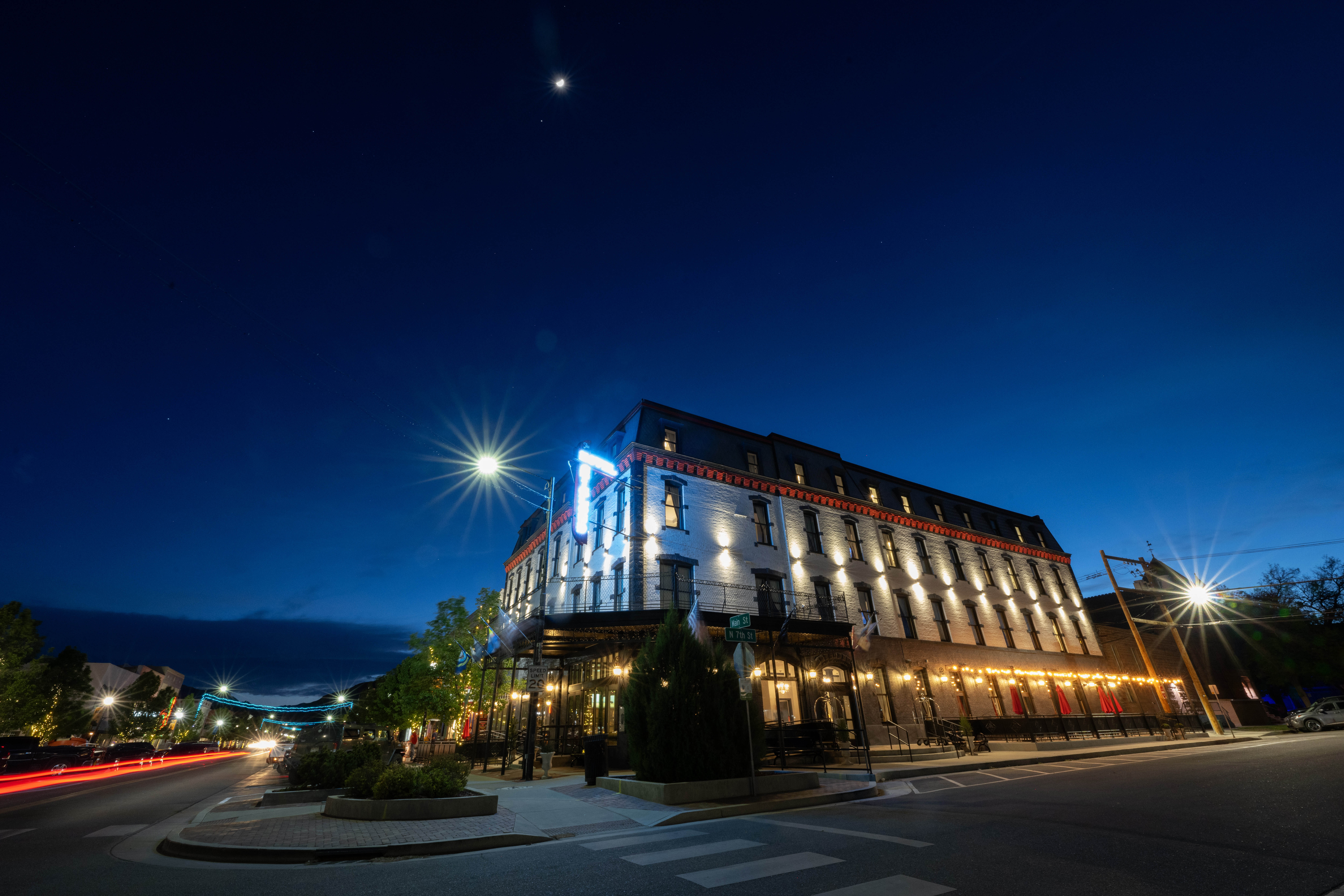
CAÑON CITY • Eight years ago, Stan Bullis stood here looking at the natural beauty: the mountains sought by hikers and bikers and rock climbers, the Royal Gorge and Arkansas River sought by boaters and anglers.
And he stood here looking at dark, vacant buildings up and down Main Street.
“It was sort of mystifying,” Bullis recalled.
It seemed to him that Cañon City had everything a thriving mountain town in Colorado had, minus the thriving part. Equally mystifying to Bullis after all his years living in Denver: “I didn’t know where Cañon City was.”
Maybe there were too many people like him, he got to thinking. Maybe people on the Front Range were only coming and going here.
Yes, that was Bullis’ ultimate conclusion — explaining why businesses always seemed to be coming and going: “The only reason people aren’t staying here is because they’ve never been given a reason to stay here.”
Now, on a transformed corner of Main Street, they have a reason.
Where the historic Hotel St. Cloud long crumbled and leaned, it now stands regal and proud, its former glory reclaimed.
Under Bullis’ vision, the 1887 landmark has been reborn. July will mark a year open after decades closed.
“It’s pretty impressive to see the life it’s brought,” said Greg DiRito, a Cañon City native who owns a restaurant on Main Street.
This once-silent, once-dilapidated corner now bustles with visitors who have been increasingly drawn to Cañon City, where more than a hotel has been transformed. Trail options have steadily expanded, officials continue talks about riverfront development and outsiders who once only knew this town for prisons have been moving in.
At this corner of Main Street and 7th Street, locals and tourists have been converging at the adjacent, hotel-owned coffee shop and at sunny patios perfect for cocktails. Or people grab a drink inside, eating as well at the bar with its original wood arches or at the sleek, cozy restaurant beside the lobby of shimmering chandeliers, hardwood, marble and velvet. Against the back wall of the restaurant, an unassuming bookshelf swings open to a dark and glassy, speakeasy-style lounge.
Surprises abound at Hotel St. Cloud. That’s part of the appeal, according to general manager Lindsay Wyss.
“People want something to discover, they want to feel like they found it,” she said. It’s like how a friend finds new music and eagerly shares it, Wyss said: “It’s that same idea. ‘I found this hotel in this random little town in Colorado, and you gotta check it out.'”
Check it out — “a stately hotel with a storied past,” by its own billing.
The story actually starts elsewhere in southern Colorado, in the old mining town of Silver Cliff. Hotel St. Cloud opened there in 1883.
“Of course, Silver Cliff was having a silver boom,” Bullis said, “and then it busted.”
Cañon City, meanwhile, was booming. The railroad boosted an economy fueled by coal mining, farming and the state penitentiary. Off the hotel went on that railroad, brick by brick, to be rebuilt in but one stunning chapter of a storied past indeed.
Other chapters feature movie stars. Stars of the silent era are said to have stayed at Hotel St. Cloud during the early 1900s, followed by the cowboy likes of John Wayne. “Stagecoach” and “True Grit” were among Western films that were shot around the Royal Gorge.
In between those colorful scenes, a darker one played out.
In the 1920s, the Ku Klux Klan infamously took root in Cañon City, rising against the influx of Catholic Italian immigrants. Klansmen made Hotel St. Cloud their headquarters. They stashed their funds behind a vault door still seen today.
Other historic aspects also remain: the wood railing and carpeted staircase ascending four floors; the stained glass above the room doors; the ceiling mimicking old tin.
The inspiration, Bullis said, was The Ramble Hotel in Denver’s River North Art District, built to be hip yet feel historic. “It was built new to look old,” he said.
The Ramble Hotel was new, while Hotel St. Cloud was old, requiring a historic restoration of the sort that Bullis’ Unbridled Companies achieved at Denver’s Grant Street Mansion and Bosworth House. These ventures expanded the organization’s worldwide event space portfolio.
“Then we were like, ‘Let’s tackle a hotel,'” said Wyss, Bullis’ longtime assistant.
A hotel in a town on the verge of potential that Bullis observed. He bought the St. Cloud at auction in 2018.
DiRito, the Cañon City native and nearby restaurant owner, was sitting on the City Council around that time. “Everybody was pretty skeptical,” he said.
Here was another outsider with another “grandiose plan,” as DiRito put it — fairly common over the decades into this century, as the hotel sat dark and the town struggled for an economic footing beyond the state and federal prisons.
Bullis came up with a careful pitch.
“Our whole vision was hope through hospitality,” he said. “Hope, meaning give the town a reason to believe in something beyond prisons and all that. If we create the right kind of hospitality experience, people would come because there’s so much to do here, and they would stay and choose to spend their money here.”
First, though, came the restoration.
Bullis estimated the project at $8.8 million. “We ended up at $20 million,” he said.
While Bullis carried confidence from those restored mansions in Denver, the hotel proved different. Much different.
“We were in way over our heads,” he said. “We had no business doing a project like this.”
Asbestos wasn’t exactly surprising; there were three rounds of removal. More surprising was the river rock foundation that was hardly a foundation.
The ultimate surprise showed up after pulling out lath and plaster from a wall.
“We came back the next day, and the hotel had sunk eight inches,” Bullis said. “We had a massive problem.”
The building needed to be jacked and then suspended in a complex job that led to another complex job: The walls needed to be fortified and essentially pulled in before falling down.
“Somewhere in there, we ran out of money,” Bullis said.
In 2021, he sent a letter to the city pleading for help. Help came in the form of state grants and tax credits.
And help came from locals — those who plowed and shoveled around the hotel, those who kept a watchful eye out for vandals, another who did the woodworking and another who did the bathroom tiling. They are among several who now drink for cheap in the speakeasy, including guys who cut hair at the barbershop nearby.
As the restoration seemed in doubt, “we were just trying to believe in the town,” Bullis said. The town, he said, had a way of returning that belief.
And now it seems Main Street is returning to a kind of bustling era that first met Hotel St. Cloud in the 1880s.
Bullis sees more storefronts filled. He sees more outdoor destinations being realized and more cars pulling off to park downtown. Last year, the county reported record lodging and sales tax collections — a sign of people staying and spending money, as Bullis hoped.
Those staying at Hotel St. Cloud can flip through an in-room booklet on local history. Historian Larry Thomas Ward is quoted on the first page:
“Throughout good times and bad, it seems the St. Cloud Hotel has always been a valued and vital member of the community, long in our memories and historically irreplaceable.”
The pages flip through the eras — eras of mining, railroading and farming, of moviemaking gone by and sightseeing still to do — before a message at the end: “The next chapter is yours to write.”