







Bipartisan amendment may keep planes at Buckley Space Force Base
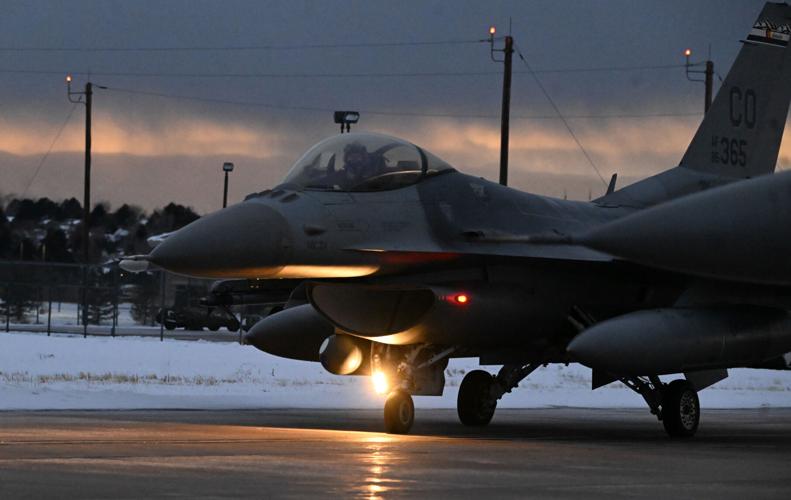
A pilot from Air National Guard’s 140th Wing, based at Buckley Space Force Base in Aurora, taxis before taking off to do some night training on Wednesday, Jan. 25, 2023. (Photo by Jerilee Bennett, The Gazette)

Buckley Space Force Base could get reassurance in next year’s defense budget that its fleet of F-16s will be replaced.
The base has some of the oldest F-16s in the Air Force at a time when the service is looking to eliminate older, maintenance hungry planes to modernize.
However, this summer a bipartisan slate of lawmakers from several states including Colorado, Nebraska, Maryland, Michigan and Idaho are backing legislation in the U.S. Senate and House that would require the replacement of Air National Guard fighter planes by 2034 and the preservation of the guard’s 25 fighter squadrons.
U.S. Rep. Doug Lamborn, R-Colorado Springs, is among those backing the legislation that’s been included in the House version of the National Defense Authorization Act, which must be passed each year to fund the military. He expects the legislation will protect numerous jobs associated with the F-16s at Buckley that protect the North American Aerospace Defense Command.
“I want to make sure that Buckley remains a viable National Guard air asset,” he said.
Progress report: Work continues on Air Force Academy visitor center, new hotel
Other lawmakers, such as Sen. John Hickenlooper, D-Colo, and U.S. Rep Jason Crow, D-Aurora, also backed the measure, saying shutting down guard units would hurt national security. Crow said in a statement the guard is responsible for 30% of the Air Force fighting force but its planes are 28 years old on average.
“We simply can’t afford continued divestment,” he said.
At the same time, the Air Force is getting rid of older plans that are “increasingly obsolete and very expensive to maintain” to free up funds to invest in other priorities, Air Force Secretary Frank Kendall explained at an event in May hosted by the Ash Carter Exchange. For example, the Air Force started to divest, or stop flying, A-10 Warthogs this year.
The Air Force needs electronic warfare, battle management, intelligence and cyber capabilities, not just planes, he explained.
When the Air Force divests older planes it is trying to replace them or replace the overall mission with an alternative that will have longevity.
“I know it’s hard locally to divest aircraft that are in your communities,” he said.
STAR Command matures ahead of possible move from Colorado Springs
If the F-16s built in 1986 and 1987 are not replaced at Buckley it could cut into the more than $1 billion economic impact the base has locally in Aurora.
Some Colorado guardsmen said earlier this year F-35s are a preferable option to replace the F-16s and prepare for possible conflicts with China because they are harder to detect on radar, making it more likely that the pilot and plane will survive conflict, hit surface-to-air missiles and make way for other combatants to follow them into battle. The base could also receive newer F-16s or F-15EXs, a plane designed to carry tens of thousands of pounds of weapons.
Lamborn said he expected the protection for National Guard units could have a good chance of surviving a political battle over the act.
Some provisions likely popular with local service members include a 5.2% pay raise and $240 million to reduce servicemember out-of-pocket housing expenses.
Lamborn said he was hopeful the pay increase would help military members deal with recent inflation.
“5.2% takes a big (chunk) of that pain away,” he said.
American defector to North Korea had loose ties to Fort Carson, Colorado Springs