







Using scooters to commute the last mile in busy South I-25 corridor
How many people who commute along the busy I-25 South corridor and into the Denver Tech Center are using Light Rail trains or other public transportation to get to work? Just a tiny 3.1%, according to a study of commuters carried out annually by the economic development group Denver South.
Only around 2% of the remainder carpool to work, and less than one percent ride bikes, according to that 2024 study. Some 93% of commuters are driving to work, all by themselves.
Last-mile problem
Transit experts say that one of the barriers that prevents a wider number of users to adopt RTD’s trains is what they call the “first-mile, last-mile” problem: How do you get from home to a Light Rail station, and more importantly, once you reach your destination on the rail line, how do you get the rest of the way to the office?

Cities of Greenwood Village and Centennial, working with Denver South and some metro districts bordering the freeway are taking a crack at solving that key issue.
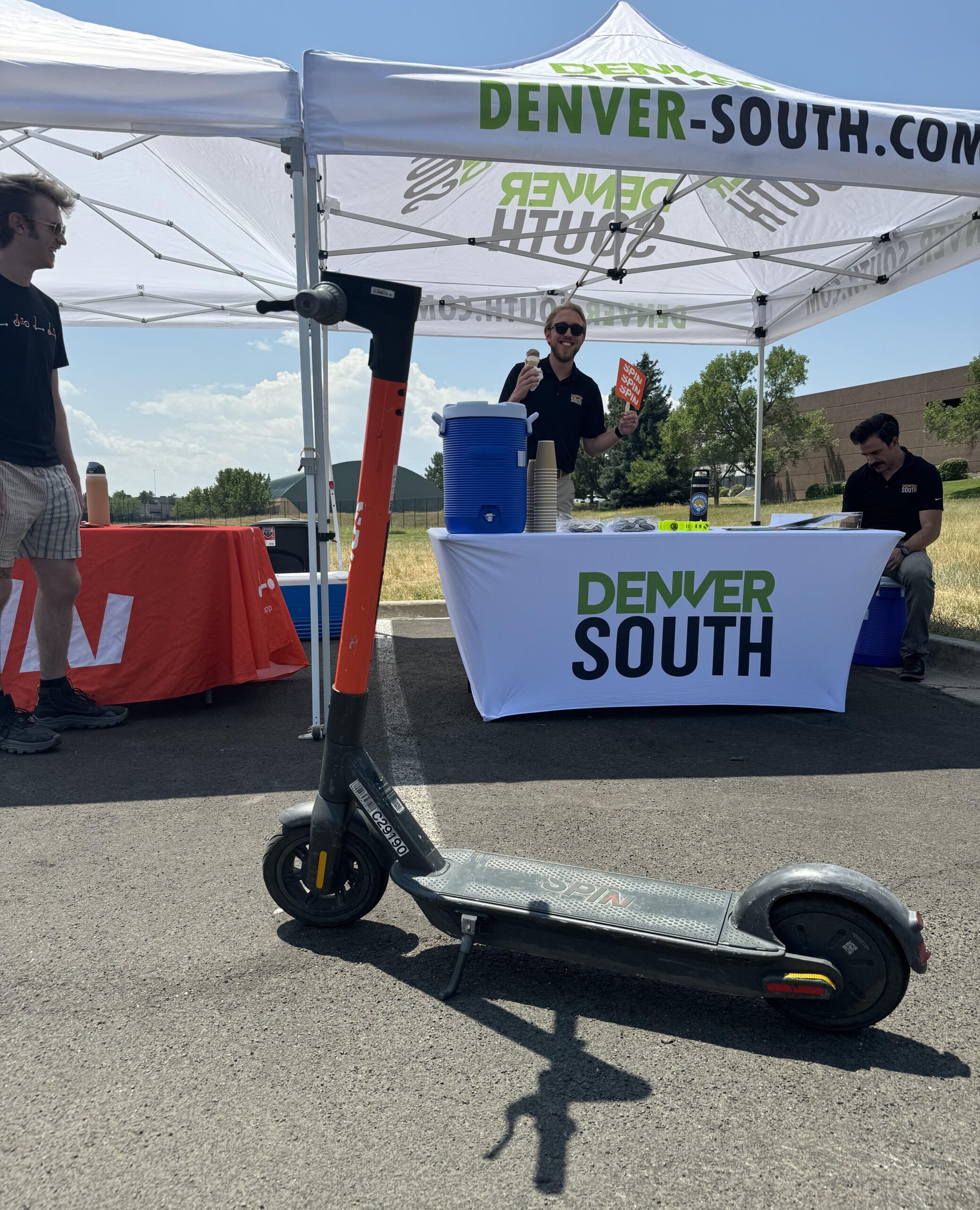
This fall, a commuter riding one of RTD’s E Line trains to Arapahoe Station in the Tech Center can download an app, pick up an e-bike or a scooter at the station, and zip west into the mile-wide Greenwood Plaza office park that spans west from the freeway. Providing the rider finishes a trip in 30 minutes and leaves the device at one of eight drop-offs within the area, they pay only a $1 “unlock” fee for the use of the device.
Micromobility
That’s a service being provided by a Spin Micromobility Program that launched last year in Greenwood Village. Spin, now being offered from two light rail stations that border large office areas along I-25, is a fast-growing expansion from a prototype started in 2017 in the Meridian office park area, along the east side of I-25 south of County Line Road.
At Arapahoe Station, the program not only carries riders to-and-from work but can work another way, too. Light Rail riders are already debarking at the station, then using a scooter to make the trip over to concerts at Fiddlers Green.
“It’s definitely being used for that,” said Daniel Hutton, vice president of transportation & mobility at Denver South.
Wider offerings
It’s early to be looking at how many riders are actually availing themselves of the new program, but Hutton added that Denver South knows for sure that the devices are being used. When a test program started a year ago, there were 25 vehicles available, but now demand is substantial enough that Spin Micromobility has expanded into a second-year test with more than twice the vehicle count.
In addition to Fiddler’s, the program out of Arapahoe Station reaches into what’s being called the Greenwood Entertainment District, with dining spots along East Arapahoe Road including Chewies, Shake Shack and Torchy’s. Also Pindustry — the rooftop entertainment venue repurposed from a car repair area that blends food, cocktails, live music, bowling, arcade games including duckpin bowling and other entertainment.
A night out
“You can use Spin to have a night out,” Hutton said.
Hutton told The Denver Gazette that the program represents another side of Denver South, focusing on transportation and reduction of congestion, as another means to encourage employers offering good salaries to move into the South I-25 corridor.
At a transportation-oriented summit held last week in Inverness, Denver South CEO President & CEO David Worley told attendees that the corridor along I-25, including the Denver Tech Center, Inverness and other business parks, has just five percent of Colorado’s population but 8.3% of its jobs. The corridor accounts for more than 11% of the state’s gross regional product, he added.
Hutton notes that I-25 cuts a diagonal through the corridor from northwest to southeast, with nine light rail stations along the freeway route, south into Lone Tree.
Getting around the island
“People need to get to and from their jobs,” he said. “You can think of this like an island, you get to the island but then need to get around the island. And you still need to go out to lunch.”
Those islands now include the one west of Arapahoe Station into the office park and entertainment district, and a second one east of County Line Station into the south area of Inverness and to Meridian.
A bike or scooter trip such as the program offers might run anywhere from $5 to $10, but is capped at $1, thanks to program co-funders including Greenwood Consolidated Metro District, Greenwood Village, and now Centennial, which joined this summer. Inverness Metro District, Meridian Metro District and Douglas County also partner in the program.
Keeping track of the fleet
A key to making any such program viable is keeping track of the micromobility fleet, making sure bikes and scooters are where they should be before and after trips.
That will become more sophisticated later this fall, when the program rolls out a new tracking system with cycle-provider Spin that will allow even more sophisticated management of the fleet.
“It will be a cool thing when it comes out,” said Daria Cutler, a spokesperson for Denver South.
Eventually, she adds, the system could appeal to other ride-share programs or mobility systems as well.
Hutton, who notes that average users of the current program are likely in the age range of 25 to 40 years old, said that the future expansion to other means will be important in bridging the “last mile” gap.
Meanwhile, to start using the system now, download the app at www.spin.app, then scan the QR code on the scooter. When you arrive at your destination, use the app to end the ride and shoot a photo of where you left it safely parked.