







Talking head games: A walk down David Byrne’s memory lane | John Moore
COMMENTARY
Laser shows were big when I was a kid. While the (baked) older kids were totally tripping out to the psychedelic wonder of all things Pink Floyd at the planetarium in City Park, I, being the youngest, was stuck back at home … having a light show of my own.
While lying in bed at night, I learned at a very young age that if I applied even the slightest pressure to my closed eyeballs, it would produce a corresponding, momentary burst of light. At first it was like looking straight into a nighttime sun: A flash of bright yellow that soon faded. More pressure and practice eventually produced a spectacular array of colors and patterns. It was like I was directing a full-length, experimental animated movie in my head. Eventually, I didn’t have to apply any pressure to my eyes at all. Pure imagination replaced physical stimulation in producing this mental imagery in my head.
Every night, I would crawl into bed, lie back and wait for the show to begin. Soon, out of nowhere, I could hear Boston’s self-titled debut album providing the underscore. A sensory fantasia played out every night on the biggest screen in the world — the back of my closed eyelids.
Was any of it ever really there?
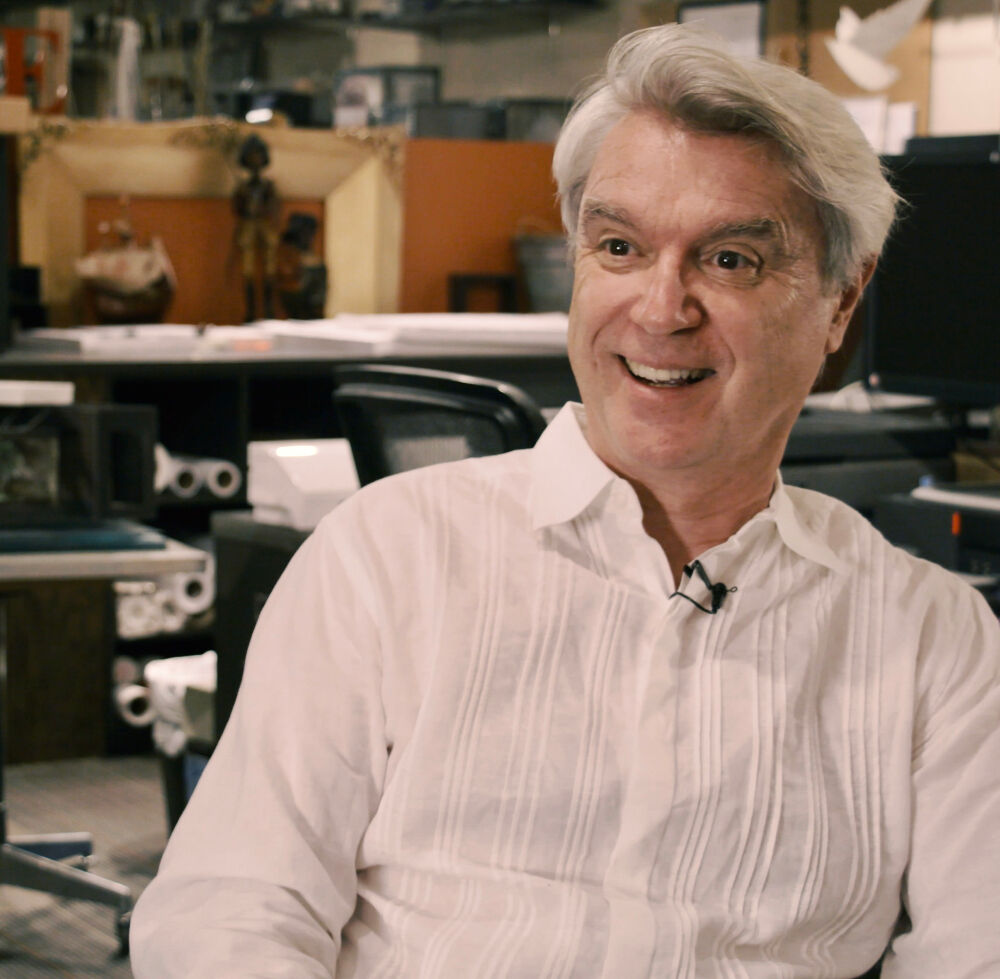
The brain is a funny thing. And now, all these years later — there’s a play about all of this. It’s “Theater of the Mind,” the brainchild of former Talking Heads frontman David Byrne, who at 70 still embraces a childlike fascination with the nerdy neuroscience of the brain. The part that makes us see things that aren’t there, remember things differently over time and, as we get older, inevitably release our grip on our past, present and future.
He’s melded all of that with some unresolved domestic issues from his own broken upbringing and turned it into a 75-minute play that unfolds throughout 12 intricately designed rooms taking up 15,000 square feet at the York Street Yards, a mixed-use industrial complex at 38th Avenue between York and Steele streets.
It’s got a plot but it’s not a play — not really. It’s the largest immersive theatrical experience ever attempted in Denver, presented in collaboration with Off-Center, the adventurous programming wing of the Denver Center for the Performing Arts. And it has been in the works for more than four years.
Which means I’ve been writing about it for four years. Without really knowing whether anything I was writing about it would ever bear any resemblance to the eventual experience, which finally opened on Tuesday. Now, I know the answer: Not really. And thankfully so.
I was actually kind of dreading this. Because what I had been told to expect was “an interactive deep-dive into the science of the human brain” — and personally, the very last thing I want from my theatergoing is a 75-minute science fair.
OK, that’s probably not exactly what I was told it would be, but that’s what my mind heard — a disconnect that turns out to be a major theme of this tantalizing experience. Which, it turns out, is not a science class at all. It’s a gentle, thoughtful rumination on the vagaries of memory and perception. And there are times when it feels like absolute magic.
Talking Heads fans are told to manage their expectations when it comes to Byrne, who wrote and developed the piece in collaboration with co-writer Mala Gaonkar, director Andrew Scoville and dozens of Denver Center artisans clearly having the time of their creative lives. Byrne does not perform in the piece. And yet, he’s everywhere. His name. His voice. His music. His curiosity. And, most important: His story. Just not his body.
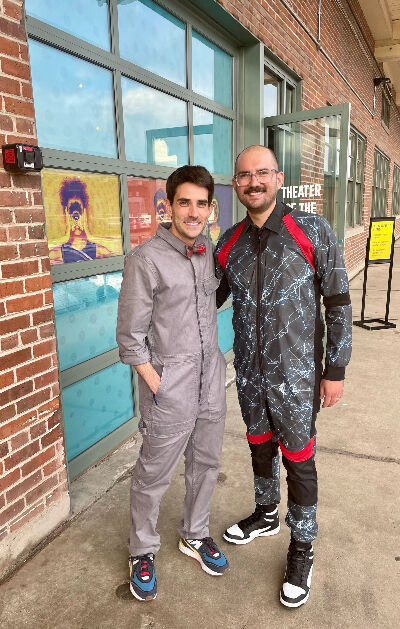
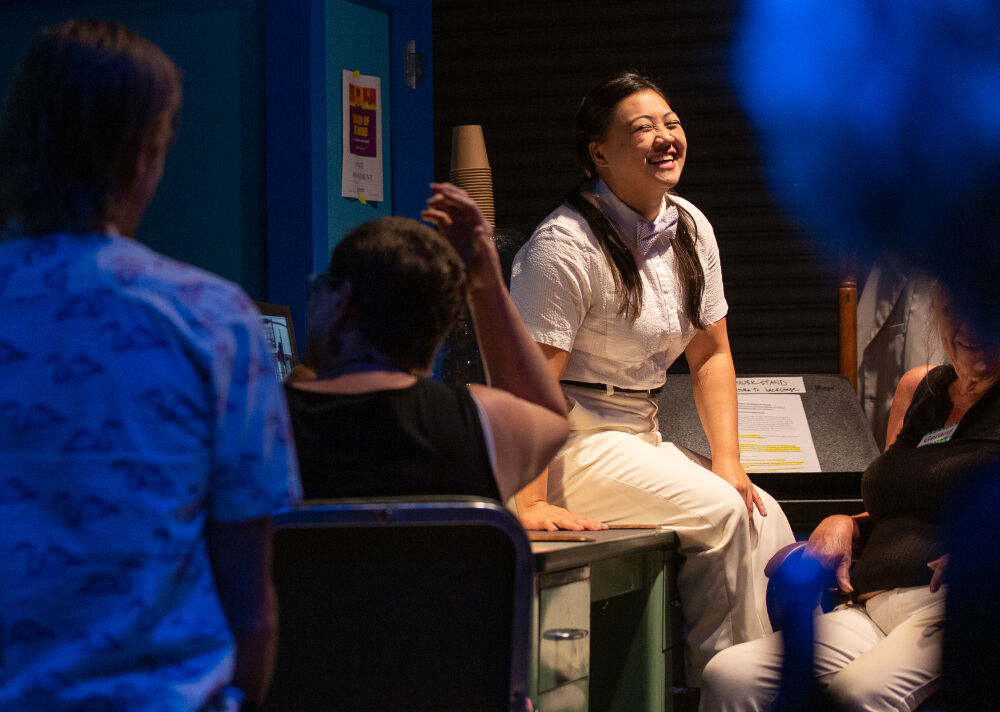
Upon arrival, you are assigned to a group of 16 led by a single “guide” named, yes: David. Your David might be any one of 12 local actors of varying genders, ages and ethnicities (one is even a stroke survivor), each of whom essentially performs this one-person play just for your small group. But they are all “David,” a character, we learn in the opening scene, who has recently died — and we, it turns out, each played some role in his life. Over the next 75 minutes, David will lead you into the recesses of his mind and memories, guiding you through some trippy little exercises that are designed to make you reconsider the reliability of your brain — and your fixed memories.
I don’t want to get too specific about what goes down in each of these 12 rooms so as not to alter the authenticity of your own experience should you go. But each is a kind of mind game that leaves you with something to ponder in its application to your own life. Weird stuff happens at every turn — not in a creepy or unsettling way — but each reinforces the notion that you can never fully trust a memory. Or your eyes, ears, taste or touch.
It is safe to say that if you have a comfort zone, you will be leaving it.
Thankfully the creators, it turns out, don’t waste a single second explaining the actual brain science of it all. But for those who just have to know the why, a QR code is provided for your own deep-dive afterward. (Go nuts!)
I was far more interested in tracking the human circumstances that have brought “David” to the end of his life. He leads us into a nightclub, a backyard, even into the inside of his cranium. (You might wonder at several points if you’ve maybe wandered into Meow Wolf.) It’s not entirely satisfying from a storytelling point of view, but it is all so charming, you might not realize until afterward that you’ve dipped your toes into some big, universal questions of death, enlightenment and regret.
Or have you?
I am writing this rambling essay on Friday, three days after taking in the experience, and questioning my every synapse along the way. I realize that the passage of 72 hours has unalterably impacted my ability to articulate my own experience now compared to, say, moments after it ended. The words cannot be the same. Not only did all 16 people in the group have very different experiences, my memory of my experience is already morphing. Why, I wonder, do I recall details more vividly while standing in the shower than I do 15 minutes later sitting at a desk? (Think about that next time you see a cocksure witness testifying in a high-profile courtroom case.)
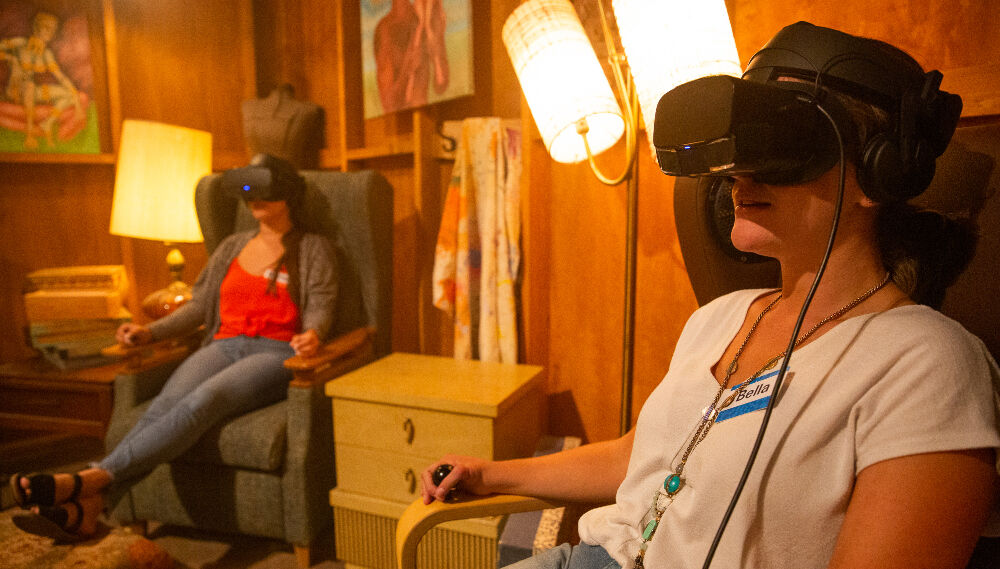
The journey culminates in an attic scene that turns into an obligatory venture into the realm of virtual reality. (It is 2022, after all.) But having us mask up for this climactic scene allows us to witness an essential interaction between our poor dead David and his 9-year-old self, which brings us the most meaningful exchange of the play. It’s the two Davids comparing very different memories about difficulties between their parents, which is much more fresh for Young David, who as a boy has a very different take than his older self.
The scene makes plain that how we think of our parents, and how we judge their choices, changes significantly as we age. And how we remember childhood trauma greatly depends on how old we are when we are remembering (or trying to forget) it. Who’s right is both unprovable and immaterial.
I talked a little about my own parents’ divorce in my previous interview with Byrne, so it’s only fitting that I briefly return to that story now. The play, and specifically this final scene, certainly brought it all right back to the surface.
When my mother, who had eight kids, left my father for a well-known local politico who also had eight kids, I hated him. Even though I barely knew him. That’s an extreme word, hate. But when you’re a teenager and some guy marries your mother, the nuance of emotional degrees tends to escape you. It wasn’t him, of course. More the idea of him. Still: Hate. Praying for Your Death Hate.
Fast forward three decades. It’s a few years after Mom died and, lo and behold, here I am driving “Doc” to a Longmont airfield to mark his 89th birthday … by jumping out of an airplane in her honor. What would my angry 14-year-old self have thought of me paying such kindness to this crazy old man in his final years?
Not sure. But I do know what I would have told that 14-year-old: “Don’t waste too much of your adolescence hating Doc.” And it would have fallen on deaf ears.
“Theater of the Mind” goes a long way toward explaining our damaging propensity to cling to old resentments based on first-hand but nevertheless faulty brain information.
The message that maybe we should let go of all that — and not the science of why touching your eyes makes light appear when you are lying in bed at night — is why I’m glad David Byrne created “Theater of the Mind” for us.
