







Denver’s police chief hints of supporting reducing traffic stops
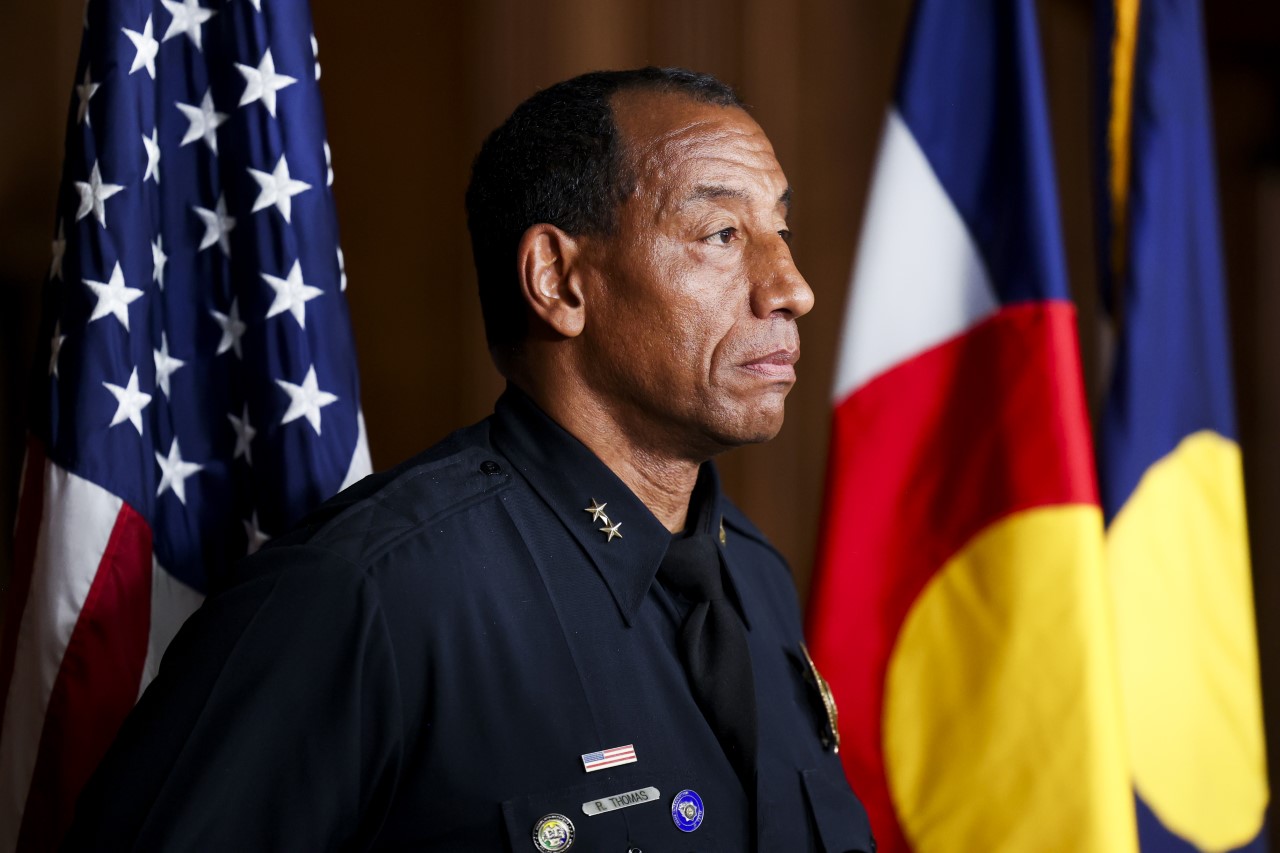
Denver’s police chief is open to the idea of examining ways to reduce traffic stops. While that may sound like counter-productive policing, those stops sometimes escalate into violent interactions between the police and civilians and at times end in deaths at the hands of law enforcement officers.
Though nothing has been decided for sure, Police Chief Ron Thomas said in a Denver Citizen Oversight Board meeting Dec. 2 the department is open to the possibility of no longer enforcing jaywalking.
It’s a type of stop that doesn’t have much of an implication for public safety and can have a disparate impact in their enforcement, he said.
Disparate impact means a law or policy that appears to be neutral on the surface but, in practice, disproportionately affects a particular group of people.
“There’s very little safety impact and quite a bit of disparate impact on enforcing jaywalking,” he said. “I’m certainly open to continued conversation about reductions in traffic stops.”
But Thomas also emphasized the value he sees of traffic stops because of what he believes is the possibility of stopping people who have committed more serious crimes.
“The law enforcement side of me is concerned about the recognition that often suspects involved in crime are contacted during traffic stops, and that there is some utility and value in conducting traffic stops,” he said.
Mitch Morrissey, who served as Denver’s district attorney until 2017, said he doesn’t believe the public safety component of jaywalking enforcement is an even one-to-one comparison in all areas of the city. Areas with heavy, fast traffic make jaywalking more dangerous than on quieter streets.
“There are different places where that’s probably not a problem and doesn’t necessarily need to be enforced. But that’s why you have to study these things before you do that.”
He said considerations for reducing enforcement of traffic laws should take into account whether the costs, such as the potential for more risky behaviors that can lead to fatal crashes, outweigh any savings in resources.
Some groups — particularly advocates of changes to policing — have taken an interest in reducing stops, saying that can free up police resources to respond to serious incidents and reduce the chances for routine encounters with civilians that escalate into violence.
In 2009, for example, Denver police beat 19-year-old Alex Landau — a Black man who then was a student at Community College of Denver — after pulling him over for making an illegal left turn.
Clear Creek County sheriff’s deputies fatally shot 22-year-old Christian Glass, who was white, during an encounter in June after he called 911 for help because his car had gotten stuck and he refused to get out.
Elijah McClain, a 23-year-old Black man, died in 2019 after Aurora police subdued him and paramedics injected him with ketamine when he walked home from a convenience store, even though he was not suspected of any crime.
A review of nearly 100 million traffic stops from 21 state patrol agencies and 29 municipal police departments by the Stanford Open Policing Project found that officers generally stop Black drivers at higher rates than white drivers, and stop Hispanic drivers at similar or lower rates than white drivers. Specifically, the study found 27 stops per 100 people among Black drivers and 13 stops per 100 people among Hispanic drivers, compared with 10 stops per 100 among white drivers.
Black and Hispanic drivers were searched more often than white drivers, the analysis found.
But the project also notes challenges of tracking traffic stops in a systemic, standardized way because of differences in the way individual agencies collect demographic data on traffic stops, whether they release the data and how states track and process data.
The project’s analysis found Colorado saw significant drops in search rates after the legalization of recreational marijuana, and the analysis draws the link between the two because many searches are drug-related.
Meanwhile, a 2017 paper out of Harvard University concluded that, when it comes non-lethal uses of force, Blacks and Hispanics are 50% more likely to experience some form of force in interactions with the police but noted that, on the most extreme use of force — shootings that involved officers — “we find no racial differences in either the raw data or when contextual factors are taken into account.”
The Harvard study sifted through numbers from New York City’s “Stop, Question and Frisk” program, as well as from incidents when officers discharged a weapon at civilians from Austin, Dallas, and Houston, six large counties in Florida and Los Angeles County to construct a database to investigate racial differences in shootings involving officers.
However, that study drew some criticism on its release. The president of the Center for Policing Equity said the paper drew conclusions that went beyond what data supported, and a different study by the CPE did not conclude that no racial bias was present in police shootings.
Taylor Pendergrass, the ACLU of Colorado’s director of advocacy who recently met with Thomas, said changes to policing practices for non-violent or non-criminal situations involve a combination of modifying the culture of heavy reliance on police for those situations, investing in programs that provide an alternative response to armed officers – such as Denver’s Support Team Assisted Response (STAR) program for behavioral health situations – and re-examining criminalization of behaviors that don’t threaten public safety.
“That’s the framework that we’ve thought about, and we’ve worked with some cities in standing up community safety departments where the police are a really important, but just one, pillar of the community safety response,” Pendergrass said.
Pendergrass is hopeful that Denver could follow steps some other cities have taken, such as Philadelphia, which recently banned stops for a handful of low-level traffic violations, such as improperly displayed registration or broken taillights, because of claims about disproportionate enforcement against people of color.
Morrissey said he sees value in enforcement of traffic laws because of the potential to deter behaviors that can lead to fatal crashes. He said concentrating enforcement, such as the use of red-light and traffic cameras in addition to police stops, in areas where data shows high numbers of deaths help reduce those fatalities.
A spreadsheet provided to the Denver Gazette by the Denver Police Department shows the agency recorded 77 traffic fatalities for 2022 as of Dec. 2. The tracking includes deaths that led to criminal charges such as vehicular homicide or felony hit-and-run.
“I think that enforcement of traffic laws at the right place at the right time for the right reasons is what you want, so we can get a grip on all these people that are getting killed on the streets of Denver,” Morrissey said.
A Colorado law passed in 2020 mandates comprehensive requirements for data about officer contacts law enforcement agencies must collect and report to the Division of Criminal Justice each year, starting in January 2023. Among the data officers have to collect are demographic information, the reason for a contact, the outcome including whether the officer made an arrest, whether they search a vehicle and whether they seize property.
For now, though, data on the demographics and outcomes of stops in Denver is scarce. The requirements of Senate Bill 217 come after an initiative several years ago in Denver to collect data what advocates described as bias and profiling in policing fizzled. The work involved creating a process for officers to record information about stops and a promise to make an online database available, but the data findings never materialized.
Nick Webber, vice chair of the Citizen Oversight Board and a public defender in Denver, asked Thomas about the possibility of reducing stops in the Dec. 2 board meeting.
He said in an interview he believes data collected by Denver police under the 2020 state law’s mandate will have a key role in evaluating the public safety value of stops, as well as helping quantify racial differences in how frequently people are stopped and when police issue tickets versus conduct searches or find evidence of more serious crimes.
“If the raw data supports fluctuating police resources in a different direction that the entire community can get behind,” Webber said in reference to yet-to-be collected data under the new law, “then that’s something that I would like to see the Citizen Oversight Board support Chief Thomas in that direction.”
Some available data suggests police spend a significant amount of time on traffic-related calls and other low-level situations, a key consideration for agencies such as Denver looking for ways to redistribute their existing resources in light of officer shortages. A look at a handful of police departments by the New York Times in June 2020 found responses to traffic accidents and enforcement made up over 15 percent of all calls for service in Seattle that year. In New Orleans, about a third of police responses were for calls about complaints, traffic accidents and noncriminal disturbances.
A review of statistics from the Denver Police Department’s open data portal shows more than 1 million stops classified as traffic or subject stops (when a pedestrian is stopped) recorded between December 2010 and December 2022.
Denver District Attorney Beth McCann, whose office conducted a study released last year on demographics of case outcomes, said at the time she kept in close contact with then-Police Chief Paul Pazen about addressing what she described as inappropriate police contacts. A spokesperson said she has not yet had a conversation with Thomas about the potential of reducing traffic stops, and McCann declined an interview.
“The idea has potential and DA McCann is generally supportive of alternatives,” spokesperson Carolyn Tyler said.
