







Winning name for future Front Range passenger rail train announced
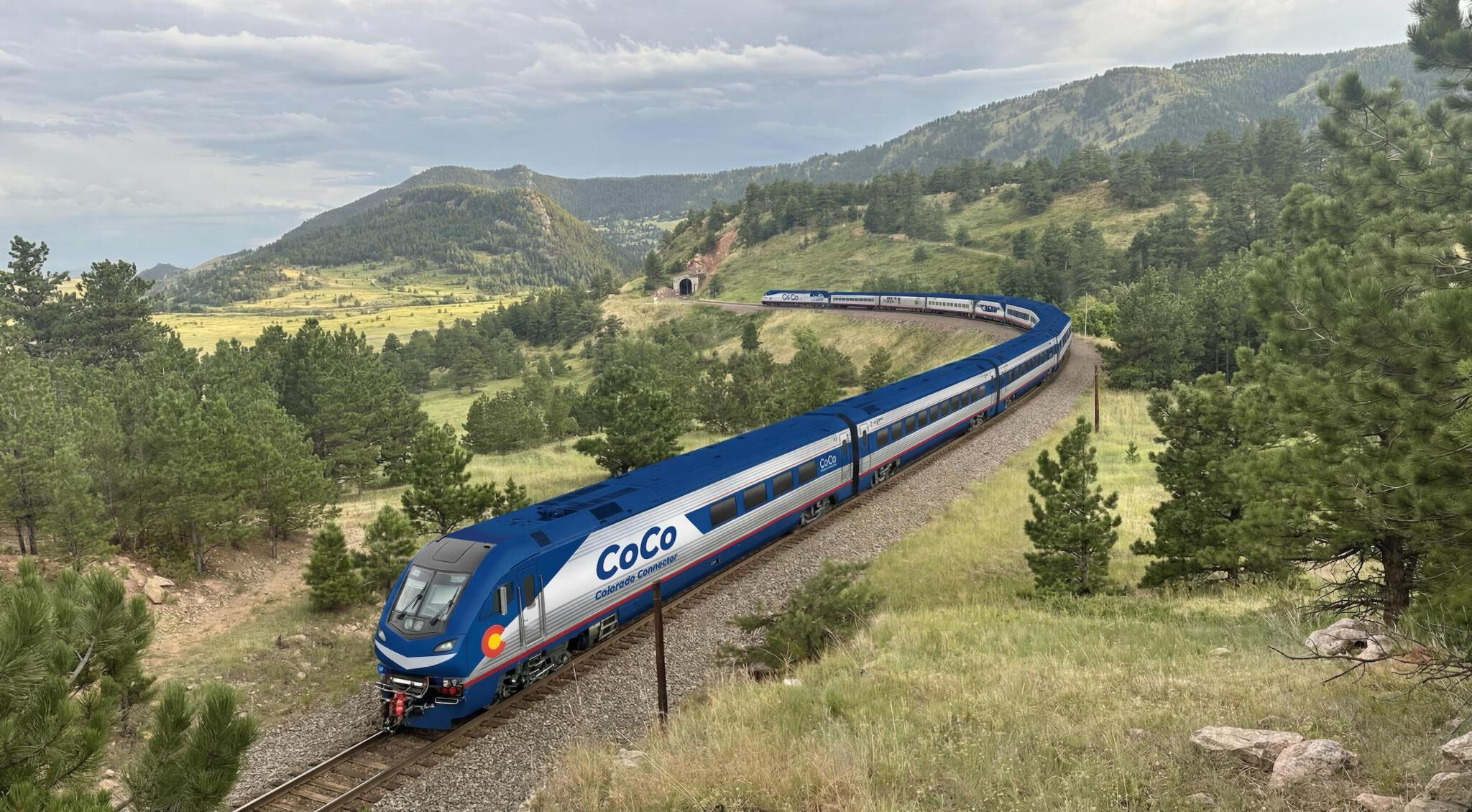
Coloradans picked “Colorado Connector,” or “CoCo,” as the name for the future Front Range passenger rail train that is planned to link communities from Fort Collins to Pueblo.
Plans call for the service to start in 2029, though deals with the communities with planned stops have not all been finalized.
The Front Range Passenger Rail District and Gov. Jared Polis announced the winner Monday after nearly 26,000 votes in a public naming contest.
Colorado Connector received 9,502 votes, or 36.8%. It narrowly edged out Front Range Express Destinations, or “FRED,” with 8,865 votes, or 34.3%.
“The Colorado Connector reflects exactly what this train is about: bringing communities together and creating a faster, cleaner and more convenient way to travel across our state,” said Polis in a news release. “Nearly 26,000 Coloradans stepped up to help name this train, and that level of participation shows just how excited people are about finally delivering modern passenger rail along the Front Range.”
District officials said the name underscores the train’s core mission of connecting cities, workers, families and visitors along Colorado’s fastest-growing I-25 corridor while offering a reliable alternative to highway travel.
“This name reflects both the communities this train will connect and the promise of the service we’re building for them,” said Sal Pace, general manager of the Front Range Passenger Rail District, in the release. “After years of planning and study, we are seeing real momentum — bringing us closer to a train Coloradans will be able to ride in just a few years.”
Initial service is targeted for 2029 with three daily round trips on the northern segment, primarily Denver to Fort Collins, according to district planning documents.
Planners envision expanding to as many as 10 to 15 round trips per day by the mid-2030s, the documents show.
The planned future corridor would serve stops including Fort Collins, Loveland, Longmont, Boulder, Denver, Littleton, Douglas County, Colorado Springs and Pueblo, according to the district. Longer-term goals include extensions toward Wyoming to the north and New Mexico to the south, district officials said.
The project aims to provide travel times competitive with — or better than — driving in peak traffic while offering a more relaxed, climate-friendly option, according to district planners.
Rail supporters argue the service could help ease highway congestion, support economic growth and give residents a practical alternative to I-25 gridlock, according to district statements.
Critics have warned the project faces high costs, limited ridership compared with cars and unfair burdens on rural areas included in the special taxing district.
The Front Range Passenger Rail District was created by the legislature in 2021 as a political subdivision spanning portions or all of 13 counties along the I-25 corridor, according to state law. Some counties and cities have expressed resistance to being included in the potential taxing district without their explicit agreement, according to news reports.
Funding remains a central challenge, district officials acknowledged.
District leaders are preparing for a potential sales tax measure on the November 2026 ballot to generate dedicated revenue, the district said. Because any new tax would require voter approval under the Taxpayer’s Bill of Rights (TABOR), the district must refer the question to the ballot for public vote, according to state law.
Initial service estimates have ranged from $800 million to $900 million for core infrastructure, though officials stress the final financial plan is still under review and they are exploring ways to leverage existing tracks and partnerships to minimize the financial burdens upon voters, the district said.
Officials are planning several town halls in the coming weeks, including one in Longmont on Wednesday. Town halls are scheduled for Boulder on April 15, and Westminster on April 29. For more information on the town hall meetings, visit the Front Range Passenger Rail website.