







Dramatic cut in assembly time could reduce housing costs of Denver apartments
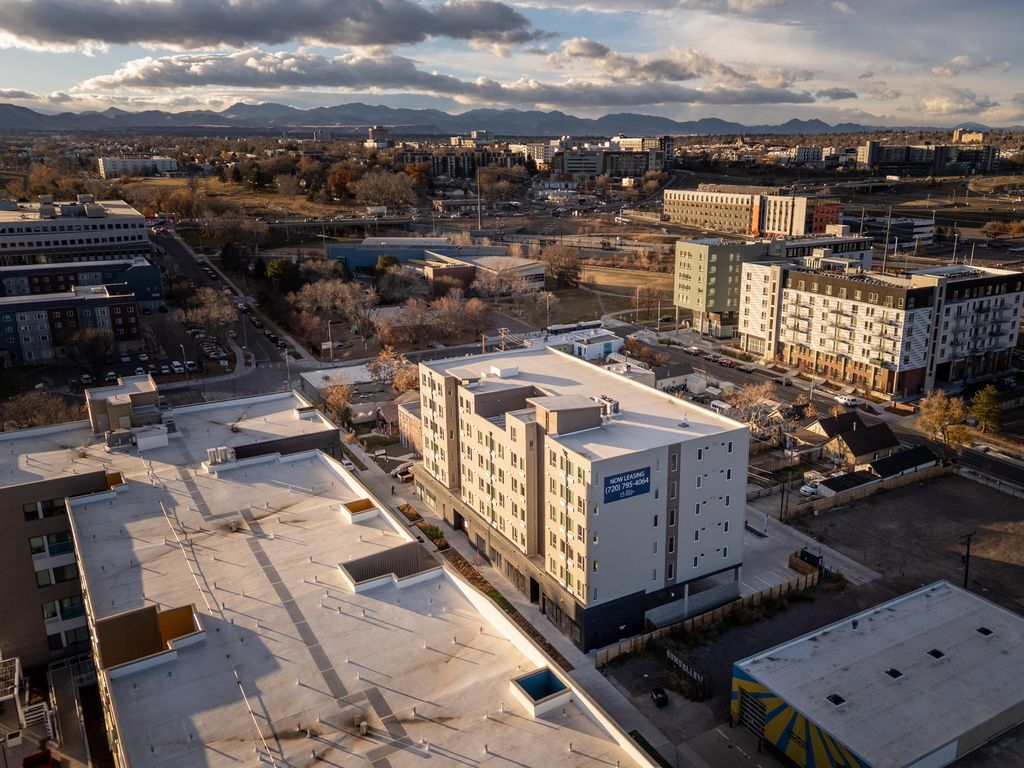
A Denver builder is showing off construction technology that could dramatically lower the cost of building apartments in Colorado, at a moment when home affordability ranks as one of the state’s greatest ongoing challenges.
Last summer, Adam Berger Development completed construction on a 77-unit apartment complex near Empower Field, where 67 of the homes are deeded to remain affordable to renters who make 80% of the area’s median income or below.
The developer used modular construction, which has been used for single-family homes for years but is now seeping into the multifamily apartment and condominium/townhome construction.
According to data from Apartments.com, the median-priced single-bedroom flat in Denver now rents out at around $1,615. But at West Holden Place, opened in Denver’s Sun Valley neighborhood south of the stadium, a single-bedroom unit with 521 square feet of space is priced at $1,295 a month.
“And our tenants love the units,” builder Adam Berger, principal with Adam Berger Development, told The Denver Gazette, after he returned from touting the project at the World of Modular tradeshow in Las Vegas.
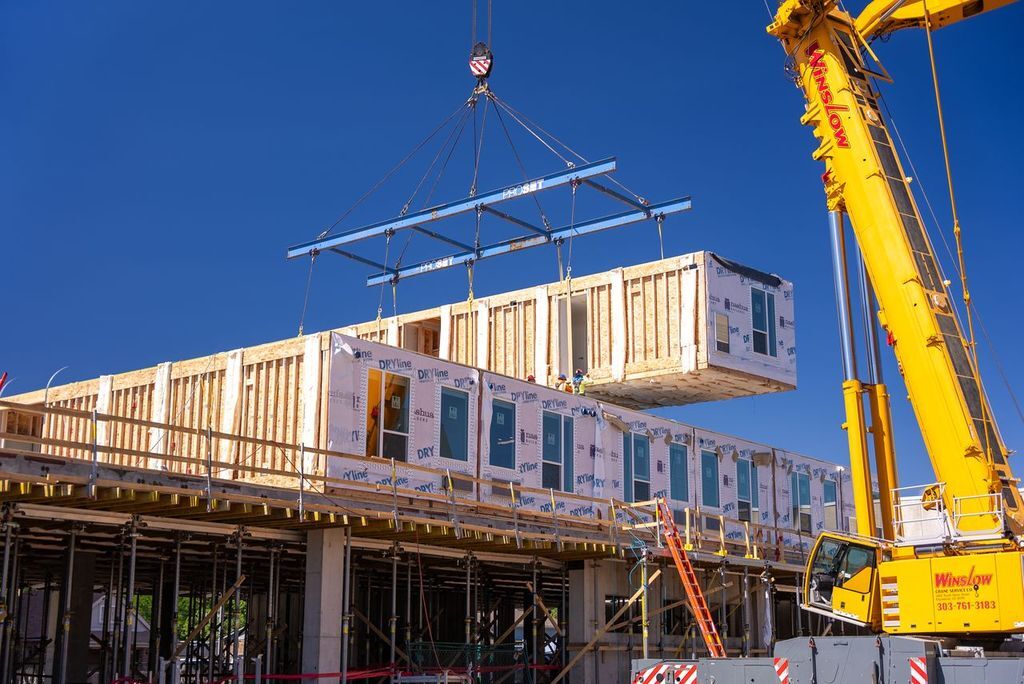
Modular construction is a key part of what keeps the price in check. A complex, multifamily project that would typically rise on site from basic building components is instead delivered as prefabricated modular units, each module having many of its interior features already factory-installed in place.
The builder then rapidly assembles the modules into a topped-off structure. The timeframe of that assembly can be extraordinarily rapid and cost-effective compared to what typical onsite construction techniques demand.
Seven-day assembly
At West Holden Place, the time required to take a building from ground level to its six-story, topped-off height was just seven days.
Manufactured construction had been vaunted for decades as a means for bringing down the cost of single-family home building. It had been applied successfully in some Denver area projects as early as the 1990s.
But the much more complex tasks of adapting it for large, multifamily structures, with a variety of sizes and unit plans, is being advanced with the help of AI technology, according to trade experts.
The West Holden Place project, Berger’s company noted, has become the largest modular multifamily development created within the city of Denver.
Berger said you have to actually see the units come together to appreciate how dramatic the technology differs from conventional construction.
“The cabinets, the countertops, the lighting and electrical panels are already done,” Berger said.
The basic building assembly involved 50 modules, with those components already installed, that came together in a “five-over-one podium” design.
The actual construction time, including the modular building assembly, was somewhere between 20% and 40% faster than a conventional building project of that scale, he said.
Nevertheless, Berger said that despite having many traditional construction tasks completed at the factory prior to delivery, the potentially revolutionary technique isn’t something that any builder could adopt overnight and bank the accrued cost savings.
“You have to really commit to it,” Berger said.
“It’s different enough from site-built construction that if you’re going to succeed in attaining the speed and cost effectiveness, you have to be an expert. That’s what we did.”
The company spent 10 years working up from smaller, modularly built duplex and townhome projects to the scale of a multistory building with dozens of units. And despite having most of the components of a finished home in place as the project topped-off, Berger said overall construction time of the project was around eleven months.
“It took longer than we wanted,” Berger added.
The largest challenge to cutting time, he said, is the interface with construction trade partners, who among other tasks carry out some of the remaining transformation of the assembly into a unified apartment building.
“It’s the coordination with the trades,” Berger added. “There’s not a lot of deep expertise (in modular building) with trade partners.”
He added that he has assembled a partner team that helped streamline the process at West Holden Place, and that will be valuable on future projects already lining up. Berger noted that his company serves both as developer and general contractor on his projects and retains ownership interests after completion.
“West Holden Place was designed to prove that modular construction can be a practical and scalable solution for delivering much-needed attainable housing,” Berger said in a statement after he returned from the World of Modular Conference, Convention and Trade Show.
During the event, West Holden Place took a first-place finish for the 10,000-square-foot-plus category in the gathering’s awards presentation.
Market challenges
Berger told The Denver Gazette that even with the potential cost benefits of modular construction, the current apartment market in Colorado confronts builders with some challenges that have little to do with construction costs.
Now nine months into leasing, West Holden Place, at West 12th Avenue near Decatur Street, is around 67% leased.
“We’ve got some stiff competition from market-rate projects right around the corner,” he said.
Despite possibly higher construction costs, many developers and owners are offering deep concessions on unit pricing at a moment when the market is coping with a surplus of units that came online from apartment projects launched during the COVID-19 pandemic.
Berger noted that in the current pricing environment, some renters who would normally be confined to affording C and D units — industry terms for decades-old product of lesser quality — find that they can afford nicer, B and A-type units.
“It’s a flight to quality, it’s gotten less expensive,” he said.
That’s made the competition stiffer on the lower end, where demand is lacking.
“But we’ve been able to compete. We’re still able to offer rents competitive to market rates,” Berger said.
But delivering a modular unit at an affordable price isn’t enough for success, Berger said.
“It’s novel, but if you’re not designing something that people say, ‘This feels good,’ it doesn’t matter if it’s cost-effective. The tenant doesn’t care, and we get that.”
Along with entry-level single-bedroom units, West Holden Place also offers 2-bedroom/2-baths units ranging from $2,275 to $2,748 monthly, according to the online listings.
Along with their advantages in assembly time, the modular-built apartments are LEED Gold-certified — an energy and environmental performance standard suggesting they would consume 30% to 40% less electricity than standard homes, while delivering better air quality and better natural daylighting.
Thomas Bryan, executive director/CEO of the Colorado Housing Finance Authority, noted that the project represents a collaboration with the City and County of Denver and Colorado Housing and Finance Authority (CHFA).
“West Holden Place demonstrates innovation both in how it was built and how it’s funded,” Bryan said.
Governor’s Mansion
Maria De Cambra, who heads the Colorado Department of Local Affairs, applauded the project, calling modular construction a critical option for creating affordable housing.
In a September report, she had highlighted the state’s shortfall of affordable homes, citing a 106,000-unit gap that would require construction of 34,100 homes a year over the coming decade to bridge.
Meanwhile, Berger is looking ahead to his next projects — including a 52-unit project in the pipeline near Swedish Hospital in Englewood, another set for Olde Town Arvada, and a 6-story project designed for a high-profile site adjacent to the Colorado Governor’s Mansion in Denver.
Its income-restricted units would target middle-income teachers and young professionals who earn between 80% to 120% of median salaries.