







Mission led by Colorado lab ends after decade studying erosion of Mars atmosphere
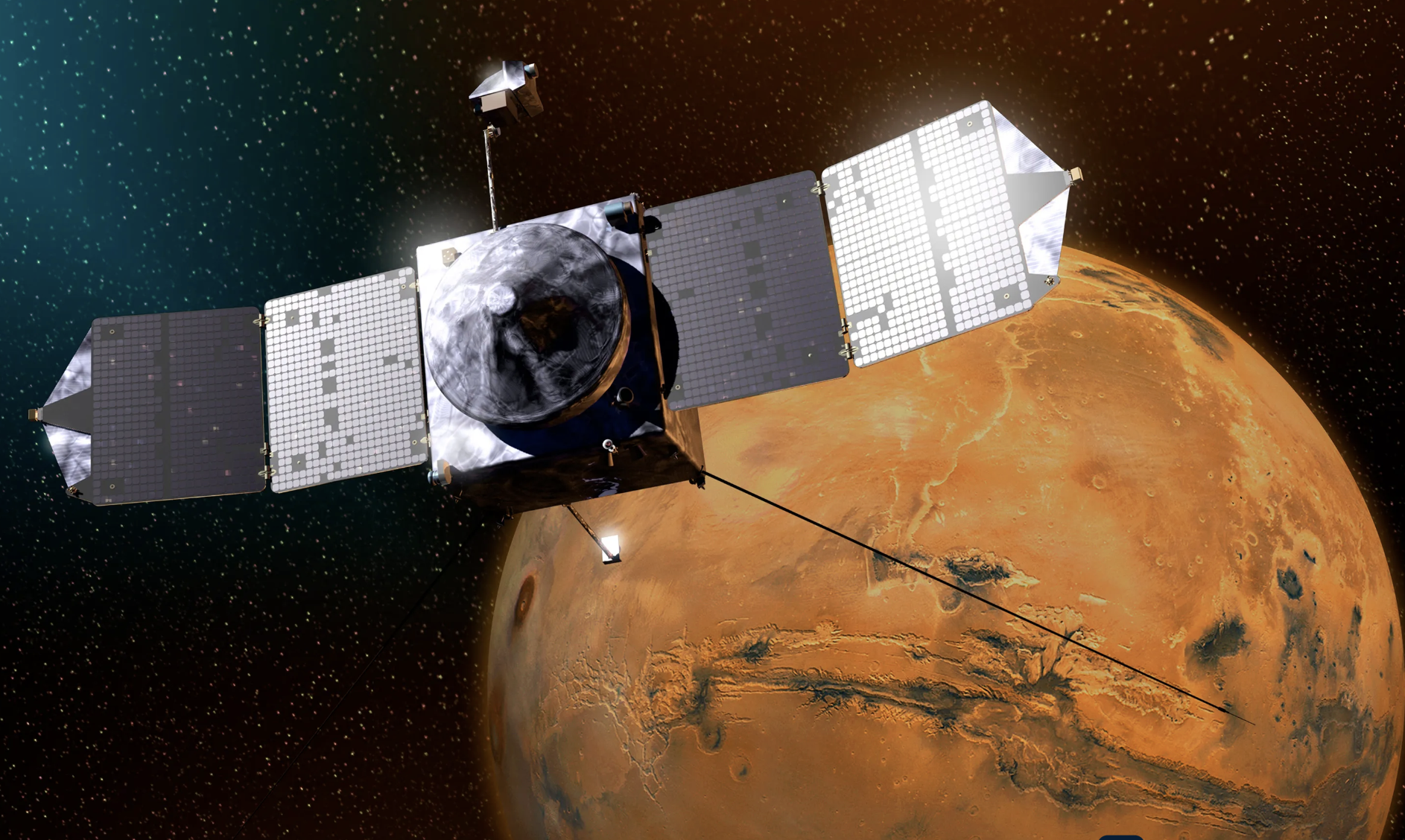
Scientists at NASA and the University of Colorado Boulder have said goodbye to a spacecraft that has spent the last 11 years analyzing the atmosphere of Mars and how it became a rocky planet.
The federal space agency announced Wednesday it has closed the Mars Atmosphere and Volatile Evolution (or MAVEN) mission after it lost the signal from the spacecraft on Dec. 6.
MAVEN — the mission led by CU Boulder’s Laboratory for Atmospheric and Space Physics and funded by NASA — was the first research probe sent to better understand the evolution of Mars’ atmosphere. It was also an important communications device transmitting data from rovers on the red planet’s surface back to Earth.
Last year, NASA said MAVEN passed behind Mars and stopped sending a signal after an “anomaly” event. The agency convened a review board to figure out what happened and see if it could be recovered, but learned the spacecraft was rotating too fast, which had drained its battery and made it lose power.
Their final conclusion? It couldn’t be saved.
“The team is certainly broken up about this, but at the same time, we are incredibly proud of the science we’ve accomplished over the last decade,” said Shannon Curry, MAVEN’s principal investigator at LASP in CU Boulder.
It’s still not clear what caused MAVEN to start rotating at an abnormal speed when it went behind the planet.
NASA leaders curbed questions about possible causes — whether it could have been impacted by space debris or experienced a technical issue — at a media teleconference on Wednesday, saying the committee is still reviewing what happened and will release its findings later this year.
Still, the mission had lasted far longer than originally planned.
When it launched in 2013, MAVEN was designed to study Mars for only one year. It ended up being in commission for more than 11 years and helped lay the groundwork for NASA’s plans to study the moon ahead of sending any humans there in the future.
Its main mission was to better understand how Mars could have gone from a potentially habitable planet to the arid rocky planet it has become.
Scientists believe Mars could have had liquid water on its surface at one point, but lost the high atmospheric pressure needed to keep water stable. Over the last decade, Curry said, the spacecraft helped scientists get the best information on how an atmosphere can erode over time.
One of its first major findings showed how Mars experienced large increases in atmospheric erosion during solar storms.
It was also the first to record “sputtering,” an atmospheric escape process when charged particles crash into the upper atmosphere and create a “cannonball in the pool” effect by pushing gas particles out of the atmosphere, Curry said, which has been a “dominant escape mechanism” in the solar system for billions of years.
“We now have a better understanding of atmospheric escape at Mars than at any other planet, including Earth,” Curry said. “And consequently, Mars is an incredible natural laboratory for understanding rocky planet atmospheres.”
The spacecraft has shaped many future missions and continues to highlight the importance of investing in Mars research and communications infrastructure to support getting humans to the red planet one day, said Tiffany Morgan, director of NASA’s Mars Exploration Program.
It was a “cornerstone” for NASA’s Mars exploration, she said.
MAVEN also holds many records for sending loads of data back to Earth from deep space, including the solar system record for most data returned during a single day.
There are three other spacecraft responsible for relaying data from Mars and NASA leaders said the communication infrastructure is still resilient without MAVEN. But there is a “slight delay” occasionally, Morgan said.
NASA leaders stressed the loss of MAVEN is a reminder that there needs to be more investment into improving communications systems if more research is to be done on the red planet.
“NASA’s future science and exploration missions will need more than what we have today with the MRN (Mars Relay Network),” said Greg Heckler, deputy program manager for Capability Development at Space Communications and Navigation at NASA.
“They will need what we call dedicated infrastructure,” he added. “Those missions, because they’re trying to do more, will do more, will need relief from the burden of managing their own com pathways.”