





Navajo president issues order blocking transportation of uranium ore through the Navajo Nation

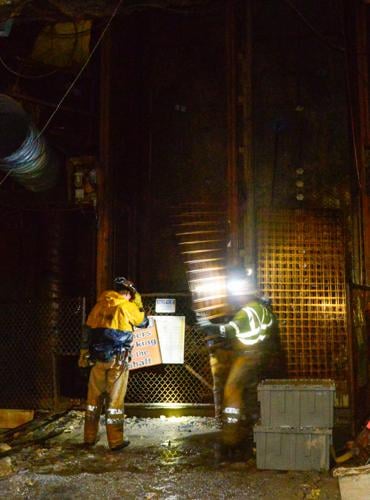
Uranium mine ore cart rails at the Hall Mine located within the Lukachukai Mountains Mining District EPA Superfund site.
Courtesy photo, the Environmental Protection Agency

Navajo Nation tribal President Buu Nygren issued an executive order banning the transportation of uranium ore from the Pinyon Plain Mine through reservation property in Arizona.
This order follows an appeal sent to President Joe Biden in May asking him to prohibit ore hauling through the reservation, as well as a 2012 law passed by the tribal government opposing uranium transport other than the removal of mine waste accumulated at more than 500 abandoned uranium mines on the reservation since 1944.
Uranium mining on the Navajo Nation in Arizona has devastated the Navajo people for 80 years, killing and debilitating thousands over the decades. The Navajo people banned uranium mining nearly two decades ago.
The Pinyon Plane Mine is on National Forest land south of the Grand Canyon Village, not on reservation land, and the operator, Lakewood-based Energy Fuels, transports its ore to its uranium mill in White Mesa, Utah, near Blanding for processing.
Curtis Moore, senior vice president of marketing & corporate development for Energy Fuels told The Denver Gazette that during full production, six-to-eight loads of ore will leave the mine per day in tightly covered trailers to prevent dust from escaping.
Moore said the company has been trucking hundreds of tons uranium ore from other mines near the Grand Canyon through parts of the Navajo Nation since 2007. The routes, on federal highways, were authorized by the company’s environmental impact statements in 1987. Moore said the route approvals were reconfirmed in 2012.
Moore also told The Denver Gazette that Energy Fuels has never had a truck accident while hauling uranium ore anywhere in the region. Energy Fuels President and CEO Mark Chalmers said the company has a 20-year track record of transporting uranium ore according to the regulations.
Aerial radiation surveys of highways through the reservation by the U.S. Environmental Protection Agency in 2018 reported “no significant deviations from background (radiation) was detected along the roadway” (U.S. 89, U.S. 160, and U.S. 161).
But Navajo authorities don’t trust uranium mining, given the terrible toll that it caused to the Navajo people from 1944 through the 1980s.
“Particularly with something as sensitive as uranium, where there is a long legacy of contamination and disproportionate impact to the Navajo people,” Navajo Nation Attorney General Ethel Branch said. “Anyone bringing those substances onto the Nation should undertake that activity with respect and sensitivity to the psychological impact to our people, as well as the trauma of uranium development that our community continues to live with every day.”
On July 30, the company hauled about 40 tons of ore in two semitrailers from the mine to Flagstaff and then north through the Navajo Nation to its mill at White Mesa, south of Blanding — a total of some 410 miles.
“The company’s failure to seek approval from the Navajo Nation for the transport of radioactive materials across its land disregards the Nation’s governmental authority and sovereignty,” President Nygren said in a statement.
“If you’re going to smuggle uranium into our borders and across our Nation and outside, that’s pretty much illegal,” Nygren said. “I’m very disappointed that this is happening in this day and age.”
Reacting to the controversy, Arizona Gov. Katie Hobbs released a statement saying Energy Fuels has agreed to pause ore shipments and engage in “good faith negotiations” to try and resolve Navajo concerns.
“I have also instructed (the Arizona Department of Emergency and Military Affairs) to partner with tribal law enforcement and assist the Navajo Nation’s emergency management team in developing an emergency response plan in the event of a road incident,” she said.
Moore disputes the authority of the tribe to prevent the use of federal highways for ore transport, but said the company will suspend shipping in order to engage in productive dialog with the tribe.
“We respect, appreciate, and agree with President Nygren’s statements in Executive Order No. 05-2024 concerning the impacts of historic uranium mining practices, which unacceptably continue to impact many Navajo People today,” Chalmers said in a statement.
“We are also greatly encouraged that the Order appears to invite a constructive dialogue relating to the transport of materials across Navajo Nation lands, which we encourage and welcome,” Chalmers added.
“I recognize the fraught history of uranium mining and the devastating impacts it has historically had on tribal nations,” Hobbs said. “That’s why I have called on the federal government to remediate sites and invest in the cleanup of contaminated state and tribal lands.”


National Renewable Energy Laboratory renamed to fit Trump’s energy policy
Bernadette Berdychowski
bernadette.berdychowski@denvergazette.com
Updated 3 hours ago
The National Renewable Energy Laboratory based in Golden has a new name to match the shift in U.S. energy policy under President Donald Trump. The Department of Energy announced it renamed the National Renewable Energy Laboratory to the “National Laboratory...

Bernadette Berdychowski
Reporter
Strip club company CEO steps down after indictments
Carol McKinley
carol-mckinley@denvergazette.com
Updated 6 hours ago
The CEO of a controversial Central City strip club is among five people who were asked to step down after being indicted in September, accused of bribing a New York state tax auditor. Eric Langan, who headed up dozens of...

Carol McKinley
Reporter

Tracy Huggins, head of Denver Urban Renewal Authority for 25 years, to step down
Bernadette Berdychowski
bernadette.berdychowski@denvergazette.com
Updated 6 hours ago
The woman who played a major role in many of Denver’s largest development projects over the last 25 years is stepping down from her role leading the Denver Urban Renewal Authority. The organization announced Tracy Huggins will step down as...
Bernadette Berdychowski
Reporter

Historic Denver YMCA to be transformed into affordable housing
Deborah Grigsby
deborah.smith@denvergazette.com
Updated 6 hours ago
U.S. Vice President Charles W. Fairbanks placed the original cornerstone for the Denver YMCA at the corner of 16th Avenue and Lincoln Street in late 1906 in an “elaborate and formal ceremony.” And as this year comes to an end,...

Deborah Grigsby
Reporter

Record shoppers, online sales surge signal strong holiday season momentum
Reuters
reuters@denvergazette.com
Updated 9 hours ago
U.S. shoppers spent $14.25 billion on Cyber Monday, pushing total online sales over the Thanksgiving weekend to $44.2 billion, according to an Adobe Analytics report, as consumers lapped up offers on everything from gadgets to household essentials. Spending rose 7.7%...

Reuters
Reporter

Prada finalizes purchase of fashion rival Versace for $1.4 billion
The Associated Press
the-associated-press@denvergazette.com
Updated 9 hours ago
MILAN — The Prada Group has closed the purchase of Milan fashion rival Versace in a $1.375 billion cash deal that puts the fashion house known for its sexy silhouettes under the same roof as Prada’s “ugly chic” aesthetic and...

The Associated Press
Reporter

Amazon to use Nvidia tech in AI chips, roll out new servers
Reuters
reuters@denvergazette.com
Updated 9 hours ago
LAS VEGAS – Amazon.com’s AWS cloud computing unit on Tuesday said it will adopt key Nvidia technology in future generations of its artificial intelligence computing chips as the firm ramps up efforts to get major AI customers using its services....
Reuters
Reporter

Despite U.S. trade war, OECD expects global economy will grow 3.2% this year
The Associated Press
the-associated-press@denvergazette.com
Updated 9 hours ago
WASHINGTON — The world economy has proven surprisingly durable in the face of President Donald Trump’s trade wars, the Organization for Economic Cooperation and Development said Tuesday, upgrading its outlook for global and U.S. economic growth this year. The 38-country...
The Associated Press
Reporter
U.S. to announce ‘bridge payment’ for farmers next week, Rollins says
Reuters
reuters@denvergazette.com
Updated 9 hours ago
WASHINGTON – Agriculture Secretary Brooke Rollins said Tuesday that the Trump administration will announce a “bridge payment” for farmers next week that is designed to provide short-term relief while longer trade and aid packages are finalized. Farm groups and Republican...
Reuters
Reporter

Boeing on track to generate billions in cash next year
Bloomberg
bloomberg@gazette.com
Updated 9 hours ago
Boeing Co. expects to generate cash again in 2026, a significant reversal in the plane-maker’s finances as it prepares to boost monthly production rates of its passenger aircraft. The U.S. company expects positive free cash flow to reach the “low-single...

Bloomberg
Reporter
PREV
PREVIOUS
Metro moves: Hotel opens in RiNo with Colorado-inspired restaurant
Welcome to the Denver Gazette’s Metro Moves. You’ll get the latest metro Denver openings, closings, hiring and promotion news here. To submit your company’s news, drop an email to bernadette.berdychowski@denvergazette.com. New hotel and restaurant opens in RiNo There’s a new hotel in Denver’s River North Arts District. The Cambria Hotel Denver Downtown RiNo opened Aug. 1. […]

FlatIron Crossing mall owners to start construction on “HiFi” entertainment district this month
A large development is coming to the shopping mall located halfway between Denver and Boulder. After years in the works, the owners of FlatIron Crossing are ready to build an “entertainment district” with a housing community next to the mall on highway US-36. Construction is set to begin this month, Jacob Knudsen, vice president of […]