







DOJ sues Denver over ‘unconstitutional’ weapons ban
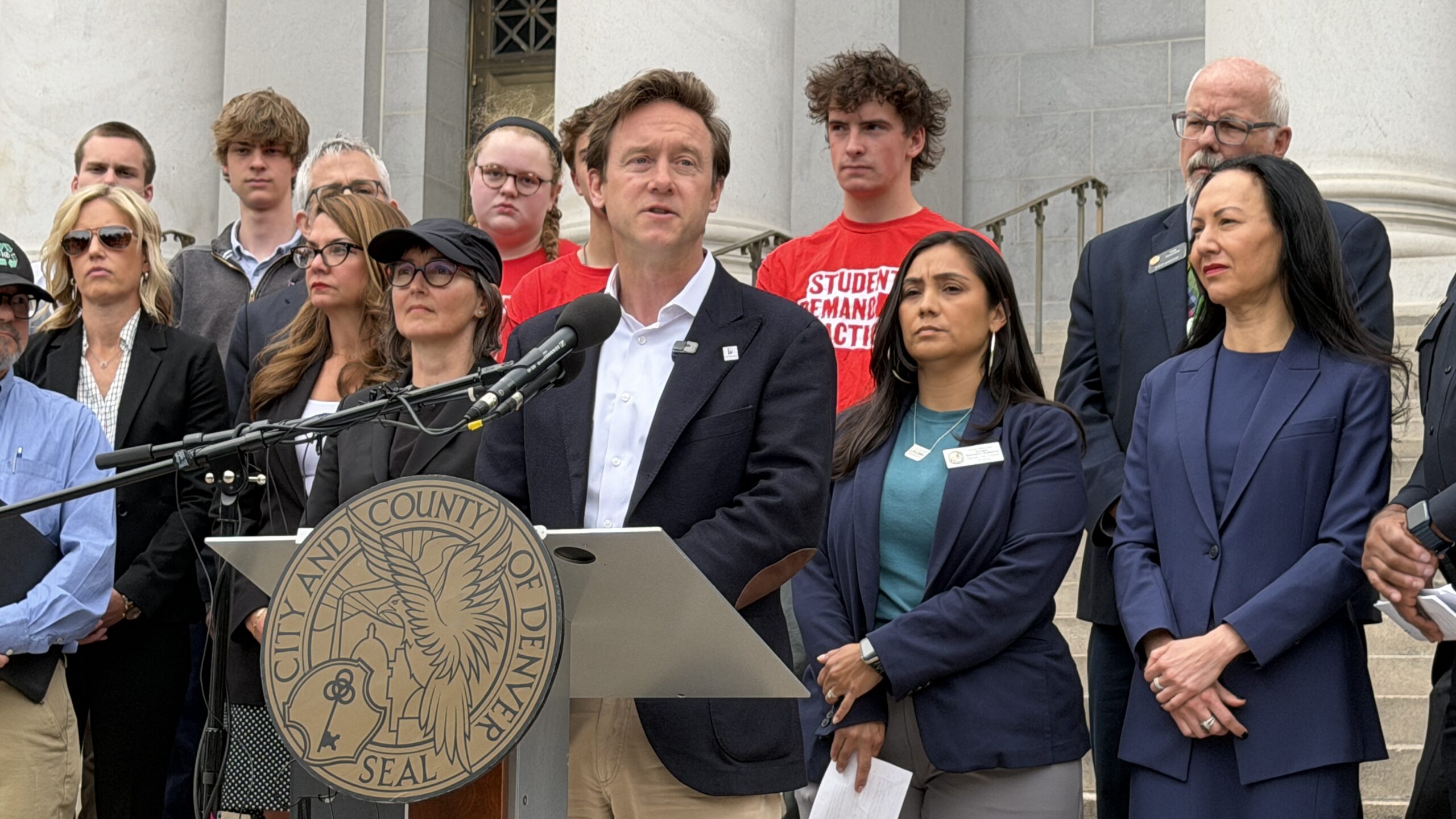
Less than 24 hours after Denver Mayor Mike Johnston publicly rebuffed the U.S. Department of Justice’s demand to repeal the city’s ban on assault weapons, the Trump administration followed through with its threat to take the matter to court.
The DOJ filed a suit in federal court Tuesday, alleging that Denver’s longstanding prohibition on “assault-style” weapons unconstitutionally bans certain constitutionally protected semi-automatic rifles and infringes on the “Second Amendment rights of law-abiding citizens to keep and bear arms in common use for lawful purposes.”
“Our answer is hell no,” Johnston had said, along with public safety leaders gathered at City Hall on Monday. “No, we will not roll back a common-sense policy that has kept weapons of war off of these city streets for 37 years. No, we will not put first responders at greater risk every time they respond to a dangerous incident. No, we will not go back to a time when folks are worried about walking into movie theaters, grocery stores, or public elementary schools.”
Naming the city government and the Denver Police Department as defendants, the complaint seeks a permanent injunction under federal rules requiring the city to end its “unconstitutional” practices, implement reforms, and prevent future constitutional violations.
A spokesperson for Johnston told The Deneve Gazette that the mayor had nothing more to add at this time and that “everything we said yesterday is true today.”
“The Constitution is not a suggestion and the Second Amendment is not a second-class right,” said Acting Attorney General Todd Blanche in a news release. “Denver’s ban on commonly owned semi-automatic rifles directly violates the right to bear arms. This Department of Justice will vigorously defend the liberties of law-abiding citizens nationwide.”
Passed in 1989, Denver’s longstanding ban on assault-style weapons restricts the possession and sale of guns with magazines carrying more than 15 rounds.
The plaintiffs argue that Denver’s ordinance “uses politically charged rhetoric,” and that the term “assault weapon” is “a political term developed by anti-gun publicists to expand the category of assault rifles to allow an attack on as many additional firearms as possible.”
The DOJ argues Denver’s ban is unconstitutional under the “Bruen step one” test, established in the 2022 landmark case New York Rifle and Pistol Association, Inc. v. Bruen, which governs how courts assess Second Amendment gun laws.
The ordinance makes it a crime to keep and bear AR-15-style rifles with standard capacity magazines, the complaint states, adding that because those rifles are protected “arms,” the Denver law is “presumptively unconstitutional.”
That’s not necessarily the case, according to Janet Carter, a Second Amendment litigator with Everytown Law.
“The Second Amendment is not a blank check for gun rights advocates,” Carter said. “It has always allowed for the regulation of particularly dangerous weapons and for weapons that are not in common use for self-defense. That’s why efforts to challenge these laws have failed all across the country. Courts applying the new history and tradition test that was established in the Supreme Court’s 2022 Bruen decision have overwhelmingly agreed that banning assault weapons is constitutional.”
In 2008, the U.S. Supreme Court, in its landmark decision in District of Columbia v. Heller, held that the Second Amendment protects the right of law-abiding citizens to possess weapons commonly used for lawful purposes.
Of the 2,100 guns that were recovered by Denver police last year, Denver Police Chief Ron Thomas said that less than 40 — or 2%— were “assault-style” weapons.
The DOJ’s demand comes as the Trump administration has moved to broadly challenge gun regulations, arguing it is “ending the weaponization of federal authority against law-abiding gun owners.” The department last month announces a plan to undo certain gun restrictions, saying its proposed new rules would “reduce unnecessary burdens on law-abiding citizens and businesses while modernizing regulatory frameworks that no longer reflect current law, agency practice, or court precedent.”
Denver City Attorney Miko Brown, who responded to the DOJ in a letter sent Monday, dismissed the DOJ’s request as “baseless, irresponsible, and a clear overreach of the federal government’s power,” adding that the city will “vigorously defend its ordinance if challenged.”
“This ordinance is not unconstitutional, no question about it,” Brown said, noting that the almost four-decade-old law has been tested and upheld in six different courts of appeal.
“These are not assault weapons that are in common use and regularly used for self-defense,” Brown added. “So, we feel really confident that if we are challenged, we will prevail.”
It is unclear whether Denver is the only city currently being sued.
“If the Trump administration wants to pressure our state and local governments to end their bans on these weapons of war, they ought to be more direct about it,” Tom Mauser, father of Columbine High School shooting victim Daniel Mauser, told reporters Monday. “They should openly declare that they and the gun industry want to see more military-style assault weapons on our streets and then let’s see how Americans feel about that. Let’s not be bullied.”
In announcing the lawsuit, Assistant Attorney General Harmeet K. Dhillon of the Justice Department’s Civil Rights Division said that “law-abiding Americans, regardless of what city or state they reside in, should not have to live under threat of criminal sanction just for exercising their Second Amendment right to possess arms which are owned by tens of millions of their fellow citizens.”
The DOJ offered to delay filing the lawsuit if the city and the Denver Police Department would have agreed to immediately cease enforcement of the so-called assault weapons ban, acknowledge its unconstitutionality, and enter into a court-enforceable decree permanently enjoining the city and Denver police from enforcing it or any similar ban in violation of constitutional rights.