







DOJ threatens Denver with lawsuit over city’s assault weapons ban
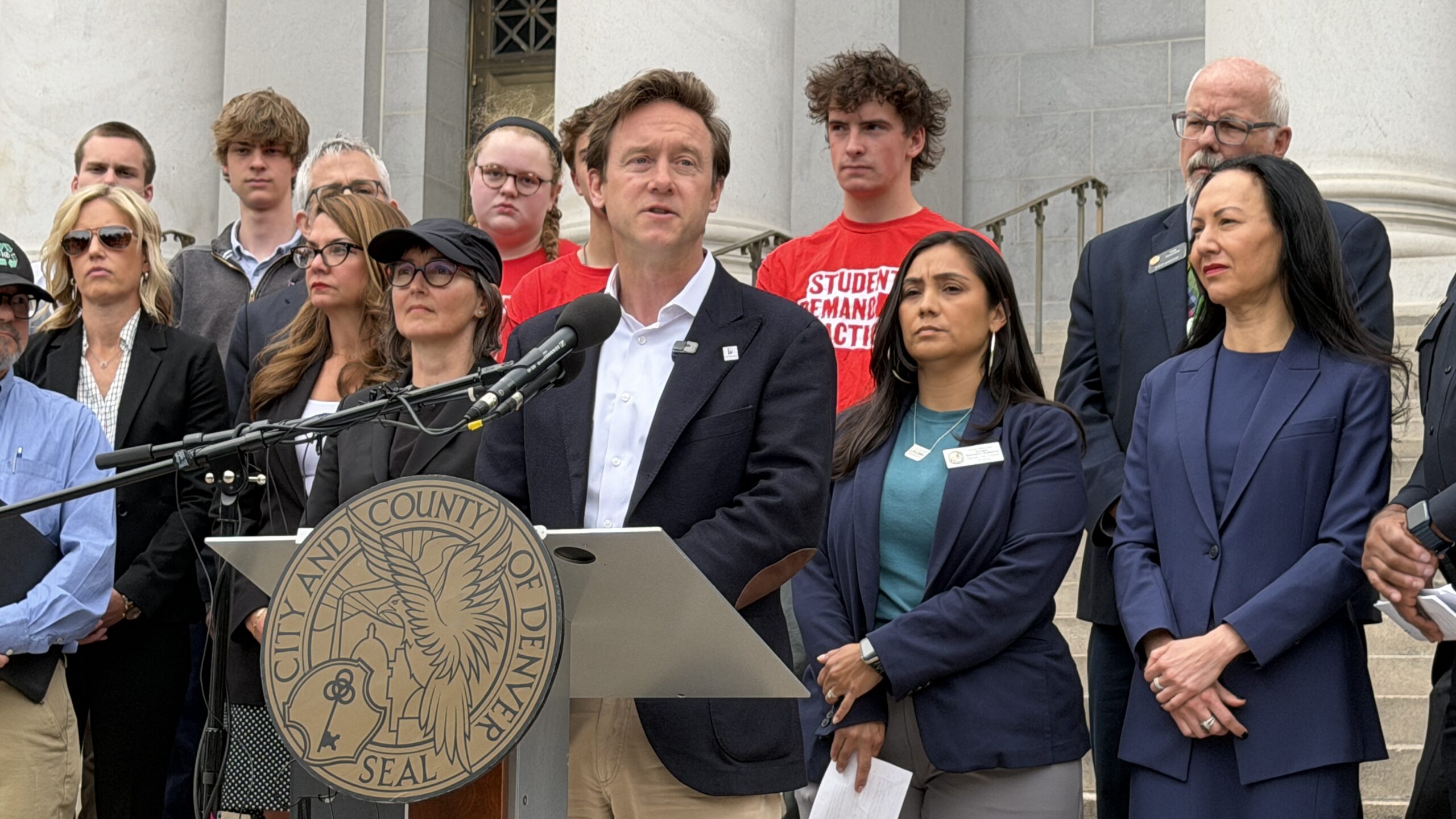
Denver officials have rejected a U.S. Department of Justice demand that they repeal the city’s longstanding ban on assault weapons.
“Our answer is hell no,” Mayor Mike Johnston told members of the press along with public safety leaders gathered at City Hall on Monday. “No, we will not roll back a common-sense policy that has kept weapons of war off of these city streets for 37 years. No, we will not put first responders at greater risk every time they respond to a dangerous incident. No, we will not go back to a time when folks are worried about walking into movie theaters, grocery stores, or public elementary schools.”
“Our answer is hell no,” Johnston told members of the press.
The demand, which arrived in the form of a letter from the DOJ, threatens a lawsuit if Denver does not comply.
“The complaint,” the letter states, “will allege that the City’s ban on AR-15-style firearms violates its citizens’ Second Amendment rights by banning constitutionally protected arms.”
DOJ officials said the department is willing to defer filing suit if Denver agrees to specific “pre-suit” negotiations to resolve the matter.
At a minimum, according to the DOJ, the city and the Denver Police Department must immediately cease enforcement of the so-called assault weapons ban; acknowledge its unconstitutionality; and enter into a court-enforceable decree permanently enjoining the city and Denver police from enforcing it or any similar ban in violation of constitional rights.
Johnston called the DOJ’s action “a sweeping overreach of the federal government.”
Denver City Attorney Miko Brown responded to the DOJ in a letter sent Monday, dismissing the request as “baseless, irresponsible, and a clear overreach of the federal government’s power,” adding that the city will “vigorously defend its ordinance if challenged.”
City officials said they are not surprised by the letter, but they do not know if Denver is the only city to receive such a request.
The city responded to the DOJ on Monday, stating that Denver has no intention of withdrawing the assault gun ban, Brown said.
As for what’s next, Brown said, “We’ll have to wait and see.”
“This ordinance has been in place for my entire career,” Denver Police Chief Ron Thomas said. “It was actually passed the year that I joined the Denver Police Department, and I am certain that not just for my fellow officers, but for all of the community, that (this) is why we’ve had less gun violence with the use of assault weapons.”
Of the 2,100 guns that were recovered by Denver police last year, Thomas said that less than 40 — or 2%— were assault-style weapons.
The DOJ’s demand comes as the Trump administration has moved to broadly challenge gun safety regulation, including loosening oversight of firearms dealers and reopening gun show loopholes.
“This idea is not abstract in Colorado.” Denver At-Large Councilmember Serena Gonzales-Gutierrez said. “We have seen way too many tragedies, and I remember this all too well, as somebody who was born and raised here in Denver, April 20, 1999, when I was a high school senior, just 30 minutes away from Columbine High School, where lives were taken and changed forever.”
Passed in 1989, Denver’s longstanding ban on assault weapons restricts the possession and sale of guns with magazines carrying more than 15 rounds.
In a statement to the press, city officials argue that “Denver retains clear legal authority to regulate firearms within its borders to protect public safety, and the ordinance is consistent with both Colorado law and the U.S. Constitution.”
“I find it interesting that the DOJ insists that Denver’s ordinance is unconstitutional,” Tom Mauser, father of Columbine High School shooting victim Daniel Mauser, said. “I would like to remind the DOJ that it is not the DOJ that determines what is unconstitutional. The courts do that.”
“This ordinance is not unconstitutional, no question about it,” Brown said, noting that the almost four-decade-old law has been tested and upheld in six different courts of appeal.
“These are not assault weapons that are in common use and regularly used for self-defense,” Brown added. “So we feel really confident that if we are challenged, we will prevail.”
Johnston has long made public safety the centerpiece of his administration, with homicides falling last year to the second-lowest rate since 1990.
Although the Mile High City just recorded one of the city’s lowest homicide totals, 37 in 2025, Johnston has said that progress is off track.
As of the city’s March 31 data, Johnston said that firearm-related homicides were flat, “not up, not down.”
The data did not include the latest string of shootings during the first weeks of April.
“Last year was a tough act to follow, as the city recorded the second-lowest homicide rate since 1990,” a Johnston spokesperson told The Denver Gazette. “That first week of April has been the biggest difference from last year to this year, but thankfully, things have slowed down since, thanks in no small part to the police department’s work to de-escalate. Still, it’s hard to extrapolate too much from a single week, good or bad, which is why we lean on more detailed data points.”
The good news, Johnston said, is that Denver has seen a reduction in shootings in its high-risk areas.
“We prioritized a focused strategy that includes economic development strategies, lighting, infrastructure, after-school programming, and officers, and it has these community groups that help build strategies and deploy them in five of those sites,” he said.
Denver has filed five lawsuits and five amicus briefs against the Trump administration to preserve congressionally appropriated funding, push back against National Guard and U.S. Immigration and Customs Enforcement deployments in cities, protect reproductive rights, and preserve the city’s values around equity, diversity, and immigration.
In March, a federal judge sided with Denver and Colorado in dismissing the Trump administration’s attempt to overrule local immigration policies.