







Rocky Flats: Art from the atomic ashes
Jeff Gipe’s ‘Half-Life of Memory’ brings our own public health disaster back home to the Arvada Center
Growing up, when my dad took the family to the company picnic, it meant roller coasters and miniature golf at Elitch Gardens. Then again, my dad worked for The Denver Post.
Here’s what happened when Jeff Gipe’s dad took his kids to the first and only family day at Rocky Flats – the long-shuttered nuclear weapons production facility 17 miles northwest of Denver:
“I see tanks rolling around, and they gave us a whole SWAT demonstration,” said Gipe, who thinks he was about 12 at the time.
Wait, what? Did you say SWAT?
(He did say SWAT.)
“They threw flash-bang grenades and conducted this whole mock drill where (actors playing) terrorists came in, and the SWAT team fought with them. They weren’t actually shooting each other, of course – but it was pretty frightening at that time.”
I don’t know. The putt-putt lighthouse with the revolving door was more my picnic speed.
It’s been 37 years since operations were halted at Rocky Flats, but the place remains an open wound for many, what with the accidental release of plutonium and its eternal physical presence in the soil. The history of government secrecy. The accidental fires and the acid spill. The unreported buried barrels. The landmark 1989 FBI raid over the illegal burning of hazardous waste. The ongoing fears about the safety of living and recreating in the area today.
Rocky Flats produced a staggering 70,000 atomic bombs, each serving as a “trigger” for thermonuclear warheads. The massive, 6,240-acre site has undergone a $7 billion cleanup and is now partially a wildlife refuge. But the half-life of plutonium is not 37 years. It’s 24,000 – which means safety in the area will never be a settled issue. (Actually, Gipe says: it will be nearly a quarter of a million years before it is “relatively less harmful”).
Gipe and I have a lot in common, both having grown up in Arvada. His dad worked at Rocky Flats for 20 years, but because he was never allowed to talk about his job at home, all Gipe ever knew was that his pops worked at the bottom of an underground office called Building 881.
(Which does sound sort of cool.)
His dad is 76 now but suffers from neurological and other disorders. “It all stems from his work there,” Gipe believes. “He’s not doing well … but at least he is still around.”
I get pretty emotional about all things Rocky Flats. My high-school best friend’s dad died of esophageal cancer after working at Rocky Flats for 17 years. Jim Downing’s lungs were contaminated with nearly 400 times more plutonium than normal, his medical records showed. He was 44 when he died. Mike and I were 15. The government settled a 26-year class-action case by agreeing to pay out $375 million to more than 15,000 downwind residents of Arvada and Westminster in 2016.
Even now, we all seem to know someone with chronic health issues that doctors can’t seem to attribute to anything other than living downwind from Rocky Flats. But that’s the insidious, consternating and highly emotional equalizer in this whole endless debate: No one can say anything with certainty. Different studies have reached different conclusions.
“The last chapter of this story has not yet been written,” said Arvada Center CEO Philip Sneed. “There’s solid science that says that Rocky Flats is perfectly safe – and that the soil that was dug up to build new homes in the area was perfectly safe. But then there’s a not inconsiderable body of science on the other side that says, ‘No, it’s not.’ I see the arguments on both sides, and most of them sound reasonable and rational.”
Which goes to show how difficult it is for those who believe the area is safe to communicate anything about the topic of risk to protesters and those whose lives are most directly impacted. The Colorado Department of Public Health and Environment has said “plutonium contamination at the site is not a threat to human health.” The Environmental Protection Agency has stated “there is no health-based reason for not visiting the Rocky Flats National Wildlife Refuge.” The U.S. Fish and Wildlife Service has posted signage that says “the refuge is safe for recreation, refuge workers and wildlife.”
But living in the area makes the question infinitely more complex and consequential.
Protesters have called for the Colorado Department of Public Health, which tracks elevated rates of cancer around Rocky Flats, to do the same for autoimmune diseases, reproductive issues, epilepsy and other health disorders. They’ve called for better soil tests and road signs that would make more plain the history of Rocky Flats. They have not been appeased.
The artist as supercollider
Gipe, a 2003 graduate of Arvada West High School, is an artist with a lifelong fascination for Rocky Flats’ complex environmental and social legacy. Over the years, Gipe has assumed the mantle of historian, preservationist, archivist and activist in his continuing quest to uncover and chronicle both the hidden history and toxic legacy of Rocky Flats.
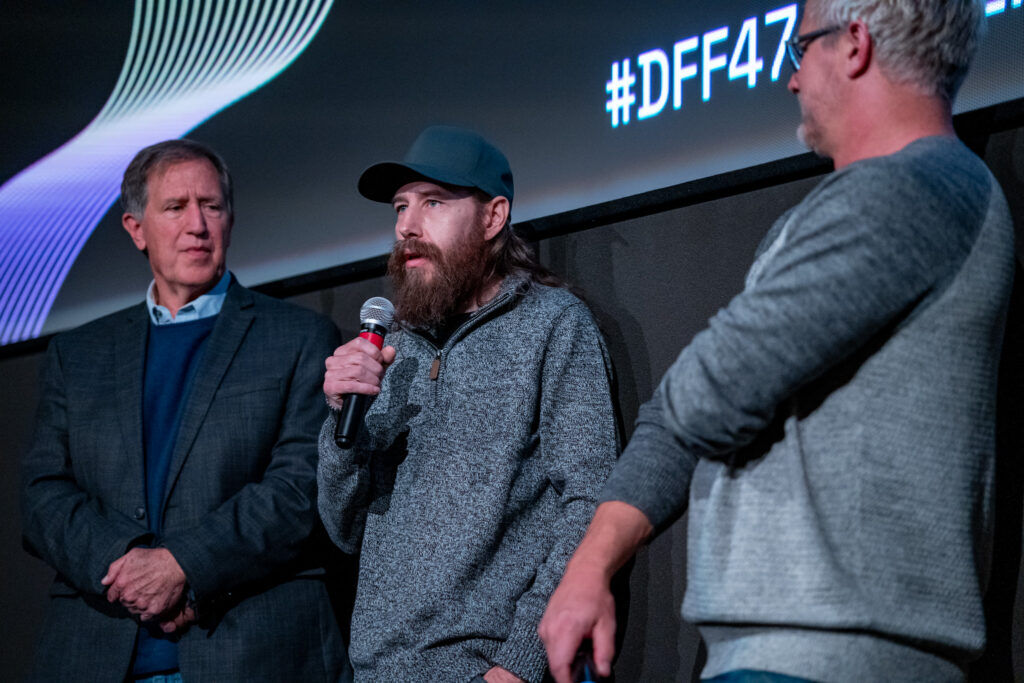
In 2024, Gipe packed several screenings of his documentary film “Half-Life of Memory: America’s Forgotten Atomic Bomb Factory” at the Sie Film Center. It was there that Mark Johnson, former head of Jefferson County Public Health, told a hushed audience: “The bravest thing I ever did in my life was to say, ‘No, I wouldn’t buy a house there,’” he said of developments around Rocky Flats. And this: “There will be people for years who will die from ongoing exposure to Rocky Flats.”
I’ll never forget meeting Judy Padilla, who worked in a lab at Rocky Flats for 22 years. Just one week before, she’d had surgery for a malignant melanoma in her left arm.
“I worked with five men who eventually got breast cancer,” Padilla told me. “One of them died at 36.” She can’t prove it, but Padilla believes at least 30 of her co-workers’ deaths since 1992 were hastened by their exposure to hazardous chemicals at work. Can she prove it? Nope. But that doesn’t make her funeral-card collection any thinner.
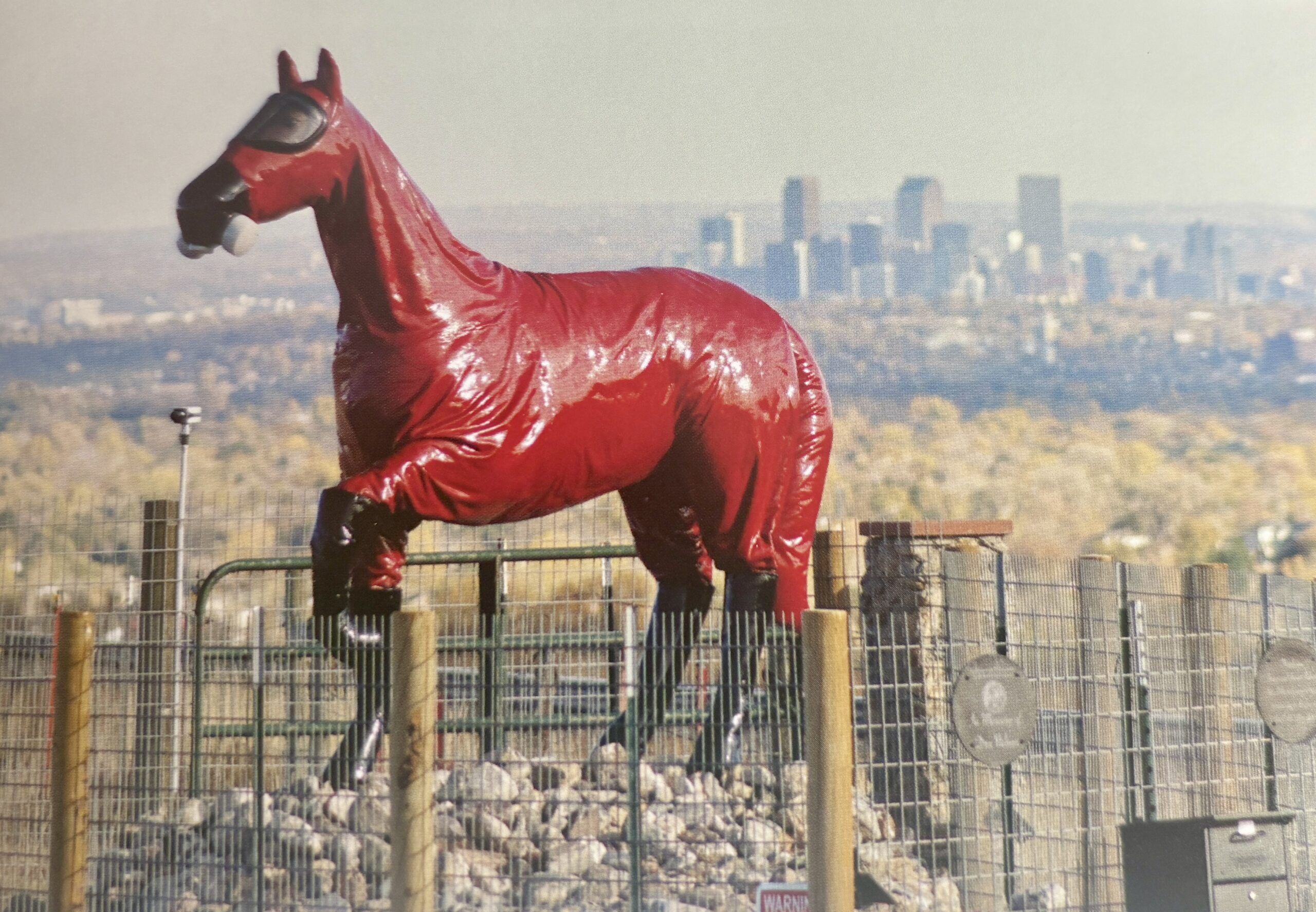
And then there was Matthew Rogers, who had recently moved his family from out of state and into a 1,500-acre planned community right across the street from Rocky Flats. He had no clue something might be amiss about any of it until well after his family settled in, when he drove past a sculpture of a life-sized horse wearing a red rubber concealment jacket and a gas mask on Highway 72.
It’s Gipe’s, and it’s called “Cold War Horse.” He considers it a memorial.
“2012 was right around the time I was really waking up to what had gone on at Rocky Flats,” Gipe said. “And that was also right when some of the housing developments were going up. So a group of us went out there one day. We passed around little flyers, and it kind of blew my mind that most of them had no clue about any of this. And some of them had already put down payments on homes.
“It just felt like something needed to be there all the time to let people know what this area was.”
Something admittedly bombastic – like a wild horse wearing a gas mask.
It took a year for Gipe to create the sculpture and two more years of going door-to-door before finally finding a homeowner who was willing to let him put the horse on their property. “Literally, it was the second-to-last house,” said Gipe. Its owners were Bruce and Janice Roberts. ”He had worked out at Rocky Flats, and he thought it was important to share the history,” said Gipe.
The sculpture went up in 2015. And it only took 10 days to come down.
“Somebody came by with what I am assuming was a truck or a tractor and pulled the whole concrete foundation out of the ground,” said Gipe. “And then they beat the horse with a sledgehammer.”
Gipe reconstructed it, put it behind a security fence and installed cameras and solar lighting. “The Cold War Horse” has now stood safely off Highway 72 between Indiana Street and Highway 93 for 10 years as a public art piece.
“I feel like a lot of my work goes a little into the realm of – I don’t want to say cheese, but – it is outrageous,” Gipe admitted with a laugh. Necessarily so, to capture people’s attention.
To Gipe, the masked horse is a symbol of industrialization and Western expansionism, and a symbol of Denver and the Rocky Mountain region. “Rocky Flats was known as the workhorse of the nuclear weapons complex,” Gipe added. “So, for me, the horse is an allegory for Rocky Flats. There are actually several horse-related pieces in the exhibit, in fact.”
Making art out of atomic waste
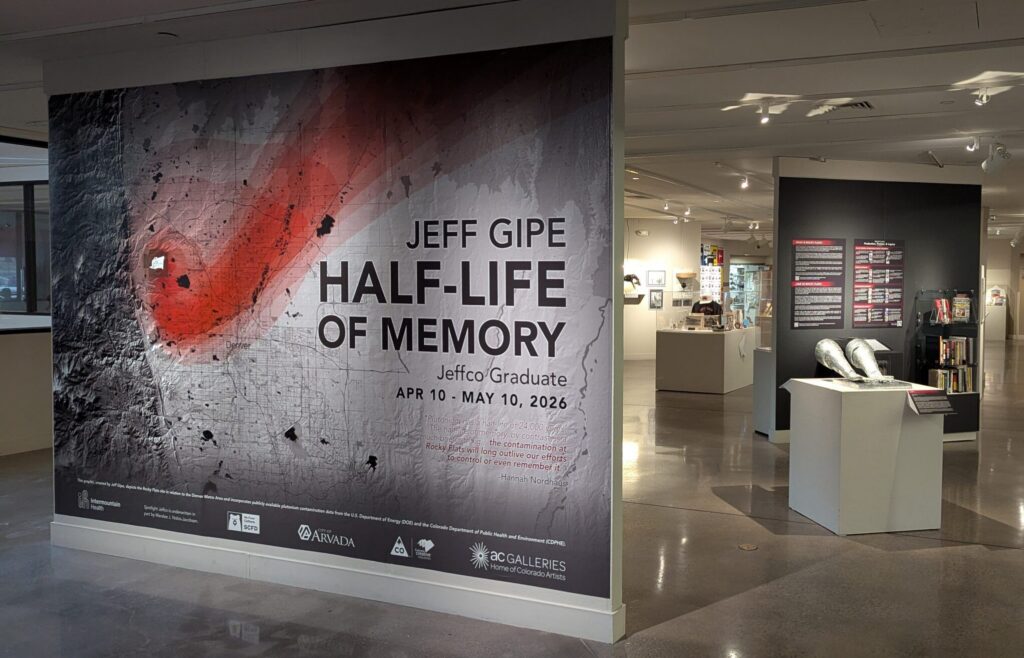
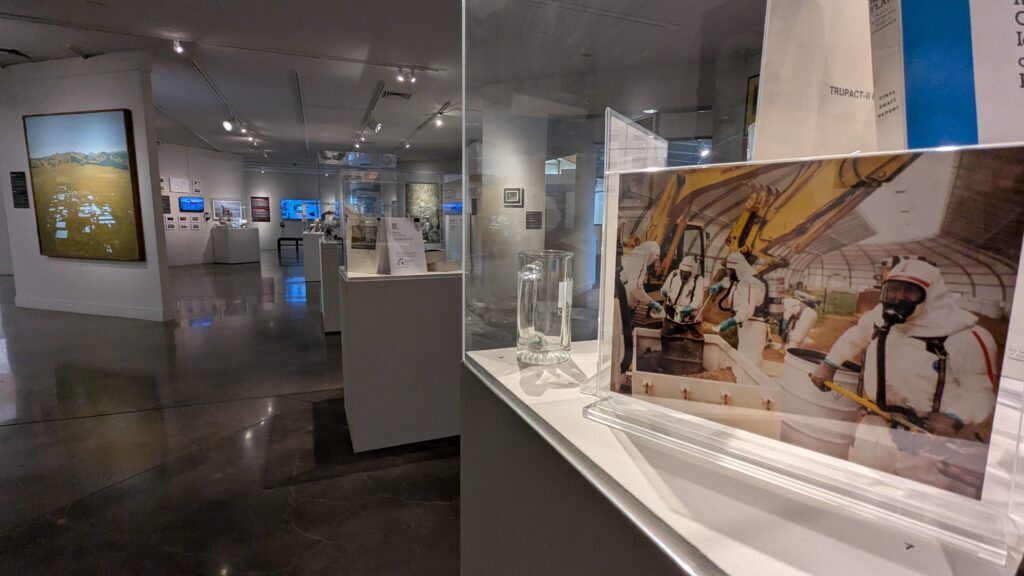
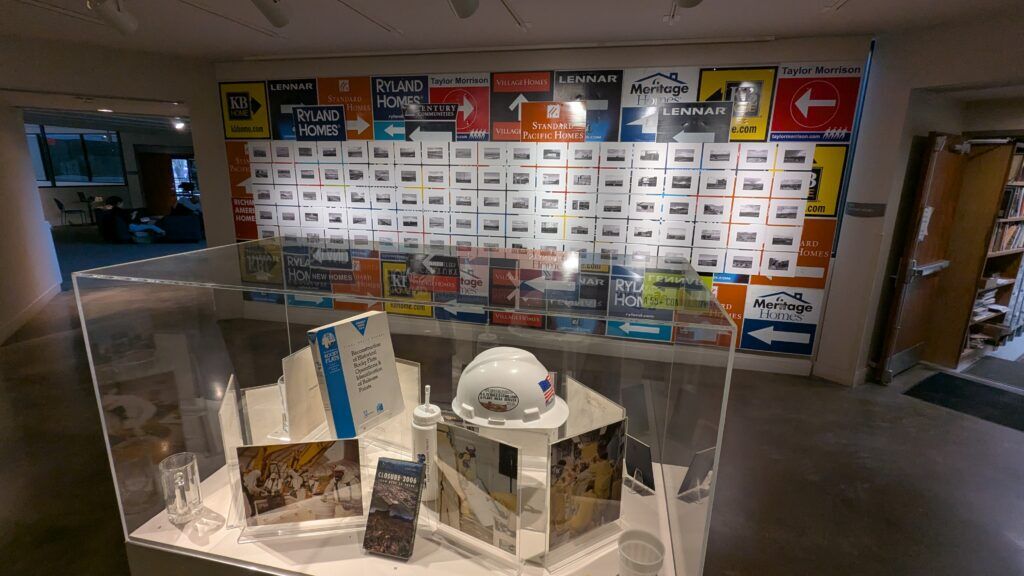
“The exhibit” is “Jeff Gipe: Half-Life of Memory.” It’s a large and compelling catch-all of personal testimonies, historical evidence, authentic artifacts and Gipe’s own artworks spanning paintings to sculptures to steel-wool photography. It’s being shown at Arvada Center – just 6 miles south of Rocky Flats itself – through May 10. It’s free – no reservation required.
“Jeff has been so deeply impacted by Rocky Flats personally,” said Collin Parson, the Arvada Center’s Director of Galleries and Curator. “At his core, he is a social and environmental artist, and his work wants to educate people about a part of our history that is already largely forgotten. I hope that that’s what this exhibit does. If it affects one person, I think it’s a win.”
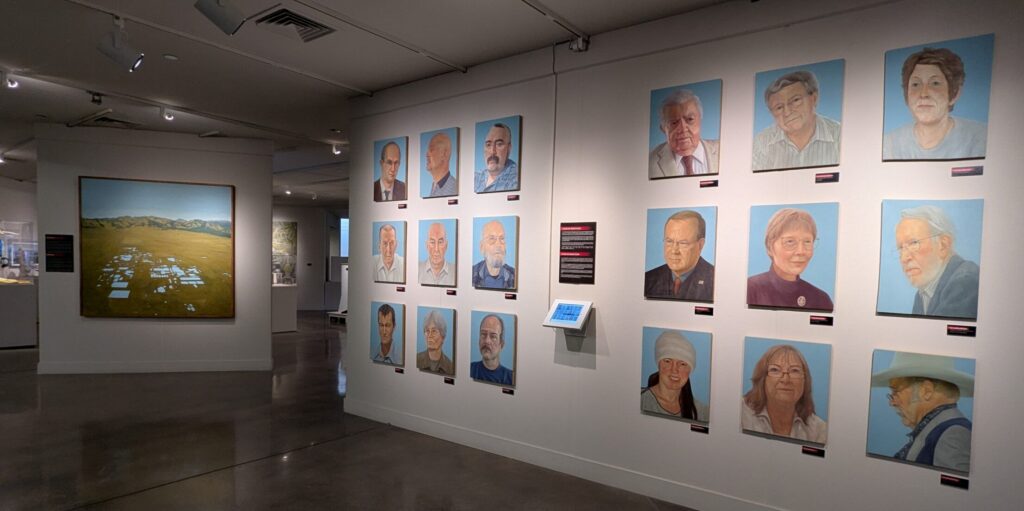
For Parson, who collaborated with Gipe on the curation and display of the exhibit, his favorite installation is a wall of portraits called “Voices of Rocky Flats.”
“There are 18 portraits displayed,” Parson said. “Some of them are former workers, others are doctors, scientists and activists all connected in some way to Rocky Flats. You can click on a portrait, and you’ll hear an audio clip of that person’s actual voice.”
Two of them are former Jefferson County commissioner Dr. Carl Johnson and NCAR radiochemist Edward A. Martell, the pair who first discovered offsite plutonium contamination at Rocky Flats – and both paid a professional price for going public.
“This is entirely Jeff’s art, and the story he wants to tell,” Parson said.
Sneed comes full ‘encircle’
For Sneed, who will retire as the Arvada Center’s President and CEO at the end of June, this exhibit is a full-circle moment. Or make that “encircle.”
Sneed grew up in unincorporated Golden in one of the first housing developments built near Rocky Flats.
“We lived in that house from 1971 through ‘79, and my father died of leukemia a few years later,” Sneed said. “Leukemia is one of the cancers that’s connected to plutonium exposure, but the problem, of course, with tracing harm back to Rocky Flats is that the cancer can be very slow-growing and can have multiple causes.”
As a college student at the University of Colorado at Boulder, Sneed drove past many recurring protests at Rocky Flats, including some that drew big names like Allen Ginsberg, Jackson Browne, Bonnie Raitt and Watergate whistleblower Daniel Ellsberg.
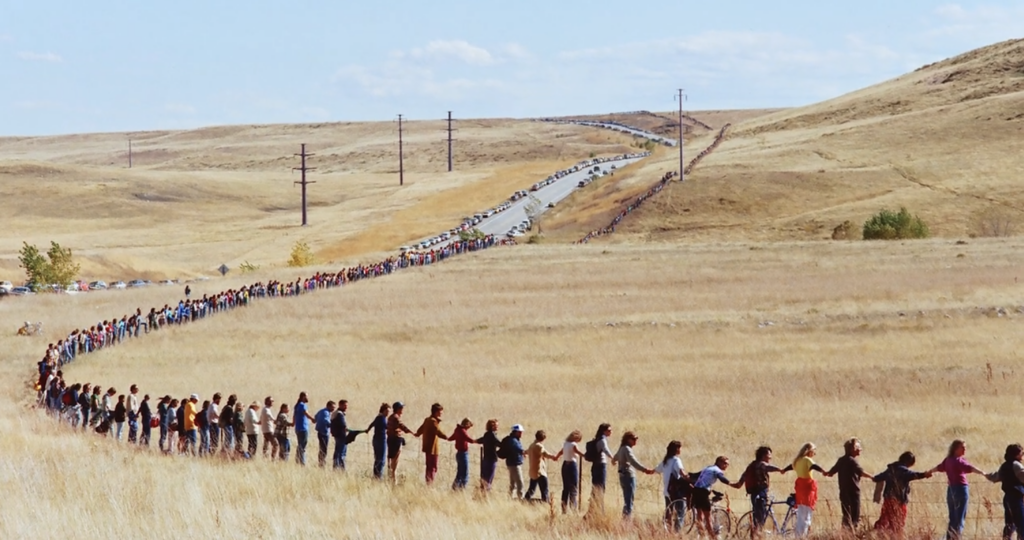
But with “The Rocky Flats Encirclement” of Oct. 15, 1983, Sneed upped his activism game.
The Encirclement was a landmark nonviolent protest in which about 17,000 demonstrators joined hands to form a (not quite complete) human chain around the plant’s 17-mile perimeter. The event was captured in a 10-minute documentary directed by Erik Sween and produced by, guess who? Jeff Gipe.
By then, Sneed was a working actor. “And right after I left The Encirclement, I got in my car and drove to the Arvada Center for rehearsals for one of the children’s plays I was acting in at the time,” he said.
In 2014, Sneed and the Arvada Center hosted a series of events to commemorate the 25th anniversary of the 1989 FBI raid on Rocky Flats – it was the first time in history one U.S. federal agency raided another.
“Bringing that event here in 2014 was our way of saying, ‘Let’s look at this. Let’s not let this die.’ And that’s still true today,” Sneed said.
“That’s why Jeff’s exhibit title is so great: Because the half-life of plutonium might be 24,000 years, but the half-life of a memory is short. People forget so quickly. I’m so glad this is one of the last exhibits that I’ll be able to say I took part in here at the Arvada Center.”
The exhibit is doubly meaningful for Parson because it runs concurrently to the 55th annual Jeffco Schools Foundation High School Art Exhibition through May 10. That concurrent exhibit is showcasing 400 artworks from students at 20 Jefferson County Schools.
In 2003, one of those students was Jeff Gipe.
For at least a dozen years, Parson has identified one Jefferson County high-school alum to feature in the Arvada Center’s upper gallery simultaneous to the annual student showcase in the main gallery. “My goal is to show the current generation of aspiring artists, ‘Look, these are some of the best artists in the state, and they attended school in the exact same district you did,” Parson said.
For Gipe, whether he’s telling the story of Rocky Flats through film, words, portraits, photographs or sculptures, the medium is not the message. The message is the message. But there is something about a museum-style art exhibit that might open people to the story differently than a documentary or book, he said.
“To me, art is so much easier to engage with than words,” he said. “I think you have an immediate visceral reaction when you see art. And the nice thing about the Arvada Center is that this is a public space that’s fairly open. I think the most impactful shows are where people come and just happen upon the art. They might not know that it’s even there until they see it. And that just opens up conversations.
“I think that’s what’s important here. No matter your view on Rocky Flats, this is something we need to talk about. That’s what this exhibit is for: To start the conversations that should be going on.”
That’s what that outrageous horse in the middle of nowhere is for, too.
“I love that you could be driving by on Highway 72, see this red horse wearing a gas mask and then pull over and ask, ‘What’s this about?’” Gipe said. “And then maybe that makes you want to read about the history of Rocky Flats. And then maybe that encourages you to delve even further into the subject. That’s what a successful public art piece does, in my opinion.
“I love ‘The Blue Mustang’ by Luis Jiménez,” he said of the 32-foot-tall, demon-eyed horse rearing up outside of Denver International Airport. (You can call him Blucifer.)
“Love it or hate it, it speaks to you. And we are always talking about it,” Gipe said. “I love that because no one ever says, ‘Yeah, I have no opinion on it.’”
It’s the same for Gipe’s “Cold War Horse.” “Either love it or hate it,” he said, “ but we should acknowledge our history. And we should teach our history to our kids.”
Before this half-life of memory fades into synaptic dust.
John Moore is the Denver Gazette’s Senior Arts Journalist. Email him at [email protected]
‘Jeff Gipe: Half-Life of a Memory’
- What: Gallery exhibit presented by the Arvada Center through May 10
- Where: 6901 Wadsworth Blvd.
- Cost: Free ticket at arvadacenter.org or at the box office
- Hours: 11 a.m.-7 p.m. Monday-Friday; 10 a.m.-4 p.m. Saturdays; noon-4 p.m. Sundays
- Special events: The April 26 screening of Gipe’s film, ‘Half-Life of Memory: America’s Forgotten Atomic Bomb Factory,’ is sold out