







Two longstanding Denver artists reflect upon New Mexican heritage
“Land of Enchantment” imprinted upon Lorenzo Chavez and Tony Ortega
Lorenzo Chavez and Tony Ortega — two Denver-based artists born in New Mexico — embody the Land of Enchantment’s longstanding aesthetics in their contemporary artworks. Both Colorado artists shared memories of living, studying, teaching and exhibiting in the New Mexican art scene for more than half a century. Each found inspiration not only in the dazzling sunlight and craggy landscapes, but also the cultural pluralism and especially the long list of notable artists who previously worked in New Mexico.
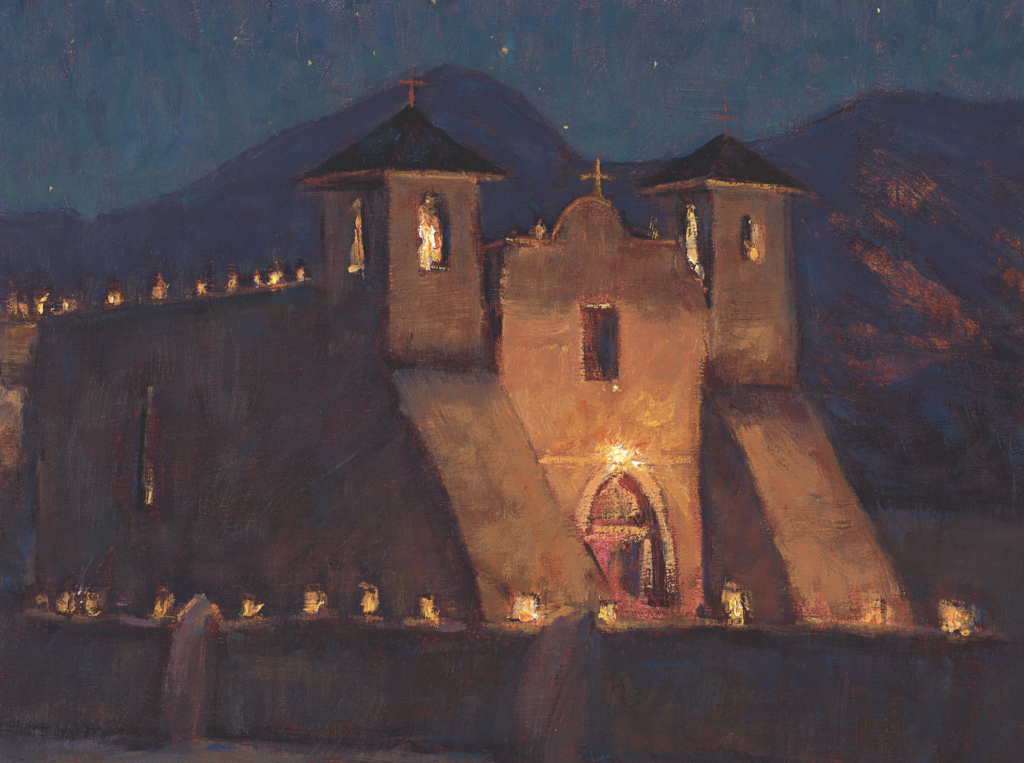
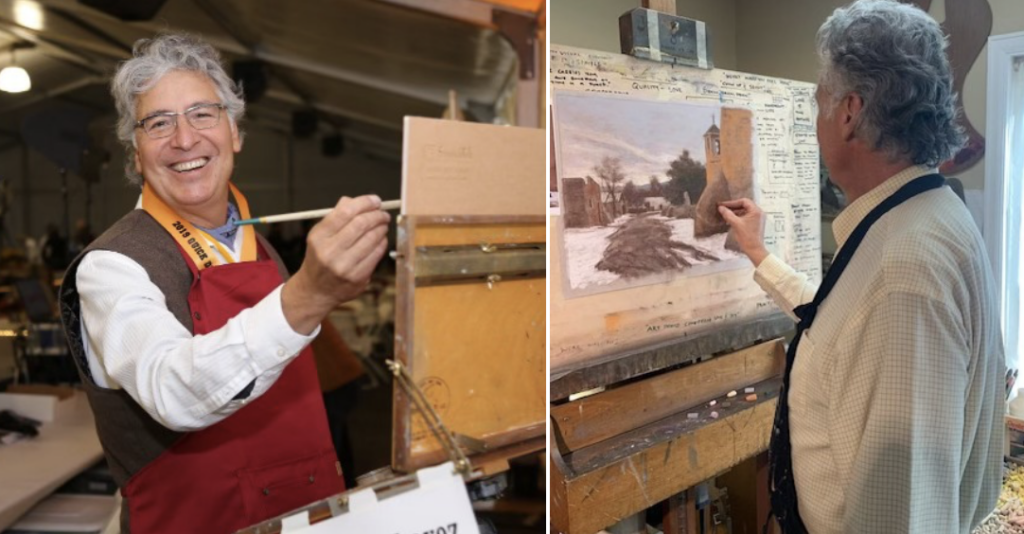
Chavez currently has three of his landscape paintings on exhibit in Greenwood Village at the Museum of Outdoor Arts (MOA) Madden Gallery exhibition titled “Beyond the Western Horizon.” He will also show works in this summer’s Colorado Governor’s Art Show, held annually in Loveland.
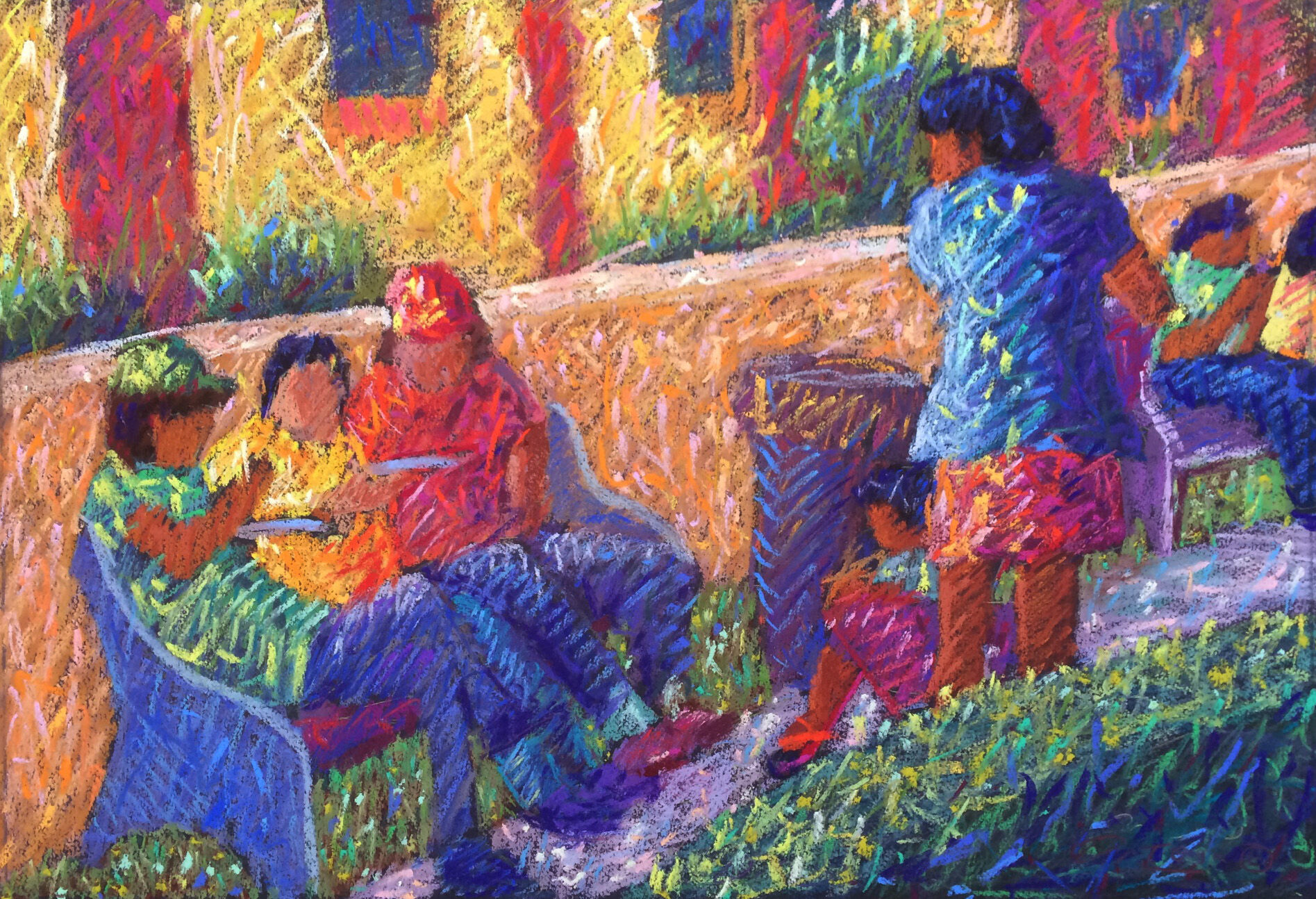
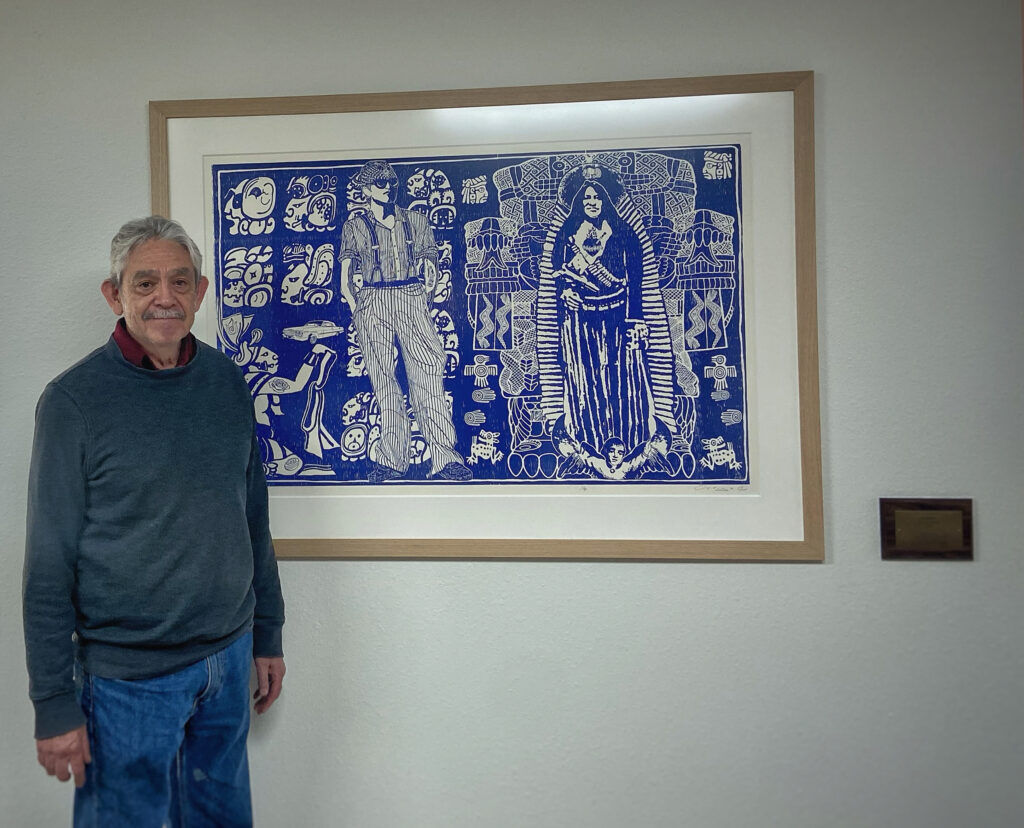
Ortega — a multidisciplinary artist known for his vibrant pastels, prints and murals depicting Chicano life — teaches art at Regis University. Ortega exhibits often and widely, currently in The Kirkland at Denver Art Museum’s exhibit titled “Round the Clock: 24 Hours of Colorado Prints.” Ortega also consistently leads the painting of community murals as public art throughout Colorado. Ortega and his wife, the artist Sylvia Montero, and their son, Ciprian Ortega, will be featured in a family exhibition titled “Tres Voces, Un Corazon” (“Three Voices, One Heart”) open May 21 to Sept. 13 at Boulder Museum of Contemporary Art.
The state of New Mexico also owns two of Ortega’s works installed as public art: Last year, at the Northern New Mexico College in Española. The University of New Mexico exhibits a large acrylic painting purchased in the late 1990s.
How a last stop in Denver started an art scene in Santa Fe and Taos
Chavez and Ortega are two of many visual artists linking New Mexico and Colorado. The story of New Mexico’s art scene includes a chapter of Denver history. The artist credited with the first acknowledgment of Taos is Joseph Henry Sharp in 1883. But the story of Taos as an art colony began in 1898 with the adventures of Bert Geer Phillips and Ernest Leonard Blumenschein. Phillips and Blumenschein had set out from New York City for Mexico City in a horse-drawn wagon. After purchasing art supplies in Denver, they headed south until hitting a rock and damaging their wagon wheel.
Mesmerized by the high desert’s dazzling sunshine and captivating landscapes, the artists opted to stay in Taos. Phillips and Blumenschein founded the famous Taos Society of Painters in 1915, together with Sharp, Eanger Irving Couse, Oscar E. Berninghaus and W. Herbert Dunton. In 1924, Ernest Martin Hennings became an active member, and in the same year, the only woman, Catharine C. Critcher, also joined the society.
In 1921, Los Cinco Pintores — “The Five Painters” — formed with members Fremont Ellis, Jozef Bakos, Walter Mruk, Will Shuster, and Willard Nash. Artworks by these foundational artists, along with prints by Gustave Baumann, can be found in the New Mexico Museum of Art, where the collection of more than 20,000 works focuses on the American Southwest. The oldest museum in the state, the New Mexico Museum of Art, built in 1917, is an art form unto itself, a masterpiece of Pueblo Revival architecture synthesizing Native American and Spanish Colonial design.
Today, Taos and Santa Fe continue to thrive with artful presence on Santa Fe’s Museum Hill and at the Santa Fe Art Auction, in the Taos Art Museum located in the Nicholai Fechin House, in the historic Mabel Dodge Luhan House, in the Georgia O’Keeffe Museum and in scores of galleries in both locations. The art history of Taos and Santa Fe is as vast as the New Mexican landscape and the stories as colorful as the trademark paintings.
Naming “The Land of Enchantment”
The state of New Mexico’s nickname — “The Land of Enchantment” — originally was the title of a book by Lilian Whiting. The moniker hints at the state’s alluring atmosphere that inspired the development of a historical and contemporary art scene centered, in particular, in Taos and Santa Fe. Defying coastal prejudices, the art colonies took shape as world-class destinations in the state, both rustic and exotic.
Ortega was born in Santa Fe in 1958. He moved to Denver shortly after, but as a boy, Ortega returned frequently to the area to visit family and later, as an adult, to exhibit his art in Taos and Santa Fe. He and his wife, the artist Sylvia Montero, continue to enjoy road trips to the area for relaxation and inspiration. But New Mexico isn’t the same as in days of old.
“I remember spending summers with my maternal grandmother between Pecos (Santa Fe), and I-25 hadn’t reached that part of New Mexico, so it was a two-lane highway and a lot of dirt roads and arroyos, and people rode on horses,” Ortega said. “As a kid in Santa Fe, the Palace of the Governors was there, the cathedral and the fine art museum. Everything else was mom and pop stores.”
At an early age, Ortega was captivated by the rustic charm of the area and the majestic New Mexican vistas.
“I still have a vivid memory from my grandmother’s wooden porch that had a vining rose bush, and I could look across the valley and see the Sangre de Cristos,” he said.
Tony Ortega’s New Mexican influences: artists and vistas
As a teen, Ortega worked for the highly decorated Denver-based artist Ramon Kelley. Ortega made a road trip to Taos with the Kelley family.
“We stopped at his gallery in Taos, and across from it was the Nicolai Fechin house, now the Taos Art Museum. Ramon strongly emulated Fechin’s work,” Ortega said. “At the time Fechin’s daughter, Eya, was running the museum. It was incredibly beautiful, and I was impressed by the aesthetic of the carving he did.”
A Russian immigrant, Fechin had moved to Taos in 1927. The artist lived there for six years. The Taos Art Museum at Fechin House exhibits the painter’s famous portraits, landscapes and still-life works in the historic home he built between in the late 1920s and early 1930s.
Once old enough to drive, Ortega ferried Kelley’s paintings from Denver to Santa Fe.
“I was definitely influenced by the landscape, the lack of cloudy days, the pastel colors,” said Ortega.
Ortega, who is part Southwest Native American, noted that he found inspiration in works by Fritz Schroeder, a Native American expressionist who taught at the Native American Art School. Ortega is represented by William Havu Gallery in Denver.
Lorenzo Chavez connects to a 1690 Spanish Land Grant
Chavez recalled learning about New Mexico’s “celebrity painters” when he was a young artist. Chavez said, “I was aware of the Taos Six in my mid-20s, and they were the hot group of young artists in the lively Taos art market.”
Chavez’s family settled in New Mexico in 1690 on a Spanish Land Grant before Albuquerque, where he was born, was founded.
“My first exposure to the art of New Mexico was when I was a little kid, and our dad would take us to the Albuquerque Art Museum,” he said. “The museum was free, and I didn’t know who the artists were, but I remember the art hit me like a ton of bricks. The paintings spoke so honestly of the land and the place and were so well done. As a young person who loved to draw, it was like magic.”
The paintings, Chavez later learned, were by the Taos Society of Painters.
“My dad would say, ‘That painting used to be in the Albuquerque High School.’ The school’s seniors would buy paintings from the Taos Society. They did it for years, and that collection eventually went to Albuquerque Art Museum.”
An artist drawn to landscapes
In his youth, the Chavez family traveled to Santa Fe to visit family or to pick apples, peaches or pinon nuts.
“A lot of the Taos artists focused on figures, but landscapes for me were the primary thing, hitting me everywhere we’d go,” Chavez said. “The great quality of light gets into so many artists. The light is pure and clear at a high elevation closer to the sun and dry with a lack of atmosphere and more clarity. And many artists are inspired by the colors with the influences of the Spanish and Puebloan cultures.”
As a young artist, Chavez spotted Ned Jacobs in a Denver restaurant and summoned up his courage to introduce himself and ask for a bit of advice.
“It was like meeting a rock star. Ned had lived in Taos, and I knew his work from a book and I recognized him,” Chavez said. “I still laugh at his advice. He said, ‘Get out now, while you can.’ It’s the best advice I never listed to.”
Painter celebrates Route 66 turning 100 in 2026
Instead of driving the highways, Chavez prefers to slow down on off-beaten paths seeking inspiration for his ongoing series of paintings titled “Back Roads of New Mexico.” He’s keen on Route 66, which celebrates a 100th anniversary in 2026. He has completed more than a dozen paintings in his series. A landscape painter for most of his life, Chavez continues to appreciate the historic adobe churches, red-tile-roofed homes, aged wooden barns and majestic landscapes he encounters on back roads of the American Southwest.
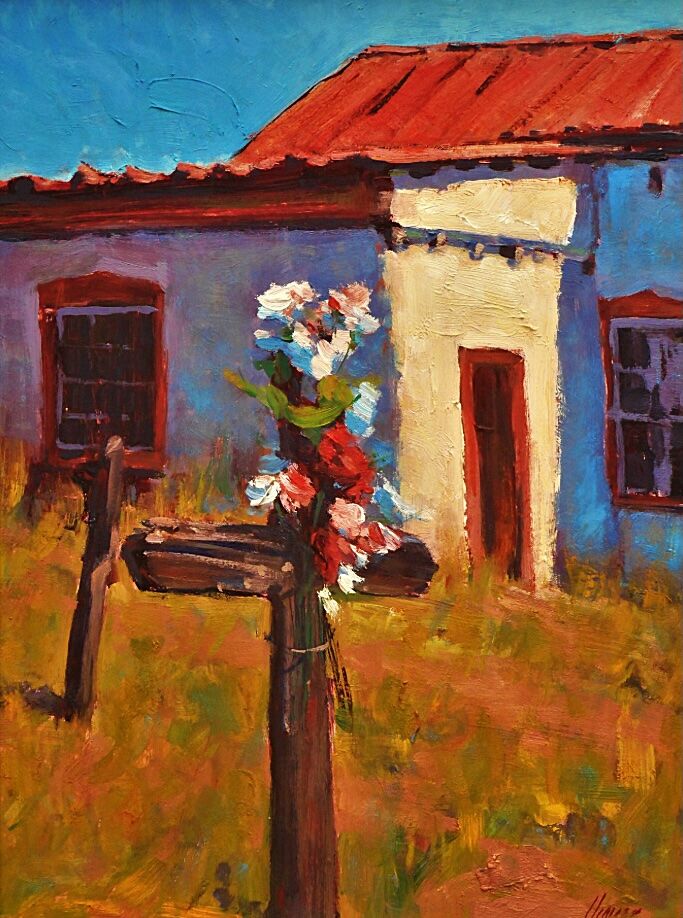
“I take the backroads. I always do, and that has done more for my painting than anything else. On the back roads, life slows down and my artistic brain clicks in, and these roads have inspired a lot of my paintings,” Chavez said.
“I’m drawn to dirt roads because I can see the history, the ruts, the dust, the way the weather has affected the roads, and for me there’s a human quality, seeing the aging, the harshness of time, the history,” he said. “I like the throwback of driving backroads that give me a chance to pull off and look at the landscape. A lot of places have changed, and I see more remnants of the past that make me imagine what these small towns were like in their heyday. On back roads, timelines converge. I like driving slowly, savoring the journey, appreciating a simplicity that allows for a transformation of my mindset. Back roads allow me time to contemplate.”
Chavez taught painting classes in Santa Fe and Taos for 18 years in the now-defunct Santa Fe Valdez Art School and continues at Bluebird Studios.
Chavez once had as a student in the actor Gene Hackman, who in 2025 died tragically at his home in Santa Fe — a place the celebrity who could have lived anywhere but chose the area for its natural beauty, artistic vibe and undeniable enchantment.