While online sales pressure retail, a Denver computer store packs in customers the old-fashioned way
In a day when almost any purchase consumers make starts out with a click online, a retail store that sells computers sounds like a dinosaur — one that should have gone extinct around the time that Tower Records (2006) and Blockbuster video (2010) did.
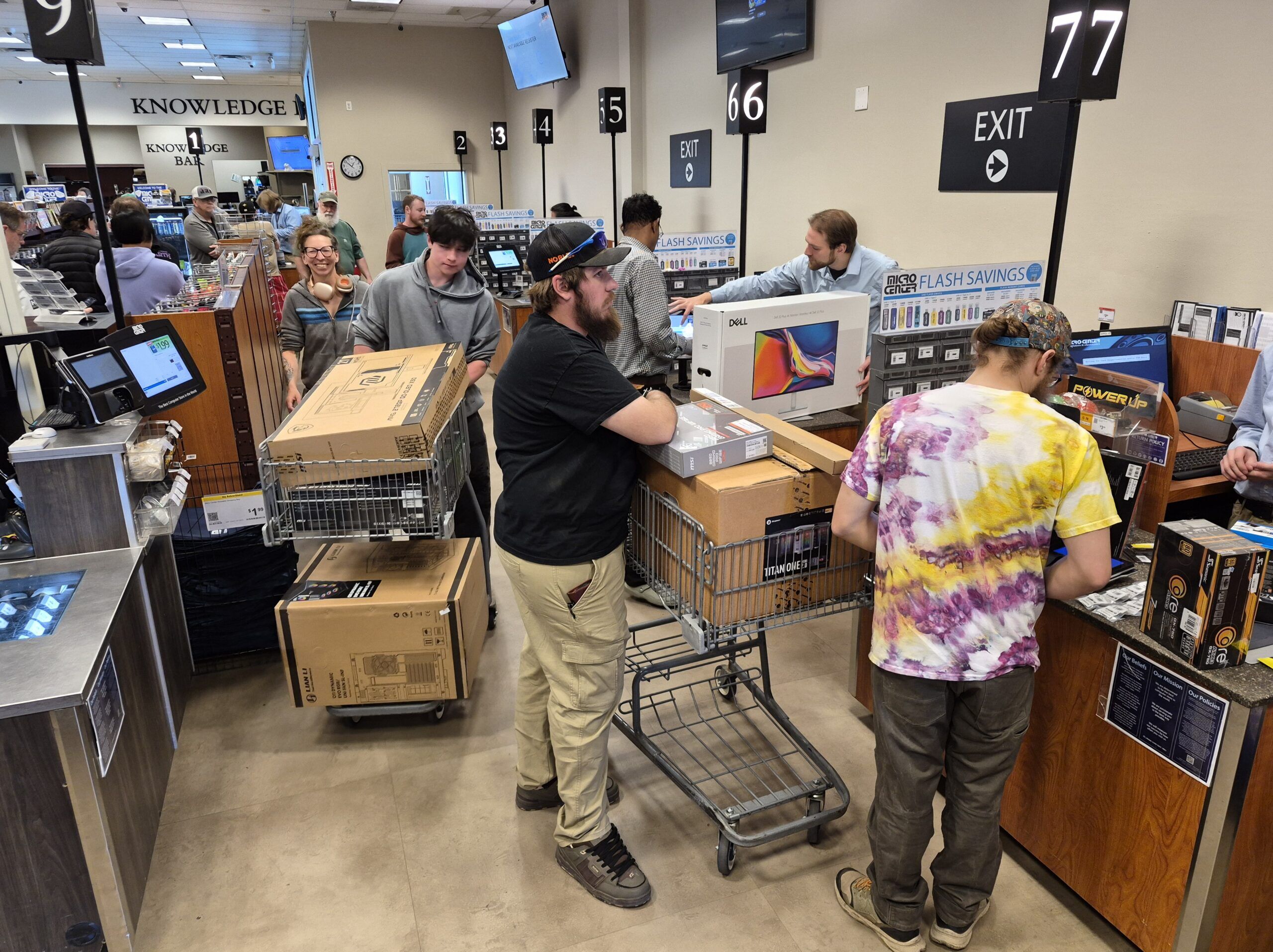
Rather, the parking lot in front of Micro Center, in a paleolithic shopping center at East Quincy Avene and South Tamarac Drive, has a packed parking lot on weekdays and is literally jammed on weekends.
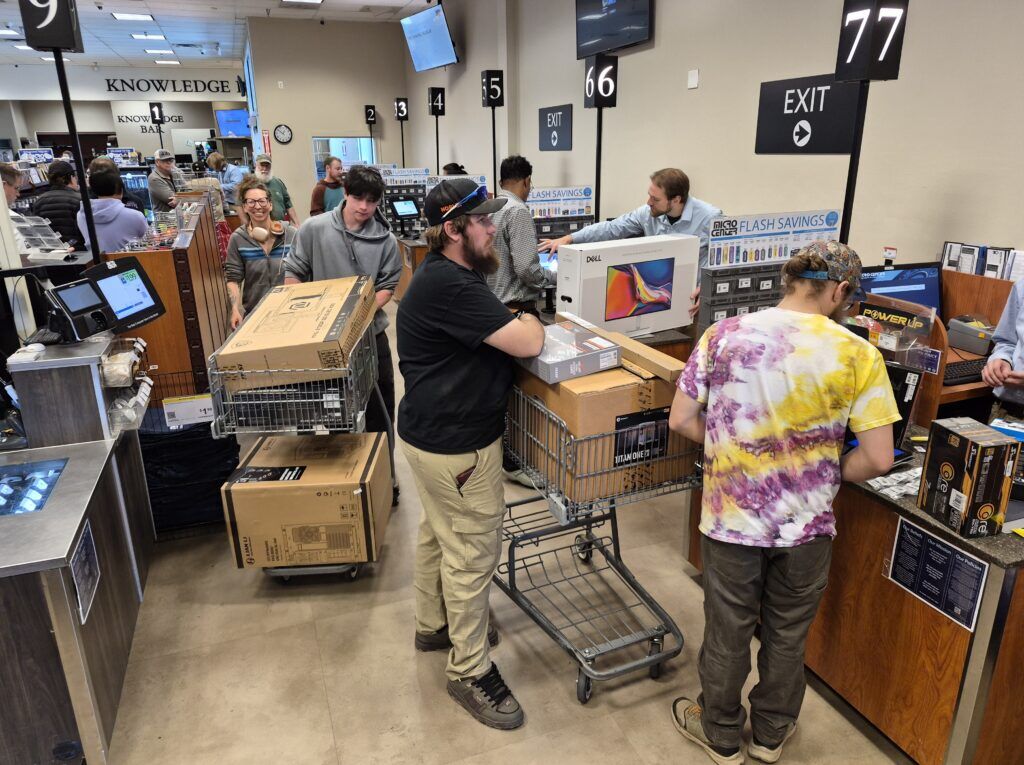
Inside, 13 checkout registers have a screen overhead that directs customers to an available station — but there are often another 20 people waiting in line, many with carts carrying large boxes.
How’s this possible, 52 years after home computer kits arrived at Radio Shack and 30 years after internet sales began eating into retail?
“I believe people still want a place to go to see the product in person,” Aaron Nolte told The Denver Gazette.
Nolte is general manager for Micro Center’s Denver store and its Colorado operation. The Columbus, Ohio, company operates 30 U.S. stores.
Want to touch it
“I believe that they want to reach out, they want to touch it, they want to have conversations with experts about it. In this store in particular,” Nolte said, “we’ve managed to continue doing that.”
That works for tech-nerds, who look much as they did in the 1970s when getting the latest gadgets was an offbeat retail experience. But it works, as well, for tech-dolts — the guy with a mouse that has a dead battery and who is essentially locked out of his PC.
“We provide an experience to the local community,” Nolte added, “so that they can still come in, have a great experience with educated people and go home with confidence.”
Getting those people-persons is the trick, he said.
“It’s challenging,” Nolte said. “We do many, many, many interviews and look for folks that have the people skills, and who also bring that passion and the knowledge and the desire to share it.”
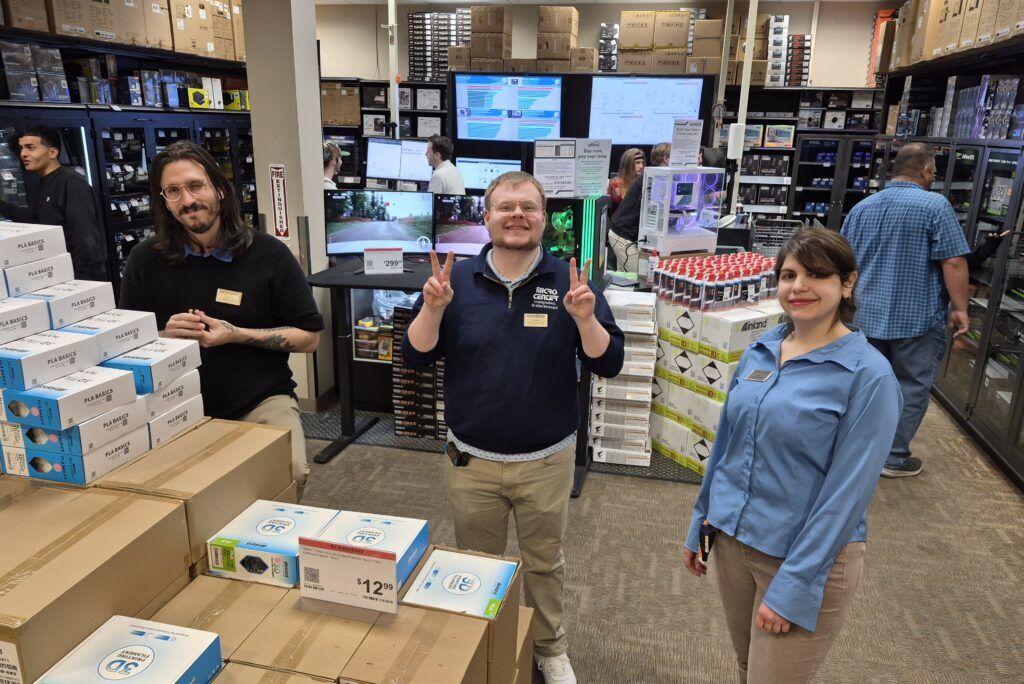
The passion is seemingly what hundreds of customers sense as they navigate Micro Center, in what was once an Albertson’s market, on Saturday afternoon. There’s a busy section of game and virtual experiences, a Costco-type lineup of big-screens, a PC/laptop showroom area, and parts and accessories shelves (including that right kind of replacement mouse).
And where there’s somebody to tell you that it’s the right one.
“People come in here and maybe they need to buy some computer ink or some paper or something like that,” explains Nolte’s sales manager Joseph Seliskar. “They say, like, ‘Oh, you do have all the stuff that the large big-box stores would provide.’”
But the person side is something the big boxes have a hard time matching.
“I have a dozen people every day tell me that this is what a big-box retailer was like 20 or 30 years ago,” Seliskar added.
“We have enough people here on the floor to spend as much time as they need with every single guest that comes in.”
Then Seliskar shows off one of those busy areas that wasn’t here 30 years back: Micro Center is doing what appears to be doing a land-office business with people who want to get into 3D printing.
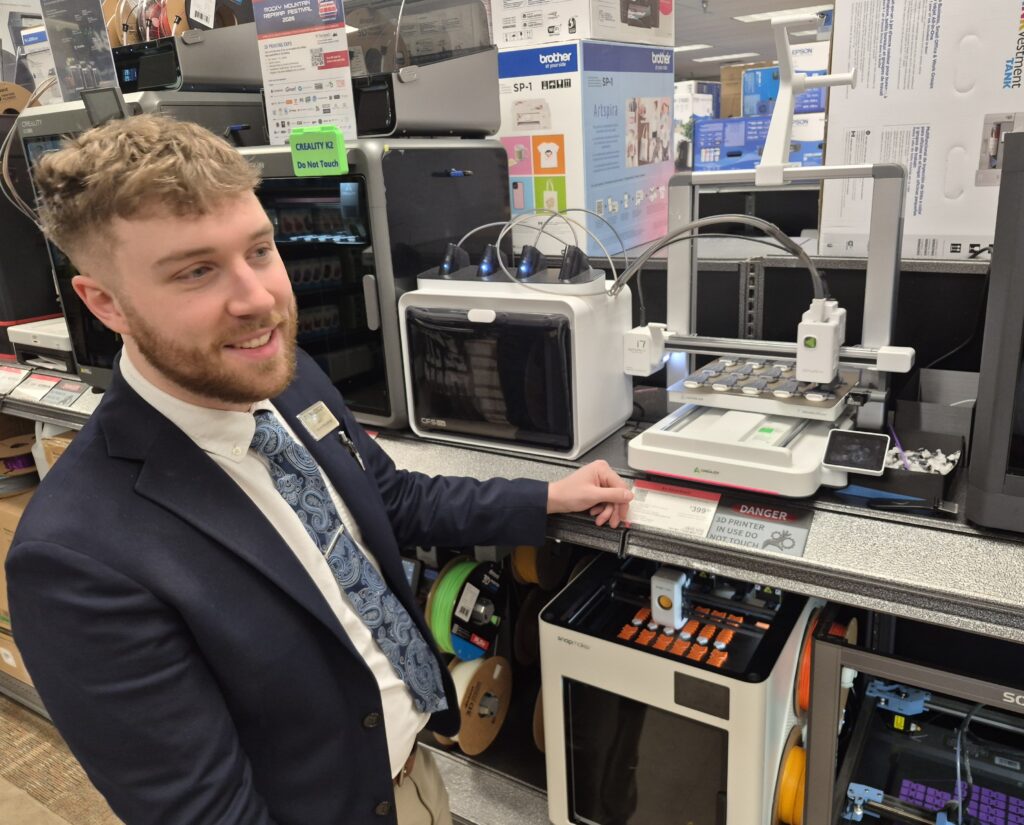
Those fascinating machines chatter away on one shelf, as a staffer stays busy explaining them. Customers, by appearance, range from ripened hobbyists in tie-dyed shirts to younger families with kids.
3D printing
Nolte, who has been with Micro Center for 17 years, originally at its St. Louis store, recalls that the Denver shop began selling 3D printers around 2010.
“It was still very expensive,” he recalled, guessing price tags were in the thousands-range.
“Now you could come in and spend $300 to $600 and really have some fun with it,” Nolte said. “It’s evolving and changing and it’s bringing a lot of traffic to our store.
“We hand out little trinkets to children (printed on the 3D devices) that come in and they’re always fascinated by it.”
All of this began in 1979, when former RadioShack employees John Baker and Bill Bayne launched their enterprise in Columbus, close to the orbit of Ohio State University. The private company doesn’t disclose the current earnings from its 30 stores, but rough estimates range from the low billions gross.
Early expansions included New York and Silicon Valley. In 1999, Micro Center moved into this space that another tech store had occupied long after its days as a grocery. The site, near Yosemite and I-225, lay at the edge of the Denver Tech Center.
Nolte is hesitant to offer a marker on how well the single Colorado Micro Center is doing. Of its 29 national affiliates, several are in California and a new one just opened in Phoenix. That store, he notes, is a custom-built, high-bay space, rather than a converted Safeway or Albertsons.
Nevertheless, customers coming by this month can see a newly installed display area for Apple/Macintosh products, much as they might in a shopping mall.
Single location
What markers might Nolte offer about just how well he is doing in Denver today?
“My answer’s going to make you laugh,” Nolte said. “It’s what I feel and experience day in and day out in this building. My conversations with customers, that’s how I gauge our success in this store.”
After continuing to draw them in decades after they might have disappeared to online sales, how was traffic impacted six years back during the COVID-19 pandemic shutdown, when customers were told to stay home?
“We stayed open and they flocked to our store,” Nolte said.
Now, with the traffic this single location is doing, couldn’t Micro Center open a shop along the Denver-Boulder Turnpike corridor or in Colorado Springs?
“We probably could,” Nolte said.
He notes that although the marketing model is largely word-of-mouth, he often talks with customers coming down from Cheyenne.
“But being an employee for almost 17 years, I don’t know if cautious is the right word, (but) I think if you look too far out in the future or expand too quickly, you risk losing that.”