







Experienced climber dies after summiting dangerous Colorado fourteener

Fourteener climbing in Colorado is a high-risk activity that can result in serious injury and death, even among the most experienced.
On Sunday, September 27, the body of a male climber was found in the area of Crestone Needle – a Sangre de Cristo Range peak that’s considered to be one of Colorado’s most dangerous 14,000-plus-foot mountains. The body was later identified as Jeff Deardorff, an experienced Colorado climber that had summited many of the state’s highest peaks.

Search and rescue personnel on Crestone Needle during the early morning hours. Photo Credit: Custer County SAR (via Facebook).
According to Custer County Search and Rescue, Deardorff was last seen on the 14,197-foot summit of the Crestone Needle on Friday, September 25. Search and rescue teams were notified that the man was missing late on Saturday night.
The search for Deardorff was started at 3 AM on Sunday, with spotters locating him at approximately 1 PM. Upon reaching the Deardorff, it was determined he was deceased.
The recovery process was quite complicated, not completed until after 9 PM. It involved lowering Deardorff’s body 100 feet down the mountain to a point where it was safe for a helicopter to extract it.
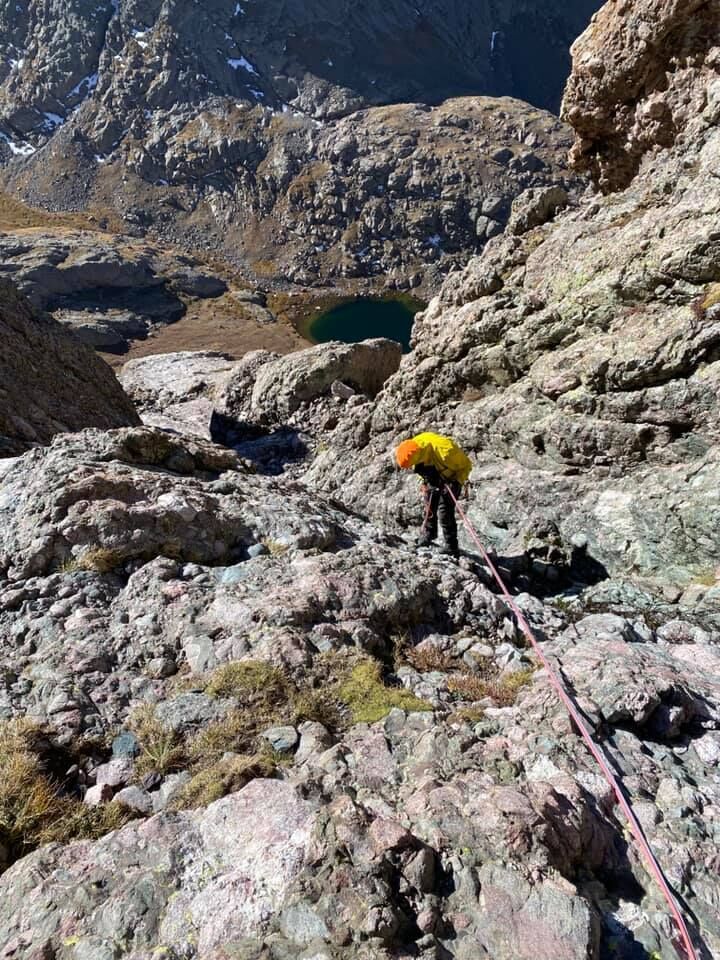
A search and rescue team member moves down technical terrain during the mission to find and recover a missing hiker on Crestone Needle. Photo Credit: Custer County SAR (via Facebook).
According to a report from CBS Denver, Deardorff took a fatal fall during his descent from the summit.
Images from the scene of the recovery show snow present on some parts of the mountain, while other portions of trail and slope remain dry. It is unclear if slick conditions played a factor in the fatal accident.

A search and rescue team member on snow terrain during the mission. Photo Credit: Custer County SAR (via Facebook).

Crews operate on snowy terrain. Photo Credit: Custer County SAR (via Facebook).
Custer County Search and Rescue posted a heartfelt message on Facebook about the incident:
“We cannot begin to imagine the tragic heartbreak this places on Mr. Deardorff’s family and friends. To further that, the Colorado hiking community as a whole.
As an all volunteer organization, Custer County Search and Rescue understands and fully respects the inherent dangers, magnitude and impact of the jobs we perform. The sadness of an outcome like this is not lost on the rescuers, and is felt across our organization.”
Crestone Needle is one of the state’s most dangerous and most challenging fourteeners. The standard route to the top is a class three hike with 4,400 feet of vertical gain and 12 miles of distance round trip. The Crestone Needle is also on one side of the infamous Crestone Traverse, which links the mountain to Crestone Peak across a dangerous class five route. The terrain on this mountain is exposed, loose, and technical. In some cases, a single slip could mean death.
If you’re off to climb any of Colorado’s fourteeners, it’s important that you’re extremely aware of the risks and that you heavily research the route beforehand. Be aware of the weather and plan ahead by determining route conditions before your hike. During the spring and fall, lingering snow from past storms can stick around for a long time thanks to frigid high-elevation temperatures.
Always be prepared for a worst case scenario. Consider bringing along an emergency communication device, such as the Garmin inReach and always tell people where you’re headed and when you’ll be back, including what specific route you’ll be on.
It’s impossible to remove all of the risk, even with the right gear and ample experience. However, taking every effort possible to minimize the risk can be the difference between life or death.
Condolences go out to the friends and family of Jeff Deardorff during this difficult time. Thanks goes out to the many organizations involved in this search and recovery mission, including Custer County Search and Rescue, the Colorado Search and Rescue Association, Western Mountain Rescue Team, Flight for Life, Saguache County Search and Rescue, Custer County Sheriff’s Department, and dispatchers at Fremont County Communications.
If you’re looking to help support Colorado search and rescue, consider purchasing something called a CORSAR card. Learn more about that here.


Metro Moves: BMC Investments hires new partner and CIO
Bernadette Berdychowski
bernadette.berdychowski@denvergazette.com
Updated 2 hours ago
Welcome to the Denver Gazette’s Metro Moves. You’ll get the latest metro Denver openings, closings, hiring and promotion news here. To submit your company’s news, drop an email to bernadette.berdychowski@denvergazette.com. BMC INVESTMENTS NAMES A NEW PARTNER After a national search, Denver-based...

Bernadette Berdychowski
Reporter

Woman stabbed at Union Station
Dennis Huspeni
dennis.huspeni@gazette.com
Updated 3 hours ago
A woman was hospitalized, and another is in custody on charges of stabbing her repeatedly, after what appeared to be a random attack at Denver’s Union Station Sunday night. Denver Police Department officers confirmed the attack and the arrest of...

Dennis Huspeni
Reporter

Former Jeffco security guard found guilty of sex assault on a child
Sage Kelley
sage.kelley@denvergazette.com
Updated 2 hours ago
A Jefferson County jury found a former school security guard and pastor guilty of sexual assault on a child by a person in a position of trust. The jury deliberated on Friday after a four-day trial, eventually finding that 68-year-old Rubel...

Sage Kelley
Reporter

Colorado snow outlook bleak through end of January, but one key chance of notable snow
Spencer McKee
spencer@outtherecolorado.com
Updated 3 hours ago
With Colorado’s snowpack at about 59 percent of the norm as of January 19 (the lowest it’s been since records started in 1987), the state’s skiers and snowboarders are eagerly awaiting the next winter storm. After an overnight tease of...
Spencer McKee
Reporter

Denver District 10 launches test program to pay pet deposits
Deborah Grigsby
deborah.smith@denvergazette.com
Updated 3 hours ago
Denver’s self-proclaimed “pet whisperer,” Councilman Chris Hinds, has launched a new program to help renters avoid having to choose between a home and their pet. Funded through Hinds’ own council budget, the program seeks prevent relinquishment, as well as unnecessary...

Deborah Grigsby
Reporter

Silverton first Colorado city to hit Prop. 123 goal
Mark Samuelson
mark-samuelson@denvergazette.com
Updated 1 hour ago
The historic mining town of Silverton has become the first local government to meet the housing commitments of Colorado’s Proposition 123, passed by voters in 2022 to promote the launch of thousands of affordable housing units. The alpine community, population...

Mark Samuelson
Reporter

Trump says he no longer thinks ‘purely of peace’ in Greenland dispute, cites not getting Nobel Prize
Emily Hallas, Washington Examiner
emily.hallas.washington.examiner@gazetteedit.wpenginepowered.com
Updated 2 hours ago
U.S. President Donald Trump told Norwegian Prime Minister Jonas Gahr Store that he no longer feels obligated to think “purely of peace” in his quest to take over Greenland and cited not getting the Nobel Prize last year — when...

Emily Hallas, Washington Examiner
Reporter

Powell will attend Supreme Court hearing on Trump power to fire Fed governor
Zach Halaschak, Washington Examiner
zach.halaschak.washington.examiner@gazetteedit.wpenginepowered.com
Updated 4 hours ago
Federal Reserve Chairman Jerome Powell will attend oral arguments at the Supreme Court for a case in which President Donald Trump is testing the bounds of his power by attempting to fire a member of the central bank’s board of...

Zach Halaschak, Washington Examiner
Reporter

Ed Markey calls to ‘invoke the 25th Amendment’
Jenny Goldsberry, Washington Examiner
jenny.goldsberry.washington.examiner@gazetteedit.wpenginepowered.com
Updated 4 hours ago
Sen. Ed Markey (D-MA) called to remove President Donald Trump from office via the 25th Amendment due to Trump’s recent efforts to acquire Greenland. Markey was responding to the letter Trump sent to Norwegian Prime Minister Jonas Gahr Støre. This...


China’s population shrinks for fourth consecutive year, intensifying fears about future
Emily Hallas, Washington Examiner
emily.hallas.washington.examiner@gazetteedit.wpenginepowered.com
Updated 4 hours ago
China’s population rate declined again last year, as the country grapples with how to revive birth rates 10 years after ending its decadeslong one-child policy. China’s birth rate in 2025 stood at 5.63 per 1,000 people, according to government data...
Emily Hallas, Washington Examiner
Reporter