







9News meteorologist ‘keeps it real’ sharing her experience with skin cancer
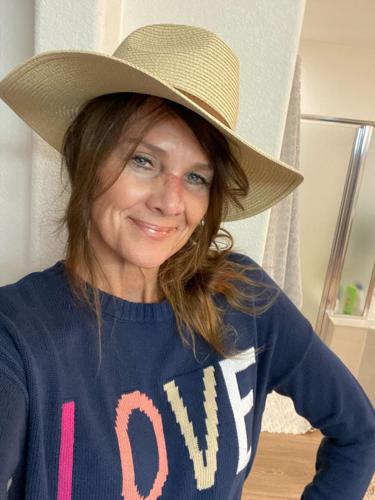
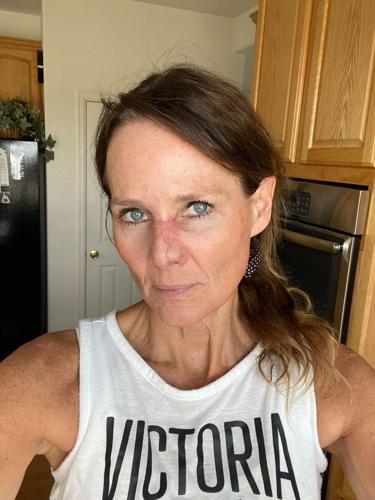
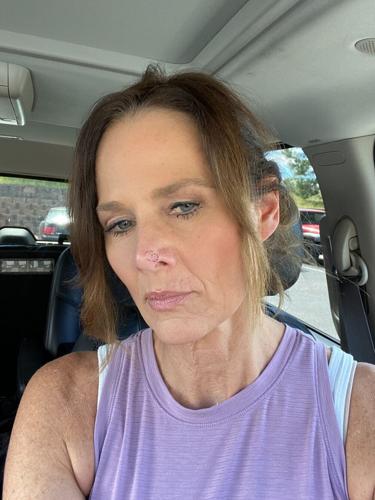
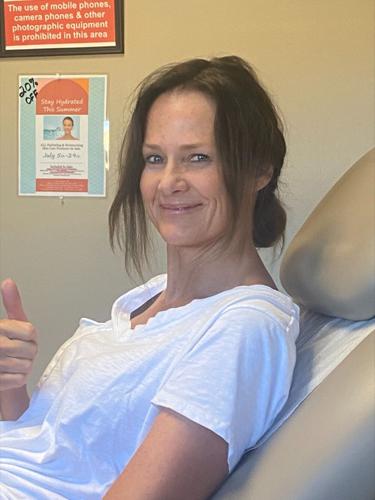
Kathy Sabine shares photos of her Mohs surgery for skin cancer and her recovery. (Courtesy of Kathy Sabine)

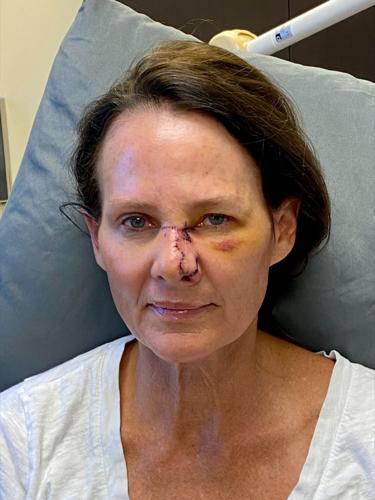
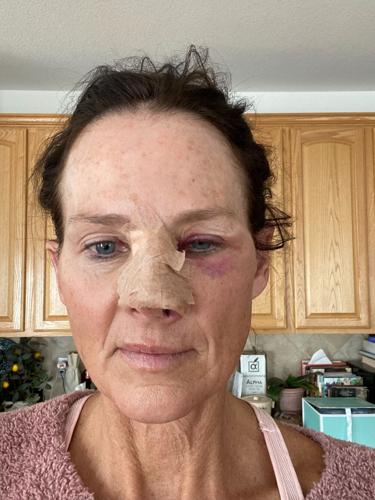
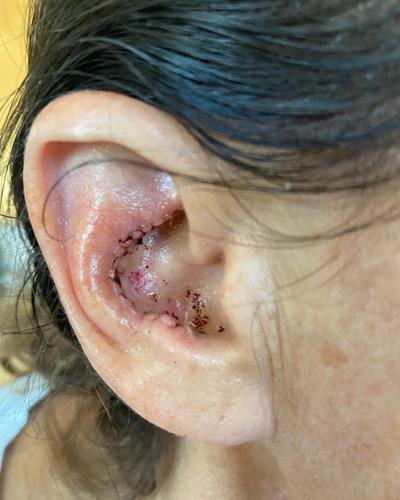
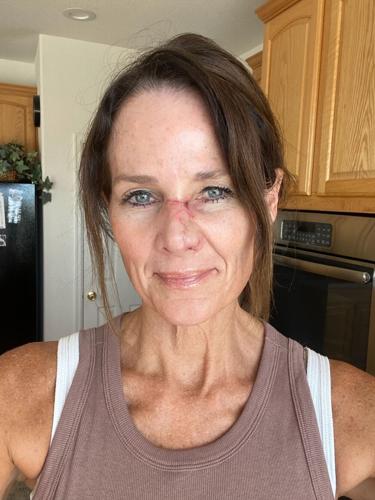
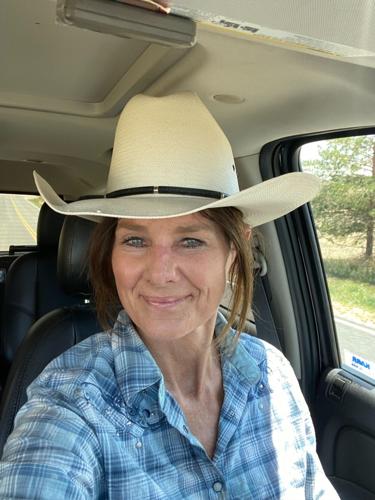
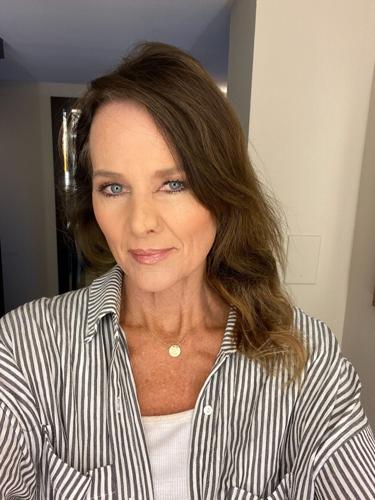
For 29 years, seven-time Emmy Award-winning 9News Chief Meteorologist Kathy Sabine has enjoyed the challenge of forecasting Colorado weather.
She said that given the number of people who live an active, outdoor lifestyle, weather forecasts in the state are important. And they can be a matter of life and death.
“I love the challenge of trying to forecast and communicate that information to people so they can make good decisions to protect their families and themselves,” she said.
She’ll have another important bit of information for viewers when she returns to work on Wednesday , following a recent bout with skin cancer.
Get checked.
Just 20 minutes can save your life.
Growing up in Lake Tahoe, Calif., Sabine has enjoyed the outdoors all her life. She learned to ski at 2 years old and grew up hiking, biking, and enjoying the mountains, she said. Twenty-nine years ago, she decided to take a job with 9News. Colorado’s mountains made for an easy transition for the native Californian.
As she aged, Sabine said a lot of people around her had skin cancer and had to have surgeries, so she got into the habit of getting checked yearly.
Six months ago, she noticed age spots on her face but one on her nose seemed different. She had the spot checked and nothing came back abnormal. However, Sabine mentioned the spot again during a recent trip to the dermatologist. Dr. Leslie Capin, founder of Dermatology Associates of Colorado, saw a subtle spot on Sabine’s nose that looked pearly after she cleaned it with alcohol.
Capin was worried it was a basal-cell carcinoma, which is a far less lethal type of skin cancer than melanoma, but difficult to diagnose given that they are so subtle. Capin recommended Sabine get a punch biopsy, where doctors could remove a skin core and test it.
Sabine followed Capin’s advice and had her punch biopsy the day of her son’s graduation, May 26. A few days later, she was diagnosed with skin cancer resulting from a hybrid of basal and squamous cell carcinomas.
Sabine said she didn’t really pay much mind to the situation when she was told to get a punch biopsy, but the diagnosis left her shaken. She had a birthday coming up and plans with her two older kids. She felt anxious and scared. She didn’t tell anyone at work.
“When (my doctor) told me, I was shocked. I felt a few tears coming,” she said. “I’m busy. I don’t have time for this.”
But despite it all, Sabine knew she had a great team of doctors supporting her. Capin had dermatologist Dr. Alison Basak perform Mohs surgery on Sabine with plastic surgeon Dr. David Archibald reconstructing her nose afterward.
Developed by Dr. Frederic Mohs in 1938, Mohs surgery allows doctors to remove skin cancer while leaving as much healthy tissue as possible, Basak said. Doctors will use a scalpel to remove the edge of a cancer, put the sample of skin under a microscope and determine whether there is still cancer. The process continues until all the cancer is removed.
Basak said skin cancers are a lot like icebergs, which can appear small on the surface but have a deep connection of roots underneath.
The surgery was supposed to take an hour, but Sabine ended up being there for four hours when Basak discovered a second spot, which was benign, at the top of Sabine’s nose and a third spot, another cancer, between her eyes.
Basak said a challenge with skin cancers located on the nose is restoring both the form and function of the body part after the procedure. To that end, doctors will either use skin grafts or skin flaps. Skin grafts are taken from another part of the body . There’s no blood flow. Skin flaps have some connection to the affected region and are loosened or slid into place to hide the work that was done.
With Sabine’s nose, Archibald had to use skin from her forehead and cheek along with cartilage from her ear to give the nose some sturdiness; otherwise, it could have collapsed inward. The cartilage helps to recreate the nose curve, Basak said.
Sabine’s surgery was July 8, and she’s shared pictures of her recovery day by day. As each day goes by and her face heals, Sabine grows more sure of her recovery and that she will be OK.
“I am woman on television, and I’m an aging woman on television, but I feel like I have the support of my employer and the folks at 9News that I don’t need to worry about that,” Sabine said. “I feel like if I come back and my nose doesn’t look exactly the way it used to, (the viewers are) gonna cut me some slack.”
Her willingness to address what she’s been through publicly has caused other to consider their own epidermal health. Sabine said people are sharing their stories with her and she knows of at least 100 people who have gone to get their skin checked as a result of her story.
“Watching you every night on 9News, so poised and articulate and gracious, and now so willing to share your story, I am finally moved to rest my ‘it won’t happen to me’ defense and start taking the necessary precautions I should have been taking all along,” one person wrote.
“If there’s one silver lining in your having to go through all this, it’s the potential of your persuading some sun worshipers out there to take doctors seriously,” another person wrote. “Thank you from us parents/grandparents/spouses who could use the backup.”
Archibald, who performs about 20-30 skin cancer-related surgeries at week, said skin cancer is separated into two categories: Melanoma and non-Melanoma cancers. While not fatal, non-Melanoma cancers should be dealt with quickly once found, Archibald said. If left untreated, skin cancers can lead to disfiguration and compromise the function of certain body parts such as the nose. They also can lead to chronic wounds.
He said Colorado residents are especially at risk for skin cancer exposure because of the state’s higher elevations and the multitude of sunny days. According to him, most Coloradans will experience a skin cancer diagnosis in their lifetime.
To that end, Sabine plans to continue her advocacy for taking skin care seriously even when she returns to her post as 9News’ 4 and 5 p.m. meteorologist. She said she will reach out to 9News about doing a public service announcement or a series on the issue.
This ordeal is another chapter of Sabine’s life that she has chosen to share with her viewers and her community. Over the nearly three decades she’s been on air, she said she’s connected with her audience as the girl next door, as a wife, mother, a daughter and a neighbor. She believes the experiences have strengthened her bond with her following.
“I’ve always just tried to kept it real with people, because they think if you’re on TV, you’re not a real person and your life is just perfect,” she said.