







New Aurora police ‘transparency portal’ shows crime stats, demographics, use of force

FILE PHOTO: Aurora Police Department interim police chief Heather Morrison stands for a photo on Tuesday, Jan. 23, 2024, at the department’s headquarters in Aurora, Colo.(Timothy Hurst/Denver Gazette)
Timothy Hurst/The Gazette

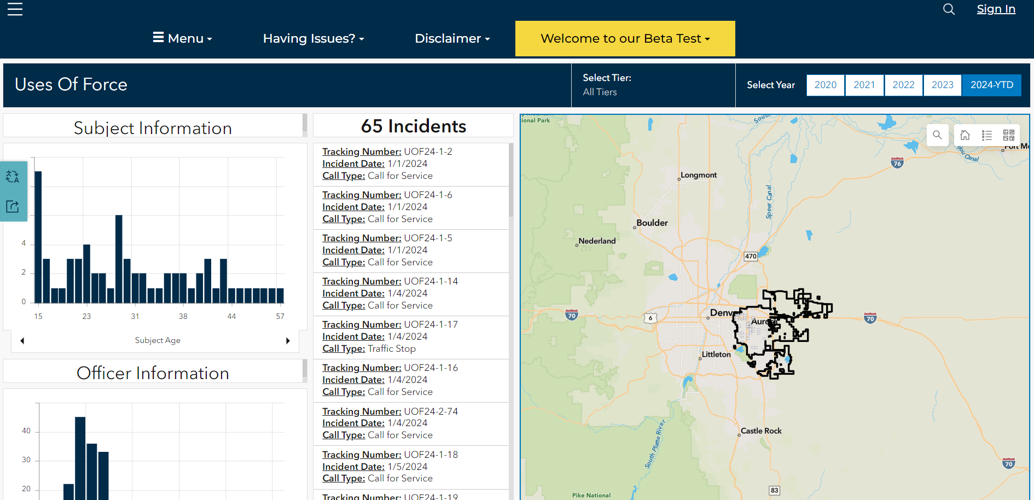
Aurora Police Department launched a transparency portal this week, a move to provide the public a way to access crime statistics, demographics and use of force data as the city continues to move forward through the consent decree.
Information in the portal will be regularly updated with information meant to make the department’s actions more transparent, according to the department.
Within the portal, there is a search function that allows users to filter the data by category or location. Crime data can be filtered by crime category, year, police district, political ward, police beat, ZIP code or neighborhood.
It will also have use of force data, which users can search in the same way.
All of the data dates back five years.
Aurora Interim Police Chief Heather Morris said the portal represents the department’s “commitment to broader information sharing with the community we serve.”
“Through this new technology, residents will be able to learn more about what their officers do every day to ensure Aurora is a safe and vibrant city to call home,” Morris said.
Morris was sworn in as Aurora’s interim police chief in January following the departure of former chief Art Acevedo.
In an interview with The Denver Gazette shortly after she was sworn in, Morris said she’s focused on making strides in the department’s consent decree and has a priority of bettering communication and engagement between APD and residents.
APD entered into the consent decree with the Colorado Attorney General’s Office in 2021 to implement changes in policing — notably the use of force and how officers engage with residents.
The consent decree was prompted by the death of 23-year-old Elijah McClain, who died after an encounter with officers in 2019 as he walked home from a convenience store.
“I think that the consent decree was a good thing for the department and for this community and for the city,” Morris told The Denver Gazette in January. “Everything that’s in the consent decree is stuff that we would be doing anyways and that law enforcement should be doing.”
The transparency portal is one of many moves the department is taking to implement these changes.
Before Acevedo’s resigning in January, he expressed excitement for the portal, which has been in the works for awhile before opening to the public this week.
Aurora officials shared details of the progress of the decree in October, saying the city has made “significant progress in pursuing its requirements.”
Aurora’s portal comes about a year after Denver Police Department launched a similar initiative.
In January 2023, DPD launched a dashboard for “performance and transparency” on its website.
Denver’s dashboard is similar to Aurora’s, containing information about general crime statistics, bias-motivated crime statistics, officer-involved critical incidents, response times, use of force and department performance reviews.
Aurora’s portal currently contains a message welcoming residents to “the first iteration of” the portal and asking for feedback.
“Please take a look around and if you find any issues, please feel free to let us know by clicking the link below and leave us the details,” the message states.
From the home page of the portal, users can access agency demographics, crime statistics, uses of force, and the department’s commitment to progress.
According to the portal, the agency has 220 female employees, 664 male employees, and three employees who choose not to identify with either gender.
APD has 683 employees who are white, making up 77 percent of its total employment. The agency has 45 Black employees, about 5 percent of its total employment. Another 12 are American Indian or Alaska Native, 28 are Asian, seven “choose not to identify,” five are Native Hawaiian or other Pacific Islander, 60 are “not indicated,” and 47 are “two or more races.”
The crime statistics section of the portal shows crime numbers yearly and monthly. According to the portal, 2024 has seen about 1,600 crimes so far and 2023 saw 17,800 in total.
In 2024 so far, there were 1,300 reported crimes in January and 343 in February as of Feb. 10.
The portal breaks these numbers down by crime type, including homicide, aggravated assault, robbery, burglary, arson, motor vehicle theft, sexual assault and theft.
Under the portal’s section for use of force, there is information breaking down the demographics of use of force subjects, including sex, age, race and ethnicity, injury and alcohol or drug impairment.
It also breaks down demographic information about the officer involved in the use of force, including their years of service, race, sex, injury and force type.
In 2023, the department reported 758 use of force incidents, with 306 of them — almost 39 percent — against Black or African American subjects, 235 (almost 30%) against White or European subjects, and 175 (22%) against Hispanic subjects.
In 2024 so far, the department has reported 65 incidents, with 25 (37%) against Black or African American subjects, 19 (28%) against White or European subjects and 18 (27%) against Hispanic subjects.
According to the city of Aurora’s website, Aurora is 52.2% White, 16.6% Black or African American and 30.1% Hispanic or Latino out of its total population of just under 400,000.
Aurora City Manager Jason Batchelor said the portal is a tool that shows the city’s commitment to being open, honest and transparent.
“It will help us further strengthen our relationship with the community through accountability and continuous improvement,” Batchelor said.

Aurora lawmakers move forward with tobacco license ordinance
Kyla Pearce
kyla-pearce@denvergazette.com
Updated 3 hours ago
Aurora councilmembers moved forward with a proposed ordinance in Monday night’s study session that would create a license for businesses that sell tobacco, Kratom and psychoactive substances. Councilmember Curtis Gardner was the only member in opposition to the ordinance, expressing...
Kyla Pearce
Reporter

One of Denver’s most prolific painters prepares his retrospective
Colleen Smith
colleen-smith@gazette.com
Updated 2 hours ago
Longtime Arts Students League of Denver teacher to show paintings and 3-D works Robert Gratiot’s Congress Park home, like most residences in the historic central Denver neighborhood, stands as a charming, one-of-a-kind brick house. Yet beyond the arched, wooden front...

Colleen Smith
Reporter

Colorado lawmakers seek faster warrant response from social media firms
Sage Kelley
sage.kelley@denvergazette.com
Updated 2 hours ago
Proponents argue legislation would prevent school shootings Colorado officials on Monday claimed that the Evergreen High School shooting could have been prevented if social media companies had been required to respond faster to warrants — and they are pushing legislation...

Sage Kelley
Reporter

Lindsey Vonn says she has complex tibia fracture requiring multiple surgeries after Olympic crash
Pat Graham
pat.graham@associatedpress.com
Updated 4 hours ago
CORTINA D’AMPEZZO, Italy (AP) — Lindsey Vonn sustained a “complex tibia fracture that is currently stable but will require multiple surgeries to fix properly” after her devastating crash in the Olympic downhill, the skier said in a social media post...

Pat Graham
Reporter
23-year-old arrested in fatal Thornton hit-and-run; GoFundMe identifies 14-year-old victim
Kyla Pearce
kyla-pearce@denvergazette.com
Updated 7 hours ago
Thornton police identified the suspect in Saturday night’s fatal hit-and-run as 23-year-old Jeremy Nobles. Police officials arrested Nobles on Sunday in connection with the incident, which killed 14-year-old boy, a Monday afternoon news release from the Thornton Police Department said....
Kyla Pearce
Reporter

Metro Moves: Glo Noodle House owners to open sushi spot in Boulder
Bernadette Berdychowski
bernadette.berdychowski@denvergazette.com
Updated 8 hours ago
Welcome to the Denver Gazette’s Metro Moves. You’ll get the latest metro Denver openings, closings, hiring and promotion news here. To submit your company’s news, drop an email to bernadette.berdychowski@denvergazette.com. NEW SUSHI SPOT COMING TO DENVER The owners of acclaimed glo...

Bernadette Berdychowski
Reporter

Cherry Creek assistant superintendent to leave full-time post amid district leadership upheaval
Nicole C. Brambila nico.brambila@denvergazette.com
nico.brambila@denvergazette.com
Updated 2 hours ago
Cherry Creek School District Assistant Superintendent Tony Poole will not return to full-time work at the end of the school year and will instead transition to a limited post-employment arrangement. Ashley Verville, a district spokesperson, said the move was not...


Lindsey Vonn’s choice to race Olympic downhill on injured knee questioned after crash
Pat Graham
pat.graham@associatedpress.com
Updated 3 hours ago
CORTINA D’AMPEZZO, Italy (AP) — The fallout from Lindsey Vonn’s devastating crash in the Olympic downhill included a key question: Given her severely injured left knee, should she have even been allowed on a course that is dangerous even to...
Pat Graham
Reporter

Denver’s Underground Music Showcase returns this summer, but moves
Sage Kelley
sage.kelley@denvergazette.com
Updated 2 hours ago
Despite tearful goodbyes, the Underground Music Showcase won’t miss a beat. The three-day South Broadway music festival will return in the summer of 2026 at a new location — the River North Art District — despite fears last year that...
Sage Kelley
Reporter

Denver weather: Temperature climbs near record high Monday
Daniel Boniface
dan.boniface@denvergazette.com
Updated 16 hours ago
Temperatures are expected to be unseasonably warm with partly sunny skies in Denver on Monday, weather forecasters predict. The National Weather Service in Boulder said the high is expected to reach 70 degrees at Denver International Airport, the city’s official...

Daniel Boniface
Reporter
PREV
PREVIOUS

Aurora council debates stance on home occupancy bill
Aurora City Council members debated Monday whether or not to take a stance on a house bill regarding housing occupancy limits, finally deciding to move the conversation to a later study session. The bill, House Bill 1007, approved by the Colorado House Friday, would restrict local governments from adopting ordinances that limit occupancy for unrelated […]

'I stand on the shoulders of everyone before me:' Aurora Councilmember Stephanie Hancock reflects on Black History Month
“Black history isn’t one month for me, it’s a lifestyle that I’ve taken on as a person of color who lives in this county.” Stephanie Hancock, a Black member of Aurora City Council, said those words to The Denver Gazette Tuesday when asked what Black History Month meant to her. “For me to contribute to […]