







Power companies race to prevent powerlines, equipment from causing wildfires

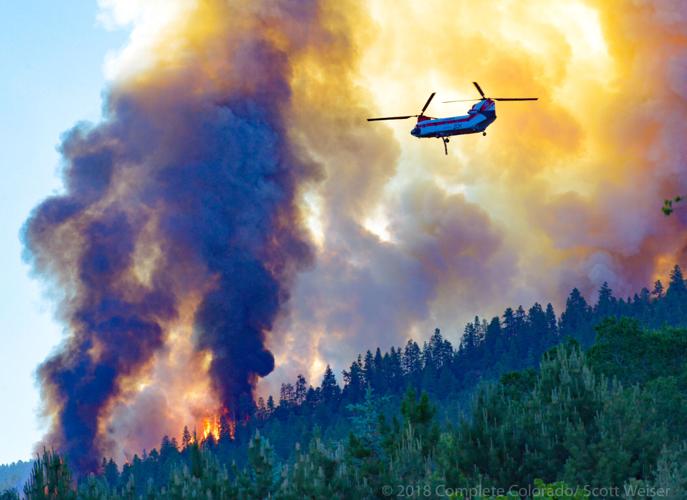
FILE PHOTO: Air tanker drops fire retardant on a ridge west of U.S. 550 north of Hermosa, Colo., during the 416 fire on June 7, 2018.
Scott Weiser/Denver Gazette


A wildfire that burned through 1,700 square miles in Texas last week killed two women, destroyed as many as 500 structures, and ravaged thousands of cattle.
A fire driven by winds that exceeded 100 mph tore through 1,100 homes and killed two people in Superior, Louisville, and Boulder County three years ago.
And the catastrophic Camp Fire killed 85 people and burned more than 153,000 acres in California in 2018.
All three fires had something in common — the spark that started them came from powerlines or electrical equipment operated by power companies.
Or at least that’s what investigations and reports claimed.
A 2023 report from the National Renewable Energy Laboratory noted six of of the Top 20 most destructive fires in California history were caused by powerlines, including the Dixie fire that burned 963,309 acres in 2021 and the Camp Fire that was responsible for 85 deaths in 2018.
And while data on electricity-caused wildfires was not available from the Colorado Division of Fire Prevention and Control, Xcel Energy, the state’s biggest energy company, reported that, in 2020, its power and transmission lines sparked 647 fires in areas at high risk for wildfires in Colorado.
Xcel maintains that its powerline did not start the Marshall Fire. The Associated Press reported that, in the case of the Smokehouse Creek fire in Texas last week, Xcel said its equipment appeared to have sparked it.
Regardless, the company is trying to find ways to minimize, if not eliminate, starting wildfires.
Last Saturday, for example, Xcel notified more than 200,000 customers that, in the event of a power failure caused by anticipated high winds, restoration of power could be significantly delayed.
In a statement to The Denver Gazette, Xcel spokesperson Michelle Aguayo said the company’s precautionary actions are not powerline “shutdowns.” Rather, they are safety precautions to prevent downed or arcing lines from automatically coming back on.
Xcel’s power grid includes what are called “automatic reclosers” that, when the high-voltage circuit breakers trip due to excessive load, will try to reset the breaker to keep power to the grid as much as possible. This reset usually takes place before line crews can respond and figure out what happened.
“On standard settings, the line is tested to see if the fault is still present — for example, a branch touches a wire and then falls to the ground. In those cases, the circuit breaker is reset to start electricity flowing again,” Aguayo told The Denver Gazette in an email. “Momentary outages — when power goes off for a few seconds (like when the lights flicker) — are a sign the system is working the way it’s supposed to.”
Xcel’s new strategy is to shut off the automatic reclosers and tweak the detection circuitry so that, should a tree fall or a line go down, it would remain de-energized until Xcel crews could go out and inspect the line for damage.
That means delays in restoring power in favor of safety.
Other mitigation efforts undertaken by Xcel since its Wildfire Mitigation Program was introduced to the Colorado Public Utilities Commission in 2019 include replacing roughly 2,300 of more than 68,000 wood power poles statewide. That plan also includes inspection of more than 2,900 miles of electric transmission lines.
Insofar as its approved request for a rate-increase rider in 2019 to pass on the costs to ratepayers, Xcel said, “There is no book on specifically how to do this, and utility wildfire mitigation plans are the product of an emerging field that does not yet have a uniform set of codes and standards.”
On its website, the company said that, since 2020, it has invested more than $500 million to improve safety and reduce the threat of powerline-caused fires.
Technology improvements have substantially increased the company’s ability to detect and mitigate potential problems, particularly in the mountains, Xcel said.
The company now uses unmanned drones to inspect equipment up close and scans power lines using Light Detection and Ranging-equipped helicopters that create 3D maps of lines and equipment that can be used to calculate wind strength analysis and detect encroachment of vegetation and trees that might damage powerlines.
“This helps us make informed decisions about where we might consider hardening equipment like power poles and other infrastructure to reduce the likelihood of equipment being damaged by trees during extreme weather conditions,” the company said on its website.
Another innovative measure is the installation of 21 tower-mounted video systems integrated with artificial intelligence to rapidly detect and report wildfires before they rage out of control, according to the company.
The Pano Rapid Detect system, funded by Xcel Energy for about $50,000 per year each, usually reports a fire to local authorities long before reported by a witness, especially in remote forest lands, according to Arvind Satyam, Pano’s chief commercial officer.
“By proactively implementing these wildfire mitigation strategies, we are helping to create a more sustainable future for all of our customers in Colorado.” said Robert Kenney, president of Xcel Colorado, at a briefing in November.
Investigative Reporter Chris Osher and the Associated Press contributed to this report.


Denver area events for March 12
Carlotta Olson
carlotta.olson@gazette.com
Updated 14 hours ago
If you have an event taking place in the Denver area, email information to carlotta.olson@gazette.com at least two weeks in advance. All events are listed in the calendar on space availability. Thursday Hawthorne Heights – 20th anniversary of If Only You Were...

Carlotta Olson
Reporter

Cam Johnson’s complete game help Nuggets cruise against Rockets
Vinny Benedetto
vinny.benedetto@gazette.com
Updated 4 hours ago
A close-to-perfect night from Cam Johnson was just what he and the Nuggets needed. “I think sometimes he’s trying to make perfect plays instead of just making the play that’s right there in front of you, (which is) usually the...

Vinny Benedetto
Reporter

Colorado State survives against Fresno State, advances to Mountain West tournament quarterfinals
Tyler King tyler.king@gazette.com
tyler.king@gazette.com
Updated 6 hours ago
Colorado State’s title defense at the Mountain West tournament rolls on to the quarterfinals. The No. 7 seed Rams held on for a 67-63 win over No. 10 seed Fresno State on Wednesday night at the Thomas & Mack Center...

Tyler King tyler.king@gazette.com
Reporter

Slim Cessna’s band says Amen after 33 years of fiery country rock
John Moore
john.moore@denvergazette.com
Updated 8 hours ago
Arts news: Since 1933, 26 band members sat in as members of one of Denver’s most beloved and least exclusive musical clubs One of my favorite concert reviews was chronicling the triumphant Denver reunion of Slim Cessna’s Auto Club 3½...

John Moore
Reporter

Elijah Wood will rave on at Cervantes’
John Moore
john.moore@denvergazette.com
Updated 10 hours ago
I am just going to preface this by saying: “I’m not entirely sure what all these words mean.” But, here goes: Actor and music enthusiast Elijah Wood’s “Wooden Wisdom” vinyl DJ project is coming to Cervantes’ Masterpiece Ballroom on May...
John Moore
Reporter

This winter was Colorado’s warmest on record
Matt Kyle
matt.kyle@denvergazette.com
Updated 9 hours ago
Colorado just had its warmest winter on record, while the Denver metro area had its second-warmest, according to meteorologists and National Weather Service data. Data show the average temperature between December and February was 33.6 degrees, nearly 2 degrees warmer...

Matt Kyle
Reporter

Rangeview boys basketball heads to CHSAA Final 4 with clear mission: ‘Finish the job’
Tyler King tyler.king@gazette.com
tyler.king@gazette.com
Updated 10 hours ago
AURORA — Finish the job. It’s the message junior Archie Weatherspoon V has gotten from multiple members of last year’s Rangeview team. “Some of my teammates have been calling me this week like, ‘Yeah man, we haven’t been to a...
Tyler King tyler.king@gazette.com
Reporter

Colorado auditor finds serious issues with labor agency’s unemployment insurance accounting
Marianne Goodland
marianne.goodland@coloradopolitics.com
Updated 10 hours ago
Colorado’s state auditors found serious issues with the accounting practices of the unemployment insurance division of the Department of Labor and Employment, concluding the agency underestimated and overestimated figures to the tune of billions of dollars. The auditors labeled the...

Marianne Goodland
Reporter

Cherry Creek School District violated disability law, state report finds
Nicholas Fogleman
nicholas.fogleman@denvergazette.com
Updated 9 hours ago
The Colorado Department of Education found that the Cherry Creek School District violated federal law when the district failed to provide sign-language interpreter services to 11 students at the start of the 2025-26 school year. A CDE investigation found that...

Nicholas Fogleman
Reporter

Previews for movies opening in theaters for the weekend of March 12-15
Carlotta Olson
carlotta.olson@gazette.com
Updated 19 hours ago
“The Optimist: The Bravest Act Is Truth” — (Drama, not rated, 112 minutes). Herbert Heller, who as a young boy survived the Holocaust and has carried an unspoken secret for 60 years, finally opens up when he meets Abby, an...
Carlotta Olson
Reporter