





A deadly disease is hitting Colorado’s bat population, while research could face cuts

A Yuma Miotis bat displays a white-nose syndrome fungal infection fluorescing on its wing.
Courtesy of Colorado Parks and Wildlife

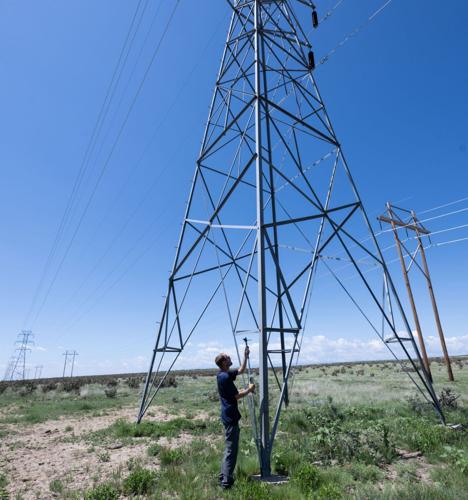

Chollas cacti dominate the landscape on the sprawling Walker Ranch just north of Pueblo. In early June, grasshoppers chirp, and swooping birds trill.
Those are not the sounds Ed Schmal is searching for with audio detectors zip-tied to tall poles along fence lines and transmission towers. Schmal is looking for evidence of an entirely different soundscape, one mostly undetectable to the human ear.

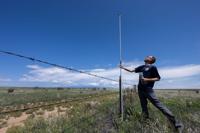
Colorado Parks and Wildlife conservation biologist Ed Schmal adjusts the angle of the microphone Friday while setting up an audio detector on the Walker Ranch north of Pueblo to record the sound waves of the bats in the area. The recorded sound waves help Schmal determine which species of bats are in the area. Colorado is home to 20 species of bats. Schmal records the bats for about four days before retrieving the data. White-nose syndrome, which was first found in Colorado in 2023, is the biggest concern among bat biologists.
The Colorado Parks and Wildlife conservation biologist is interested in the sonic signatures of Colorado bats. Mostly ultrasonic, each bat species produces a unique sound wave that can be picked up by Schmal’s monitoring equipment. A bat’s signature looks a bit like the Nike “swoop.”
“Everything else is going to look very differently on the sonogram,” he said.


Colorado Parks and Wildlife conservation biologist Ed Schmal programs an audio detector Friday on the Walker Ranch north of Pueblo before installing the device to record the sound waves of the bats in the area. The recorded sound waves help Schmal determine which species of bats are in the area.
CPW has had the unobtrusive microphones and equipment on the ranch for a decade, collecting data for a nationwide project to better understand the often elusive creatures. Colorado has 20 species of bats, carving out niches in the state’s varied environment. Instead of the stereotypical caves, they mostly roost in small numbers wherever cover can be found; in trees and among talus rock slopes, in attics and the undersides of bridges.
Schmal has documented nine different species on a few acres of the Walker Ranch over the years. He is hoping, in the wake of a catastrophic bat disease making its way into the state, those nine continue to appear in the data.
“I think it’s spreading everywhere,” he said.
The first case of white-nose syndrome in Colorado was discovered in spring of 2023 at Bent’s Old Fort National Historic Site, about 70 miles to the west of Schmal’s research site. The deadly fungus that causes the syndrome has been attributed to millions of bat deaths since its discovery in 2006 in New York, with a near-total fatality rate for many infected colonies.
A victim might have papery, lesion-filled wings, said Schmal.
The fungus doesn’t always kill bats outright. Rather, by forcing infected animals to come out of hibernation to groom or leave their compromised roost, it puts bats in a weakened state to withstand winter.
“Not only is the tissue being damaged, but the animal is basically starving to death,” explained Dan Neubaum, CPW species conservation program manager.
The jump into Colorado did not come as a surprise. The disease has been spreading around the state like a boulder breaking the surf on a beach, said Neubaum. It was only a matter of time.

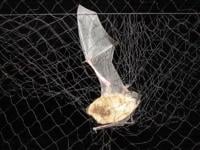
A bat caught in a mist net for white-nose syndrome swab sampling.
Since 2023, cases have been detected elsewhere in the state. First among the bats of the plains, documented cases are climbing in elevation.
Not every species of bat is affected the same by white-nose syndrome, and Neubaum said researchers are hoping that the difference in habitat and behaviors between Eastern U.S. and bats in the West might prevent a similar devastation. A drier climate might not promote the fungus as well, while dispersed bat populations could slow spread.


Colorado Parks and Wildlife conservation biologist Ed Schmal zip-ties a microphone to a painter pole while installing an audio detector Friday on the Walker Ranch north of Pueblo before installing the device to record the sound waves of the bats in the area. The recorded sound waves help Schmal determine which species of bats are in the area. Colorado is home to 20 species of bats.
“If the infection is lower and slower, we might see that from the very start,” he said.
The problem with documenting those differences is that much is still unknown about Colorado’s bats, especially those on the Eastern Plains.
“We don’t even know where most of our bats are,” Neubaum said.
Colorado bats can be anywhere, and those roosting choices are not obvious without following radiotransmitter-attached individuals back to their homes. If a population is badly affected with white-nose syndrome, the evidence might not be easy to find.
Schmal’s efforts on the Walker Ranch are one part of the effort to better understand the baseline of the state’s bat population before it is rocked by white-nose syndrome. In addition to ultrasonic monitoring, he’s also been out trapping specimens this year. Pueblo County, where Schmal is based, has seen multiple cases of the disease this spring.
The national database that will eventually catalog Schmal’s sonic data is the North American Bat Monitoring Program (NABat) and is primarily run by the U.S. Geological Survey.
Schmal is concerned that NABat, like other federal environmental programs this year, might lose key staff or disappear altogether under the weight of funding cuts. He said the longitudinal data NABat logs is rare for a non-game species.
“We could lose this entire program,” he said.


A researcher uses a pipette to vaccinate a little brown myotis bat.
According to an internal email obtained by the journal Science, the Trump administration is expected to ask Congress to cut all biological research at USGS, a branch of the Department of the Interior, in the 2026 budget.
If Colorado bats begin to disappear, the vacancy might have far-reaching effects. Bats occupy a space in the food chain, so white-nose syndrome could harm the equilibrium of predator species like owls.
Bats also provide “ecological services” to humans, says Schmal. Namely, bats are major predators for insects. With fewer bats, the insects that destroy crops and otherwise bother humans increase.
“Change to the insect community could be one of the big things that we see, and we don’t fully understand what that’s going to look like, either,” said Neubaum.
USGS researchers have developed a vaccine for the disease that is currently going through field trials, including one in Colorado. At one testing site near Steamboat Springs, Neubaum said the established colony with a documented infection is under study.
“It’s going to be interesting to see how those individuals fare and whether it helps or not,” he said.
Scaled administration is still a barrier.
“We know realistically that we can’t reach a huge portion of the population to apply that method,” he said.
Schmal’s detectors will run for about a week collecting sound signatures — indirect evidence of what one of the state’s most mysterious creatures is up to from dusk until dawn every night.
Neubaum said the enigma is part of bats’ charm.
“I think I like them because there are so many unanswered questions for them,” said Neubaum.

Large weekend storm drops 33″ of snow at one Colorado spot, snowpack doubles over 7 day stretch
Jonathan Ingraham
jonathan.ingraham@denvergazette.com
Updated 2 minutes ago
The first big snow storm of winter 2025-26 for Colorado dropped about 10-20 inches in the northern mountains, 8-14 inches in the central mountains and 3-8 inches in the southern mountains. Colorado’s snowpack doubled in both median average and snow...

Jonathan Ingraham
Reporter
Denver weather: More melting on Monday as temperatures climb
Jonathan Ingraham
jonathan.ingraham@denvergazette.com
Updated 10 minutes ago
Melting snow will continue Monday across metro Denver as the sun is forecast to come out in full as temperatures push into the 50s today. Denverites can expect sunny skies, with a high near 53 today, according to the National...
Jonathan Ingraham
Reporter
EDITORIAL: Another sign wolf reintroduction needs to halt
The Gazette Editorial Board
thegazette-editorial-board@gazette.com
Updated 3 days ago
Five years after Coloradans voted by a razor-thin margin to reintroduce wolves to Colorado, they are right to look at the job state officials and agencies have done and ponder whether this a dog that just doesn’t hunt. Amid criticism...

The Gazette Editorial Board
Reporter

Ag industry can’t surrender the keys to the Kingdom
Rachel Gabel
rachel-gabel@denvergazette.com
Updated 3 days ago
Animal agriculture, ranching, hunting, and farming are not dying ways of life. The cowboy is not about to ride off into the sunset and certain extinction. Beef is not going to be replaced by cultured meat, any variety of bugs,...

Rachel Gabel
Reporter

Denver Broncos ready to ‘test our stuff’ as schedule toughens after 10th straight win
Chris Tomasson
chris.tomasson@gazette.com
Updated 6 hours ago
LAS VEGAS – During their 10-game winning streak, the Broncos have fattened up against some losing foes. The schedule, though, is about to change. The Broncos (11-2) next Sunday will face Green Bay (9-3-1) at home in a battle of...

Chris Tomasson
Reporter

Broncos’ Harvey steals spotlight from first-round pick Jeanty in Week 14 win
Kyle Fredrickson
kyle-fredrickson@denvergazette.com
Updated 8 hours ago
LAS VEGAS — RJ Harvey stole the show from Ashton Jeanty. The Broncos defeated the Raiders, 24-17, on Sunday at Allegiant Stadium in a clash of rookie running backs. Las Vegas selected Jeanty at No. 6 overall (first round) out of Boise State. Denver picked Harvey at No....

Kyle Fredrickson
Reporter

Mark Kiszla: How Bo Nix has become the Wayne Newton of NFL QBs, singing all the hits he knows by heart
Mark Kiszla
mark-kiszla@denvergazette.com
Updated 10 hours ago
LAS VEGAS – Paying tribute to Mr. Las Vegas, Broncos quarterback Bo Nix followed the tried-and-true showbiz rule of Wayne Newton. When bringing your act to the bright lights of the Strip, the audience demands you play the greatest hits....

Mark Kiszla
Reporter

Sparked by Marvin Mims’ first career punt return for TD, Broncos roll to 24-17 win over Raiders
Chris Tomasson
chris.tomasson@gazette.com
Updated 10 hours ago
LAS VEGAS – The Broncos are winning big these days, so it was only appropriate Marvin Mims Jr. did the Mile High Salute on Sunday. The wide receiver did so after his 48-yard punt return for a touchdown in the...
Chris Tomasson
Reporter

Nikola Jokic passes Michael Jordan on NBA’s assists list as Nuggets add 10th straight road win | 3 takeaways
Vinny Benedetto
vinny-benedetto@denvergazette.com
Updated 9 hours ago
The Nuggets probably were buzzing on the flight back from Charlotte after extending the franchise-record road winning streak to 10 games. Here are three takeaways from Denver’s 115-106 win over the Hornets on Sunday at Spectrum Center: 1. For a...

Vinny Benedetto
Reporter

Broncos WR Marvin Mims returns punt for ‘clutch’ touchdown in road win over Raiders
Kyle Fredrickson
kyle-fredrickson@denvergazette.com
Updated 9 hours ago
LAS VEGAS — A buzz started growing on the Broncos’ sideline when Marvin Mims dropped back to return a punt against the Raiders. “We talked about it: Marvin is going to break through and score him a touchdown,” cornerback Patrick...
Kyle Fredrickson
Reporter