








Colorado whitewater parks inhibiting fish migration, CPW study finds
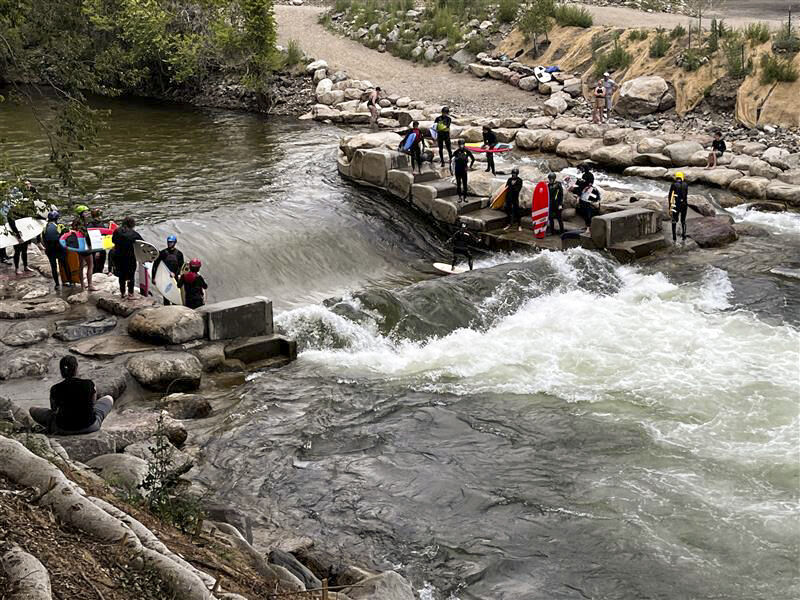
Flannelmouth suckers only had a 2% passage probability, making for an almost impassable barrier
A study published in October by Colorado Parks and Wildlife (CPW) researchers suggests features built at man-made whitewater parks (WWPs) are having negative impacts on fish passage.
The three fish species the study focused on were brown trout, Colorado sculpin and flannel-mouth suckers.
One of the study’s lead authors, Eric Richer, said CPW first began looking into the impacts of whitewater parks on fish passage a number of years ago after one scientist, an avid angler, was fishing near the whitewater park on the Arkansas River near Buena Vista.
Richer said the researcher noticed he was catching more fish downstream of the man-made structure than he was as he worked his way upstream through the structure.
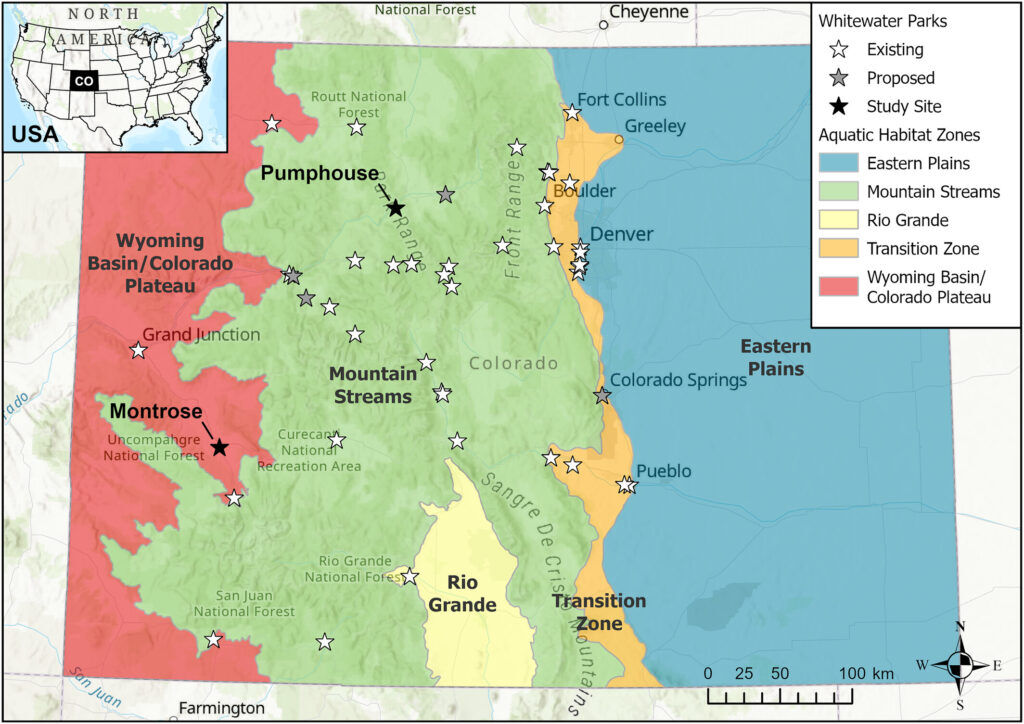
The study, published in the peer-reviewed journal “River Research and Applications,” looked at two Colorado whitewater parks that have incorporated fish passage structures into their design; the Pumphouse Recreation Area along the Colorado River and along the Uncompahgre River near Montrose.
CPW was also aware of these two projects through the Army Corp. of Engineers permitting process and was able to design a study that modeled fish movement before and after the construction of the white water parks.
Currently there are over 40 WWPs completed or in the planning phases within Colorado, occurring in all major aquatic habitat zones, however, researchers found that although WWPs may provide economic and recreational benefits for local communities, WWPs can have unintended impacts on instream biota (animal and plant life of a particular region) as well as river functions.
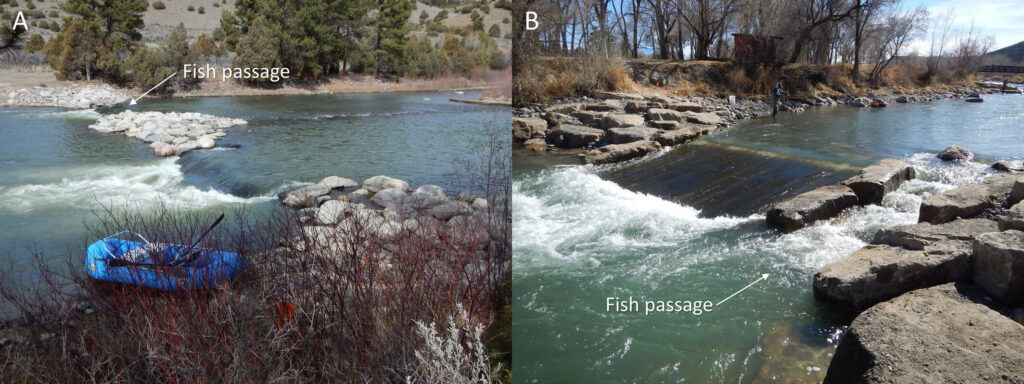
The WWP at Pumphouse features a constructed boulder island that splits the river into two channels. The channel on river left of the island was designed as a play wave, and the channel on river right was intended to provide fish and boat passage.
The WWP at Montrose includes six structures, each consisting of a play wave formed by a prefabricated concrete slab with a design slope of 11% and narrow (~1 m) fishway that was separated from the WWP chute by a row of closely spaced boulders.
Each study site was surveyed in 2014, one year prior to WWP construction, using a combination of topographic and bathymetric surveying equipment. Surveys were then replicated following the completion of WWP construction in 2015.
To study the impact of the whitewater park structures on fish passage, researchers completed detailed surveys of the channels at both sites before and after the construction of the park structures.
According to the study, the scientists then used a two-dimensional hydraulic model to look at water depths and velocities, which they compared to fish passage criteria for the three species of interest at different stages of their life cycles: juvenile, average adult and large adults.
Richer said for fish to get through a whitewater park structure it’s a relatively short distance of only a few meters, and the researchers assumed the fish would use burst or sprinting swimming capabilities to do so.
| Species | Size class | Fish length (mm) | Max velocity (m/s) | Minimum depth (m) |
| Colorado sculpin | JV AA LA | 41 63 86 | 1.09 1.18 1.31 | 0.06 0.06 0.06 |
| Brown Trout | JV AA LA | 152 305 457 | 1.29 2.06 4.02 | 0.06 0.13 0.20 |
| Flannel-mouth Sucker | JV AA LA | 152 305 457 | 0.62 0.84 1.29 | 0.06 0.13 0.20 |
However, the study concluded that after whitewater park construction, brown trout, the strongest swimmers, maintained the highest proportion of passage probability at about 23%, followed by Colorado sculpin at about 15%. But for the Flannelmouth suckers, the whitewater parks appeared to be nearly impassable and a complete barrier, with only 2% passage probability.
In addition to using models, the researchers also captured fish at the Pumphouse site, marked the fish and moved them downstream of the whitewater park structure, then came back a year later to see how many of the marked fish had made it upstream of the structure.
Again, adult trout appeared to make it upstream past the whitewater park while fewer juvenile trout succeeded. The researchers also found there was also a higher concentration of suckers below the whitewater park structure than above it, suggesting the park could be impacting the suckers’ movement.
The full study from the CPW can be read online here.

Aurora council returns to full public comment allowance, hears demands for police reform
Kyla Pearce
kyla-pearce@denvergazette.com
Updated 5 hours ago
Residents of Aurora used a full hour of the reinstated public comment period during Monday night’s meeting, taking advantage of the restored time to talk about a need for police reform and for stronger oversight of tobacco products ending up...

Kyla Pearce
Reporter

Denver council delays stadium rezoning, rejects Key Lime Air contract
Deborah Grigsby
deborah.smith@denvergazette.com
Updated 5 hours ago
Denver’s dreams of a new women’s soccer stadium will have to wait a little longer as members of the city council voted Monday to delay an ordinance rezoning the land where the stadium is proposed to be built. Council Bill...

Deborah Grigsby
Reporter

Jeffco Public Schools workers to find about layoffs this week
Sage Kelley
sage-kelley@denvergazette.com
Updated 4 hours ago
Jeffco Public Schools employees received a voicemail from Superintendent Tracy Dorland Monday morning warning them of potential job cuts in the next year. “My holiday message this year is a more somber and serious one,” Dorland said in a voicemail...

Sage Kelley
Reporter

Denver man sentenced to life in prison for South Platte River Trail homicides
Sage Kelley
sage-kelley@denvergazette.com
Updated 9 hours ago
A Denver man will spend his life in prison after killing two people on the South Platte River Trail. A Denver District judge sentenced Tanner Fielder to life in prison without the possibility of parole Monday in connection to the...
Sage Kelley
Reporter

Aurora teen arrested in connection to Montview Park shooting
Sage Kelley
sage-kelley@denvergazette.com
Updated 10 hours ago
The Aurora Police Department arrested a 17-year-old boy in connection to a fatal shooting in November. The department arrested the male — who will not be identified due to being a minor — on Monday on suspicion of first-degree murder...
Sage Kelley
Reporter
Xcel Energy prepares for power shutoffs to help prevent a repeat of the Marshall fire
Scott Weiser
scott-weiser@denvergazette.com
Updated 7 hours ago
Forecast high winds along the Front Range on Wednesday revive memories of the devastating 2021 Marshall fire that destroyed more than 1,000 homes when gusts downed energized power lines. Xcel Energy now weighs proactive power cuts to avoid similar ignitions...

Scott Weiser
Reporter

Armed suspect dead after 8-hour standoff with police in Greeley
Sage Kelley
sage-kelley@denvergazette.com
Updated 13 hours ago
An armed suspect allegedly killed himself in Greeley after an eight-hour standoff with police. The Greeley Police Department initially responded to a home in the 4700 block of 29th Street around 8:30 a.m. Sunday, according to a news release. The...
Sage Kelley
Reporter

Colorado officials react as Trump weighs reclassifying marijuana
Marissa Ventrelli
marissa-ventrelli@denvergazette.com
Updated 7 hours ago
Colorado policymakers and advocacy groups are responding to reports that the federal government could begin loosening restrictions on marijuana, according to insiders in Washington. According to the Washington Post, President Trump is expected to sign an executive order directing federal...

Marissa Ventrelli
Reporter

Denver weather: Record heat possible Monday as warm December continues
Jonathan Ingraham
jonathan.ingraham@denvergazette.com
Updated 19 hours ago
Denver just experienced six days straight of a high temperature of 60 degrees or above, and now can add Monday as day seven. The record high for Dec. 15 is 68 degrees. Denver residents can expect sunny skies today, with...
Jonathan Ingraham
Reporter
Trio of snow storms headed for Colorado, could deliver 10-20 inches by Christmas weekend
Jonathan Ingraham
jonathan.ingraham@denvergazette.com
Updated 8 hours ago
Snow is finally back in the forecast for Colorado as a trio of storms could bring snow to the state from the middle of this week through the Christmas weekend; maybe fresh snow on Christmas Day too. Current forecast models...
Jonathan Ingraham
Reporter
PREV
PREVIOUS

Xcel Energy prepares for power shutoffs to help prevent a repeat of the Marshall fire
Forecast high winds along the Front Range on Wednesday revive memories of the devastating 2021 Marshall fire that destroyed more than 1,000 homes when gusts downed energized power lines. Xcel Energy now weighs proactive power cuts to avoid similar ignitions amid dangerously dry conditions. The Marshall fire erupted under comparable wind events with gusts exceeding […]

2025 Holiday Events in and around Denver
MUSIC Through Dec. 20: Strolling Holiday Carolers — Weekends, The Shops at Northfield, 8340 Northfield Blvd., Denver; shopsatnorthfield.com/events. Dec. 15: My Favorite Queens — Presented by the Denver Gay Men’s Chorus, 3 p.m., St. Andrew United Methodist Church, 9203 S. University Heights, Highlands Ranch, $35. Tickets: denverchoruses.org/box-office. Dec. 16: Holiday Brass — 7 p.m., Boettcher Concert Hall, […]