







Colorado attorney general joins lawsuit against Trump energy emergency order
Colorado Attorney General Phil Weiser joined a multistate lawsuit challenging an executive order invoking the National Emergencies Act that President Donald Trump issued on the day of his inauguration. The order fast-tracks fossil fuel projects by bypassing or shortening environmental reviews.
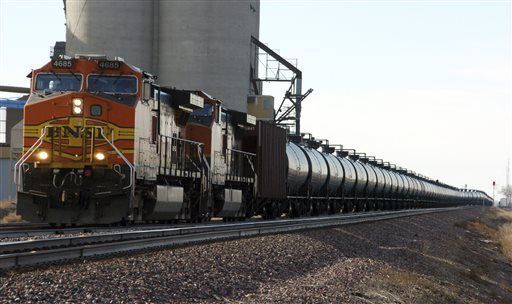
While the Act applies nationwide, according to a news release from his office, Weiser’s immediate concern centers on the Uinta Basin Railroad. It’s an 88-mile railway that will transport waxy crude from oilfields in northeastern Utah near Duchesne to the national rail network near Helper, Utah, to connect to the Union Pacific’s Central Colorado line, which already carries oil through Colorado.
The Uinta Basin produces waxy crude that requires special handling. Current output is about 90,000 barrels per day, mostly trucked to refineries in Salt Lake City.
The proposed Uinta Basin Railway would connect the basin to national networks via an 88-mile line. It would enable the transport of up to 350,000 barrels per day to Gulf Coast refineries, as well as providing better transportation into and out of the basin, according to the Seven County Infrastructure Coalition.
“Congress passed the National Emergencies Act to prevent presidents from declaring national emergencies for pointless or partisan purposes — exactly what the president has done with this executive order,” Weiser said in a news release. “Energy production is at an all-time high. The only energy emergency is the one that is the president’s head.”
The lawsuit, filed in U.S. District Court for the Western District of Washington, names Trump, Interior Secretary Doug Burgum, the head of the U.S. Army Corps of Engineers, and the Advisory Council on Historic Preservation as defendants. Sixteen states seek to declare the order illegal and halt emergency permits.
“Derailments, spills, or other accidents from oil trains traveling on rail lines next to our rivers pose a serious risk to the millions of people, businesses, and farms that depend on these critical sources of water,” Weiser said. “We challenge this made-up emergency to protect our communities and our land, air, and water in Colorado.”
Proponents argue that rail expansion boosts the economy. It creates jobs, supports energy independence, and reduces risks associated with truck traffic. Rail offers safer, efficient transport to distant markets, they say.
The Seven County Infrastructure Coalition backs the project, saying it marks a turning point for rural Utah, enabling safer transportation and economic diversification.
Environmental groups and Colorado officials have raised concerns about the project’s potential impacts. The Center for Biological Diversity has called the railway “a dangerous, polluting boondoggle that threatens people, wildlife and our hope for a livable planet,” citing increased risk of fires and oil spills along the Colorado River corridor.
U.S. Sen. Michael Bennet and Rep. Joe Neguse stated in a 2026 letter: “A train derailment that spills oil in the headwaters of the Colorado River would be catastrophic not only to our state’s water supplies, wildlife habitat and outdoor recreation assets, but also the broader Colorado River Basin.”
A coalition of 10 local governments warned in a 2022 court brief: “The release of highly flammable crude oil could ruin this unique region for decades.”
Keith Heaton, director of the Seven County Infrastructure Coalition, said in a prior interview with The Denver Gazette that the waxy crude “is not a liquid. It’s a solid. So, it’s not a hazardous material. It’s not a flammable liquid. It’s a solid. So, if there was a derailment, it would be like picking up a bunch of candles off the ground.”
Heaton described rail as “the safest and most ecological way to transport material,” given the crude’s properties.
The Supreme Court ruled on the related railway approval in May 2025. In an 8-0 decision in Seven County Infrastructure Coalition v. Eagle County, the court reversed a D.C. Circuit ruling. It held that the Surface Transportation Board complied with the National Environmental Policy Act by focusing on the railway’s direct effects.
The court said NEPA does not require analysis of upstream oil drilling or downstream refining effects separate in time or place. Agencies need only consider the impacts of the project at hand, and courts must afford substantial deference to agency choices in NEPA reviews.
The ruling cleared the path for the railway after years of litigation. It emphasized NEPA as a procedural statute focused on the immediate project.
Weiser has filed 51 lawsuits against the Trump administration this term. Many focus on funding, rights, and environmental protections.


RTD offers free rides Wednesday to mark Transit Equity Day, honor Rosa Parks
Scott Weiser
scott-weiser@denvergazette.com
Updated 3 hours ago
The Regional Transportation District will offer zero-fare service across all bus, rail, FlexRide, Access-a-Ride and Access-on-Demand services on Wednesday, allowing riders to travel at no cost to observe Transit Equity Day and honor civil rights icon Rosa Parks. The agency...
Scott Weiser
Reporter

So … why do we care about Bad Bunny?
Isabelle Rosewater, Special to The Gazette
Isabelle-Rosewater@gazette.com
Updated 3 hours ago
Puerto Rican superstar’s selection to headline first Super Bowl halftime show in Spanish has sparked global conversation and controversy Puerto Rican superstar Bad Bunny’s selection as the first artist to headline a Super Bowl halftime show performing entirely in Spanish...

Xcel Energy defends power shutoffs
Scott Weiser
scott-weiser@denvergazette.com
Updated 23 hours ago
Xcel Energy officials defended the company’s use of public safety power shutoffs during extreme wind events as a necessary step to prevent wildfires, while telling Colorado lawmakers the company is accelerating efforts to make future outages more targeted and shorter....
Scott Weiser
Reporter

Avian flu spreads to backyard flocks in Larimer and Logan counties
Nicole C. Brambila nico.brambila@denvergazette.com
nico.brambila@denvergazette.com
Updated 1 day ago
The new cases follow last week’s disaster declaration tied to a commercial outbreak in Weld County. The Colorado Department of Agriculture confirmed three additional cases of the highly pathogenic avian flu in backyard flocks in Larimer and Logan counties, in...


Arapahoe County seeks public comment on proposed well pad near Bennett
Kyla Pearce
kyla-pearce@denvergazette.com
Updated 1 day ago
Arapahoe County officials are seeking public comment on a proposed oil and gas facility that would be located just south of I-70 in the unincorporated part of the county. Members of the public have until 11:59 p.m. on Feb. 11...

Kyla Pearce
Reporter

Metro Moves: Bass Pro Shops will open in Loveland soon
Bernadette Berdychowski
bernadette.berdychowski@denvergazette.com
Updated 1 day ago
Welcome to the Denver Gazette’s Metro Moves. You’ll get the latest metro Denver openings, closings, hiring and promotion news here. To submit your company’s news, drop an email to bernadette.berdychowski@denvergazette.com. New Bass Pro Shops in Loveland to open soon The highly-anticipated...

Bernadette Berdychowski
Reporter

Colorado prepares to send NASA around the moon with upcoming Artemis II launch
Alexander Edwards
alexander-edwards@denvergazette.com
Updated 13 hours ago
When NASA’s Space Launch System at Kennedy Space Center in Florida fires its engines for the second time in history, it will be flying because of more than 14,000 Coloradans. It will carry four astronauts, three Americans and one Canadian,...

Alexander Edwards
Reporter

More people are now leaving Colorado than moving here from other states | Vince Bzdek
Vince Bzdek
vince-bzdek@denvergazette.com
Updated 3 days ago
By Vince Bzdek It’s finally happened. Buried in all the self-congratulatory reports about Colorado reaching the 6 million mark in population last year was news that should be keeping our political leaders up at night. For the first time in...

Vince Bzdek
Reporter

Colorado School of Mines wants to prove a masters isn’t needed to work in quantum
Bernadette Berdychowski
bernadette.berdychowski@denvergazette.com
Updated 3 days ago
A new program at the Colorado School of Mines aims to fix a major misconception in the budding quantum industry: that a master’s or doctorate degree is required to secure a job in the field. It doesn’t help when nearly...
Bernadette Berdychowski
Reporter

Will this be Denver’s year to see office vacancies fall?
Bernadette Berdychowski
bernadette.berdychowski@denvergazette.com
Updated 4 days ago
Another major downtown Denver office sold this week at less than a quarter of its last known value. Denver Place, a two-tower complex at 999 18th St., was acquired for $47.5 million by the CP Group, Angelo Bianco, managing partner...
Bernadette Berdychowski
Reporter
PREV
PREVIOUS

Colorado's federal judges slash motions backlog to lowest in years
Colorado’s federal trial judges collectively had 37 motions in civil cases that had been sitting on their dockets for at least six months without a ruling, as of Sept. 30. That is the smallest backlog the state’s U.S. District Court has experienced since September 2017, before many of the current judges were even on the […]

Jeffco had largest increase in homelessness in metro area last year
While Denver officials boasted a decrease in homelessness over the past few years, Jefferson County has seen the highest increase in the metro area. Jeffco saw a 27% increase in homelessness from 2024 to 2025 — the largest increase within the metro, according to Kerry Wrenick, regional homeless coordinator for the county. Those numbers are […]