







Lakewood Auto Theft Task Force shows off new forensic camera
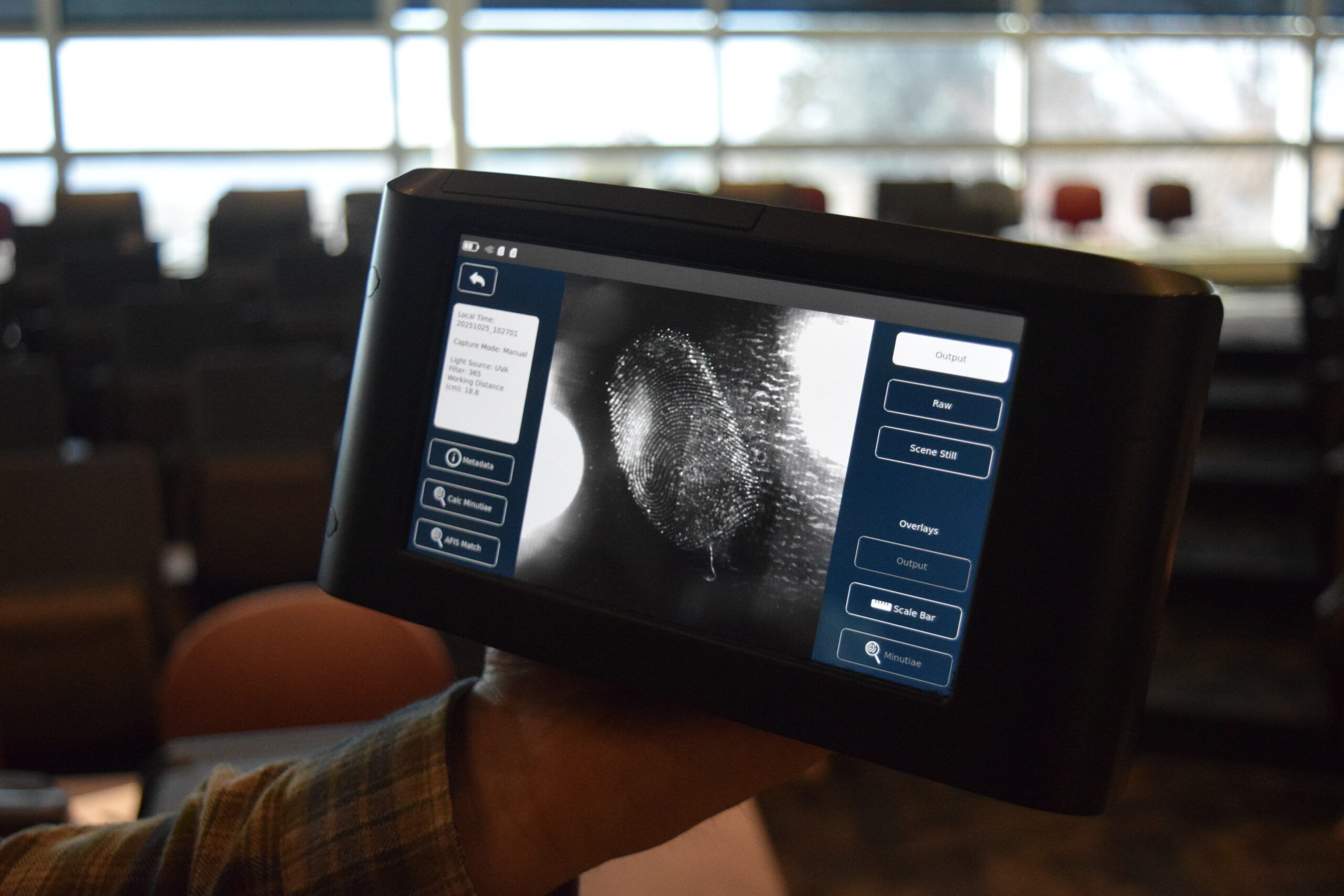
A small, four-pound camera looks to drastically change the way crime scenes are processed in Colorado.
The Colorado Auto Theft Prevention Authority (CATPA) and the Metropolitan Auto Theft Task Force began training local departments with its new forensics camera on Wednesday at the Lakewood Police Department. The goal is to cut down crime scene investigating through its hybrid-spectral imaging system.
The BlindSite Scene from Smytec is a brand-new camera that works to find and take photos of latent fingerprints, DNA and body fluids without the need for chemical enhancement, processing the photos directly on the camera.
Furthermore, the camera connects the fingerprints directly to the Automated Fingerprint Identification System (AFIS), processing direct matches on the software.
“The ability to be able to bring it here, it’s awesome,” Lakewood Police Cmdr. John Pickard told The Denver Gazette, comparing the device to when normal cameras were introduced to crime scenes, cutting down the need for artist drawings.
“You see something you know is going to change the game, and it’s like ‘wow’,” he continued.
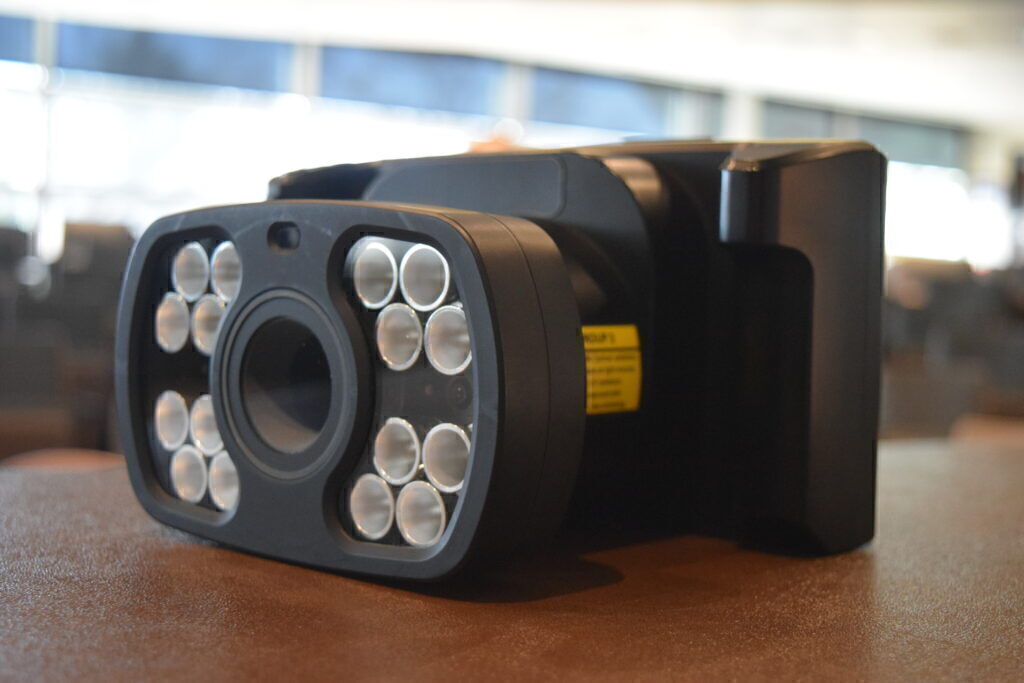
The camera can also recreate digital versions of the fingerprints and DNA, limiting the need for lifts that could potentially damage the evidence. These digital versions could then be used directly as evidence in court cases.
The camera — which launched in September after nearly five years of development — is the first of its kind, with metro Denver law enforcement agencies being of the first in the United States to pick up the technology.
Alexander Smyth created the camera in the United Kingdom in 2019. The small company, currently made up of seven people, keeps all of the production within the United Kingdom, flying out to Lakewood for the training process Wednesday.
“It’s very complicated optics,” Smyth said of why the technology hadn’t been created already. “To get something that small that utilizes the sensitivity that we do, it’s very difficult.”
While the camera runs around $45,000, the Metropolitan Auto Theft Task Force paid around $70,000 for theirs. The price increase was due to the integrated AFIS system, tariffs and a five-year warranty.
Still, the task force believes the price will pay off almost immediately.
“Efficiency is the main draw,” Smyth said. “If you just have a regular break-in and you want to process the door or window. You could be there for the whole day. With this, you can do it in an hour.”
Smyth’s research found that if England were to adopt the camera in its police work, it would save around $137 million in crime-scene labor.
“If you extrapolate that out to the U.S., the savings would be significant,” he said.
“Initially, it’s going to be slow like anything new,” Pickard said. “It’s going to be finding what is best practice, but it will greatly expedite the process and find more things than we normally do.”
Part of that introductory process, as Pickard mentioned, was sifting through the added evidence. Due to the camera’s high-powered ability, investigators will pick up more evidence than they usually would, making the job of deciphering it more arduous — but more effective.
“It’s almost too efficient,” Pickard laughed.
Officers will start using the camera in the next month. Auto-theft cases will be the only ones the camera works, at first. Once the practice is perfected, the camera will start being used for bigger cases outside of just auto theft.


Denver 911 wants upgrade to $24M dispatch system
Deborah Grigsby
deborah.smith@denvergazette.com
Updated 2 hours ago
After 23 years on the job and millions of calls, Denver 911 hopes to retire its aging dispatch system in favor of a new $24 million computer-aided dispatch system from Motorola. The system, sometimes referred to as CAD, documents all...

Deborah Grigsby
Reporter
Fort Collins officer arrested for asking woman for explicit photos
Michael Braithwaite
michael.braithwaite@gazette.com
Updated 4 hours ago
A Fort Collins police officer turned himself in Wednesday on suspicion of attempted sexual exploitation of a child and official misconduct. Andrew Cirone, 31, allegedly asked a woman for explicit photos of herself from when she was a teenager, according...

Michael Braithwaite
Reporter
Family of man fatally shot by DougCo deputy files wrongful death lawsuit
Michael Braithwaite
michael.braithwaite@gazette.com
Updated 11 hours ago
The family of a man who was fatally shot by a Douglas County Sheriff’s Office deputy filed a wrongful death lawsuit against both the deputy and the department. Tyrone Glover, an attorney representing the family of Jalin Seabron, said during...
Michael Braithwaite
Reporter

Second suspect sentenced in 2022 fatal Lakewood apartment fire
Sage Kelley
sage.kelley@denvergazette.com
Updated 1 day ago
The 15-year-old boy charged with murdering a mother and daughter in an apartment fire years ago was finally sentenced last week. Jefferson County District Judge Lindsay VanGilder sentenced the juvenile to a maximum sentence of seven years in the Colorado...
Sage Kelley
Reporter

DA charges 3 suspects in fatal Thornton burglary attempt
Sage Kelley
sage.kelley@denvergazette.com
Updated 2 days ago
The Adams County District Attorney’s Office filed charges against three suspects in connection to a burglary attempt that ended with a fourth suspect being shot to death. The 17th Judicial District Attorney’s Office filed burglary and crime of violence charges...
Sage Kelley
Reporter

Jeffco counselor pleads guilty on sexual assault charge
Sage Kelley
sage.kelley@denvergazette.com
Updated 2 days ago
A Jeffco Public Schools counselor pleaded guilty to a sexual assault charge Monday morning following a multitude of delays. Chloe Castro — standing next to her defense attorney, Marshall Breit — pleaded guilty to one count of sexual assault on...
Sage Kelley
Reporter

Brighton police lift shelter-in-place order
Daniel Boniface
dan.boniface@denvergazette.com
Updated 2 days ago
Brighton police have lifted a shelter-in-place order that shut down a street in the town Monday morning. Beldock Street was closed between Chavez and Sandoval streets during the incident, the Brighton Police Department said on its official Facebook page. Residents...

Daniel Boniface
Reporter

Teen dies after hit-and-run crash in Aurora
9News
9news@denvergazette.com
Updated 3 days ago
Talal Maaliki, 71, was arrested in connection to the crash at Colfax Avenue and Sable Boulevard that killed an 18-year-old man, Aurora police said. AURORA, Colo. — An 18-year-old pedestrian died on Saturday after being injured in a hit-and-run crash....

9News
Reporter
Aurora hit-and-run leaves man dead, infant hospitalized; teen arrested
Michael Braithwaite
michael.braithwaite@gazette.com
Updated 4 days ago
A teen was arrested by Aurora Police Friday after he fled the scene of a fatal crash he allegedly caused by running a red light. Jonathan Garcia, 19, faces vehicular homicide and reckless driving charges after he ran a red...
Michael Braithwaite
Reporter
Boulder man arrested for creating AI sex images using children’s photos
Michael Braithwaite
michael.braithwaite@gazette.com
Updated 5 days ago
The Boulder County Sheriff’s Office announced Friday it had arrested a man for allegedly altering real children’s photos into sexual material using artificial intelligence. Daniel Fairchild, 72, faces 23 counts relating to the sexual exploitation of a child, including producing...
Michael Braithwaite
Reporter
PREV
PREVIOUS

DougCo launches new alert and reporting systems
Douglas County residents have a new way of getting up-to-date police alerts and reporting low-level crimes. The Douglas County Sheriff’s Office rolled out its new emergency alert system, DougCoAlert, in January. It replaced the previous CodeRED system used by the county until November. The sheriff’s office cancelled the $65,000 annual contract with Crisis24, the company […]

Arapahoe County adopts new approach to opioid abatement funding, invests $4M in service building
Arapahoe County officials are investing more than $4 million in opioid harm reduction programs, with the latest phase of funding taking a new approach, according to a news release. Normally, county officials seek out fully built programs to fund through a request for proposals. But this time, they’re looking for partners to help design and […]